
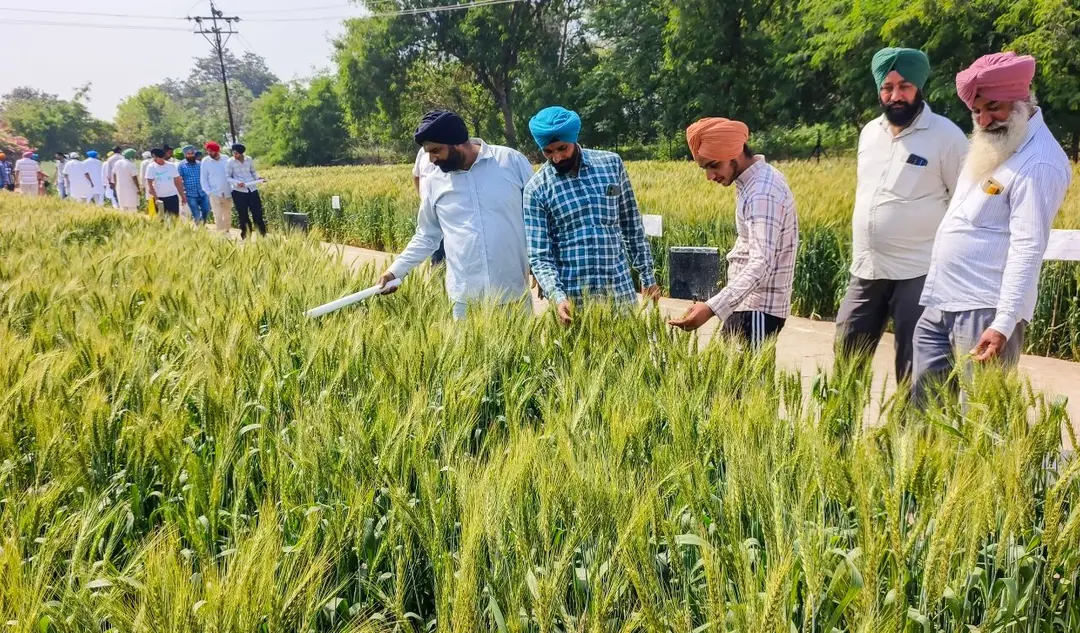
Over Rs 2.9 crore in soil carbon payments for 2,550 farmers
More than Rs 2.9 crore will be distributed through digital payments to 2,550 small farmers in Punjab and Haryana for adopting regenerative farming practices, the Union Ministry of Agriculture said on Wednesday. Dr ML Jat, DARE Secretary and ICAR Director General, initiated the Direct Benefit Transfer at Punjab Agricultural University in Ludhiana. The first issuance covered around 30,000 acres and more than 50,000 carbon credits, with each farmer receiving about Rs 3,000 to Rs 15,000.
Source
Telangana Today · read the original report ↗
Desk check · compared with the source
What the desk checked (5)
- Over Rs 2.9 crore will be paid to 2,550 small farmers in Punjab and Haryana via digital payments for regenerative farming. — Attributed to a Ministry of Agriculture statement issued on Wednesday; figures appear in source.
- First issuance covered about 30,000 acres and more than 50,000 carbon credits, with farmers receiving roughly Rs 3,000-Rs 15,000 each. — Figures appear in source; no independent verification document cited.
- The 'Aadi' Grow Indigo programme, launched in 2019 with ICAR technical guidance, covers over 2 million acres and 100,000-plus farmers in seven states under the Verra VM0042 methodology. — Programme details as stated in source; methodology named but not otherwise sourced.
- Enrolled fields during 2019-2022 saved an estimated 45 billion litres of water and kept over two lakh tonnes of residue out of fires, avoiding about 1,000 tonnes of PM2.5 emissions. — Presented in source as programme estimates, not verified data.
- Dr ML Jat, DARE Secretary and ICAR Director General, initiated the Direct Benefit Transfer at Punjab Agricultural University, Ludhiana. — Named official and venue given in source; direct attribution present.
Analysts’ view opinion
This is the first visible sign that India's agricultural carbon market has moved from paper to farmers' bank accounts. But the economics should be read at their true scale — Rs 2.9 crore across 2,550 farmers averages roughly Rs 11,000 each, which is a top-up on crop income rather than a livelihood in itself. The real economic value sits less in the transfer and more in the externalities: water saved, input costs avoided and cleaner air.
- Rs 3,000–15,000 per farmer is small against a season's cultivation costs, but it can partly offset the risk of switching to unfamiliar practices.
- The payment route matters — Grow Indigo paid from its own funds before the credits were fully sold, shifting price and sale risk from the farmer to the company.
- The choice offered to farmers — an assured upfront sum or 75 per cent of net carbon revenue after sale — is a classic certainty-versus-upside trade-off, and smallholders typically lean towards certainty.
- The stated 45 billion litres of water saved, over two lakh tonnes of residue kept out of fires and roughly 1,000 tonnes of PM2.5 avoided are gains that never show up in a farmer's ledger but do show up as public savings on power subsidy and health costs.
- With over two million acres and more than 100,000 farmers already enrolled across seven states, the real question is whether measurement and verification costs fall enough for the model to scale profitably.
What to watch — Watch how quickly and how much the post-2022 cohort receives in the next monitoring cycle, and whether global carbon credit prices lift or squeeze the per-acre return.
The story does not establish what price the credits fetched, what farmers' net gain was after their own cost of adopting these practices, or whether the practices would persist if the payments stopped.
Deep dive
Research brief · 8 facts · 4 dates · exam-readyThe brief
Context
India's agricultural carbon market has moved from policy design to actual payouts at the farm level. Under 'Aadi', a Grow Indigo farmer carbon programme launched in 2019 with technical guidance from ICAR, small farmers in Punjab and Haryana who adopted regenerative practices between 2019 and 2022 have been paid for verified carbon credits. The Union Ministry of Agriculture said over Rs 2.9 crore will be distributed to 2,550 farmers via digital transfers, with the first payments released at Punjab Agricultural University, Ludhiana. The credits were issued under the 'Verra VM0042' methodology after independent verification of greenhouse gas reductions and soil carbon gains.
Key facts
- Over Rs 2.9 crore will be distributed to 2,550 small farmers in Punjab and Haryana for adopting regenerative farming practices, per the Ministry of Agriculture statement.
- The first issuance covered around 30,000 acres and more than 50,000 carbon credits; each participating farmer receives approximately Rs 3,000 to Rs 15,000.
- Dr ML Jat, Secretary, DARE and Director General, ICAR, initiated the Direct Benefit Transfer at Punjab Agricultural University (PAU), Ludhiana.
- Payments are part of 'Aadi', a Grow Indigo farmer carbon programme launched in 2019 with technical guidance from ICAR.
- Practices adopted between 2019 and 2022 included Direct Seeded Rice (DSR), reduced tillage and crop residue management.
- The programme covers more than two million acres and over 100,000 farmers across seven states, issuing credits under the 'Verra VM0042' methodology.
- For enrolled fields during 2019-2022, the programme estimates savings of 45 billion litres of water and over two lakh tonnes of crop residue kept out of fires, avoiding an estimated 1,000 tonnes of PM2.5 emissions.
- Farmers could choose between an assured upfront payment and 75 per cent of the net carbon revenue after credits were sold; Grow Indigo paid from its own funds before credits were fully sold.
Timeline
- 2019'Aadi', the Grow Indigo farmer carbon programme, is launched with technical guidance from ICAR.
- 2019-2022Enrolled farmers adopt Direct Seeded Rice, reduced tillage and crop residue management; emissions reductions and soil carbon changes measured.
- After 2022Farmers who joined later are placed in the next monitoring cycle and will be paid as their carbon credits are issued.
- 17 September 2026 (published date)Ministry of Agriculture announces over Rs 2.9 crore in payments; first DBT released at PAU, Ludhiana on Wednesday.
Who has a stake
- 2,550 small farmers in Punjab and Haryana — Receive Rs 3,000-Rs 15,000 each as additional income for verified carbon outcomes on their fields.
- Ministry of Agriculture / DARE — Demonstrating that agricultural carbon markets can deliver income to small farmers, moving from policy to farm level.
- ICAR and its institutions — Provided scientific and field expertise in GHG accounting, crop-simulation modelling, soil sampling, device validation, training and remote sensing.
- Grow Indigo — Runs the 'Aadi' programme, released digital payments from its own funds before credits were fully sold.
- Punjab Agricultural University, Ludhiana — Hosted the programme where the first Direct Benefit Transfer to farmers was initiated.
- Verra (VM0042 methodology) — Provides the methodology under which the agricultural carbon credits were issued and independently verified.
Why it matters
This is one of the first instances of Indian farmers actually receiving money for verified soil carbon and greenhouse gas reductions, turning climate-smart practices into a cash stream rather than only a cost. The same practices address Punjab and Haryana's two biggest environmental crises: groundwater depletion, through Direct Seeded Rice, and stubble-burning smoke, through crop residue management. If the measurement and verification model holds, it offers a template for scaling carbon payments to smallholders nationwide.
UPSC angle
Prelims pointers
- 'Aadi' is a Grow Indigo farmer carbon programme launched in 2019 with technical guidance from ICAR.
- Agricultural carbon credits under the programme are issued using the 'Verra VM0042' methodology.
- Dr ML Jat is Secretary, Department of Agricultural Research and Education (DARE) and Director General, ICAR.
- Programme scale: over 2 million acres, more than 100,000 farmers, seven states; first issuance 30,000 acres and 50,000+ carbon credits.
- Claimed co-benefits for 2019-2022 fields: 45 billion litres of water saved and about 1,000 tonnes of PM2.5 emissions avoided.
- Key practices credited: Direct Seeded Rice (DSR), reduced tillage, crop residue management.
Mains framing
The Rs 2.9 crore payout to 2,550 Punjab and Haryana farmers marks the operationalisation of agricultural carbon markets in India, where verified soil carbon gains and greenhouse gas reductions from Direct Seeded Rice, reduced tillage and crop residue management are converted into tradable credits under the Verra VM0042 methodology. The causes are twofold: an ecological crisis in the north-western paddy belt marked by groundwater depletion and stubble burning, and the absence of any direct financial reward for farmers who adopt costlier or riskier sustainable practices. The implications are significant but qualified: per-farmer receipts of Rs 3,000 to Rs 15,000 for a multi-year cycle are modest relative to cultivation costs, payments depend on long measurement-and-verification cycles, and farmers must choose between an assured upfront sum and 75 per cent of net carbon revenue, a trade-off between certainty and value. The credibility of such programmes rests on the scientific infrastructure ICAR has supplied - GHG accounting, soil sampling protocols, crop-simulation modelling and remote sensing. The way forward, on the evidence of this case, lies in shortening payment cycles as later cohorts enter monitoring, ensuring transparency in how credit revenue is shared, and linking carbon incentives with existing water-conservation and residue-management efforts so that environmental co-benefits, not just credit volumes, drive the design.
Key terms
- Regenerative agriculture
- Farming systems aimed at improving soil health, water conservation and climate resilience, such as reduced tillage and residue management.
- Direct Seeded Rice (DSR)
- Sowing paddy seed directly in the field instead of transplanting; can reduce irrigation requirements compared with conventional transplanting.
- Carbon credit
- A verified unit representing greenhouse gas reduction or soil carbon increase, here issued to farmers' fields after independent verification.
- Verra VM0042
- The methodology under which the programme's agricultural carbon credits were issued.
- DARE
- Department of Agricultural Research and Education, whose Secretary also serves as Director General of ICAR.
- Direct Benefit Transfer (DBT)
- Digital transfer of payments directly to beneficiaries; used here to route carbon payments to farmers.
Practice questions
- Agricultural carbon markets are being projected as a new income source for small farmers. Examine the opportunities and limitations, using the Punjab-Haryana soil carbon payments as an illustration.
- How can practices such as Direct Seeded Rice and crop residue management simultaneously address groundwater depletion and air pollution in north-western India? Discuss with reference to recent carbon-credit initiatives.
- Discuss the role of ICAR's scientific inputs - greenhouse gas accounting, soil-sampling protocols and remote sensing - in making farm-level carbon credits credible and verifiable.
Grounded only in the source report — figures and dates are the source's, not inferred.