
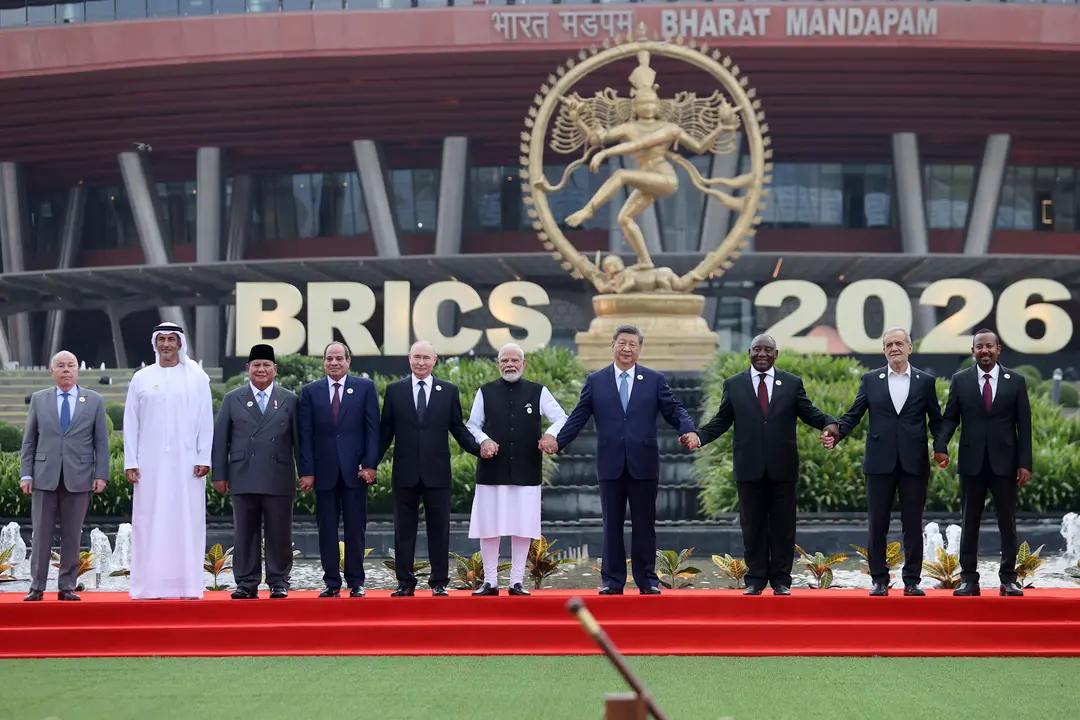
Russia stays focused on Europe despite BRICS summit, says PRIO
An analysis by the Peace Research Institute Oslo says the 18th BRICS summit in New Delhi on September 12-13 produced a joint declaration despite member differences, but it did not mention Russia's war against Ukraine. Putin spent three days in Delhi holding bilateral meetings and called the G7 declining. The piece cites a nine-month fall in Russian oil output from Ukrainian drone strikes and a 14 percent key interest rate.
Source
BRICS / G20 / SCO / Quad · read the original report ↗
Desk check · some claims need care
What the desk checked (5)
- The 18th BRICS summit was held in New Delhi on September 12-13 and produced a joint declaration that does not mention Russia's war against Ukraine. — Stated in the source and attributed to Rossiiskaya Gazeta reporting; declaration content described by the author.
- Putin stayed in New Delhi three days, held many bilateral meetings, and had no face-to-face talk with Xi Jinping at the summit. — Attributed in the source to Izvestiya, September 12.
- Russian oil production has fallen for nine months due to Ukrainian long-range drone strikes on energy infrastructure. — Attributed to Forbes.ua, September 10; figure appears in source.
- Russia's central bank is holding the key interest rate at 14 percent. — Figure appears in source, attributed to The Bell, September 10.
- September 12 explosions at Bulgarian firm EMCO's ammunition facility prompted a sabotage investigation with suspicion of Kremlin involvement. — Attributed to Radio Svoboda; suspicion is described as unproven in the source itself.
Analysts’ view opinion
Putin spent three days in New Delhi and told the BRICS stage that the G7 is "declining", but the strategic reality the PRIO analysis points to is different — Moscow's real focus remains Europe. That the joint declaration made no mention of the war in Ukraine signals that BRICS members want distance from Russia's confrontation rather than co-ownership of it. With most members other than Iran keen to keep profitable ties with the US and EU, the limits of Russia's attempt to turn BRICS into an anti-Western bloc are clearly visible.
- The absence of any reference to the war in the joint declaration may look like a diplomatic win for Moscow, but it more plausibly reflects a lack of consensus and a deliberate choice of neutrality by members.
- Using a BRICS platform in Asia to warn that European troop deployments in Ukraine would mean war with Russia shows the summit served partly as a megaphone aimed at Europe.
- A nine-month fall in oil output under sustained Ukrainian drone strikes, alongside a 14 percent key interest rate, are indicators of economic strain on Russia's capacity for a long war.
- The article notes Russia's hope lies in an oil price spike — precisely the outcome that worries import-dependent BRICS members, a sharp illustration of divergent interests inside the grouping.
- The story cites an investigation into possible sabotage after explosions at a Bulgarian munitions facility; unproven as it is, it shows the security of European industrial infrastructure is becoming a central front.
What to watch — Watch the pace of integrating Ukraine's defence industry into European rearmament programmes, the scaling up of interceptors against jet-propelled drones, and the outcome of investigations into suspected sabotage in Europe.
The story does not establish proven Russian responsibility for the Bulgarian explosions or similar incidents — these remain suspicions under investigation — and this is a researcher's analytical comment, not a verified intelligence finding.
Deep dive
Research brief · 8 facts · 6 dates · exam-readyThe brief
Context
An analysis by Pavel K. Baev of the Peace Research Institute Oslo (PRIO), also published by Eurasia Daily Monitor, examines what the 18th BRICS summit in New Delhi on September 12-13 meant for Russia. Russian state media portray BRICS and the Shanghai Cooperation Organization as vehicles of a multipolar order replacing Western dominance. The piece argues that despite the summit's joint declaration, Moscow remains fixated on Europe because its economy and war effort hinge on European support for Ukraine. The declaration itself made no mention of Russia's war against Ukraine.
Key facts
- The 18th BRICS summit was held in New Delhi on September 12-13 and produced a joint declaration despite differences among member states, particularly Iran and the United Arab Emirates.
- The New Delhi declaration does not mention Russia's war against Ukraine.
- President Vladimir Putin stayed in New Delhi for three days and held many bilateral meetings, but had no face-to-face conversation with Xi Jinping at the summit; they had met on August 31 at the SCO summit.
- Putin described the Group of Seven as "declining" and "not so big", mocking its self-image as a "blossoming garden" surrounded by "wild jungle".
- Ukraine's sustained long-distance drone campaign against Russian energy infrastructure has caused a fall in Russian oil production for the past nine months.
- The Central Bank of the Russian Federation is holding the key interest rate at 14 percent, which is unlikely to fully contain inflation.
- On September 10, Ukrainian forces struck the Russian oil tanker Armada Leader in the Black Sea near Sochi.
- On September 12, explosions at an ammunition storage facility of Bulgarian company EMCO, which supplies munitions used by Ukraine, triggered a sabotage investigation and suspicions of Kremlin involvement.
Timeline
- 2022Russia's full-scale invasion of Ukraine; its international influence shrinks considerably thereafter.
- August 31Putin and Xi Jinping meet at the SCO summit.
- September 3Kommersant headline sums up Russia's outlook: "Less growth, more inflation"; Carnegie Politika notes departure of Western investors as a core industrial problem.
- September 10Ukrainian forces strike the Russian oil tanker Armada Leader in the Black Sea near Sochi; reports of a nine-month fall in Russian oil output.
- September 12Putin says deployment of European troops in Ukraine would constitute war with Russia; explosions at Bulgaria's EMCO ammunition facility prompt sabotage probe.
- September 12-1318th BRICS summit in New Delhi adopts a joint declaration silent on the Ukraine war.
Who has a stake
- Russia / the Kremlin — Uses BRICS and SCO to claim leadership of a multipolar order while facing accelerating economic decline, falling oil output and a widening budget deficit.
- India (summit host) — Invested great effort in organising the summit and securing a joint declaration despite member differences; wary of Putin's obsession with Europe.
- Other BRICS members and guests (China, Kazakhstan, Vietnam, UAE) — Most seek profitable cooperation with the United States and European Union; a spike in oil prices, Russia's hope, is their main worry.
- Ukraine — Depends on European engagement; integrating its defence industries into European rearmament and racing to mass-produce interceptors against Geran-5 jet drones.
- European Union / European states — Targeted by Russian threats and rising sabotage; German votes in Saxony-Anhalt and incidents in Leipzig and Magdeburg matter more to Putin than the BRICS agenda.
- Iran — The exception among BRICS members in also being in confrontation with the West; a source of intra-BRICS differences alongside the UAE.
Why it matters
The brief suggests that the multipolarity showcased at New Delhi has limited value for Moscow: the declaration's silence on Ukraine shows other BRICS states' reluctance to endorse Russia's war, while Russia's leverage rests on oil prices it can no longer control. For India, hosting a consensus summit was a diplomatic achievement, but it also exposed how far Russia's priorities diverge from the group's agenda of tariffs, artificial intelligence and UN Security Council reform.
UPSC angle
Prelims pointers
- 18th BRICS summit: New Delhi, September 12-13; joint declaration adopted with no mention of the Ukraine war.
- BRICS originally Brazil, Russia, India, China, South Africa; now 11 member states (BRICS Info, accessed September 9).
- Russia's central bank key interest rate held at 14 percent amid rising inflation.
- Russian oil production has fallen for nine months due to Ukrainian long-range drone strikes on energy infrastructure.
- Attacks on tankers have spread from the Strait of Hormuz to the Bab al-Mandab Strait.
- SCO summit met on August 31, where Putin and Xi Jinping held a face-to-face meeting.
Mains framing
The New Delhi BRICS summit illustrates the gap between the rhetoric of multipolarity and the interests of its members. Russian state media frame BRICS and the SCO as replacements for Western dominance, and Putin contrasted a strengthening BRICS with a \"declining\" G7; yet Russia stands out for its escalating confrontation with the West, while most members and guests such as Kazakhstan and Vietnam court the United States and European Union. That divergence explains the declaration's silence on Ukraine. Underlying it is economic weakness: classified and doctored statistics, a deep crisis of state finances, a growing budget deficit as war spending expands, diminishing returns from higher taxation, and a 14 percent key rate that still cannot contain inflation. Moscow's one hope, a spike in oil prices from tanker attacks spreading from Hormuz to Bab al-Mandab, is precisely what other BRICS members fear, and is offset by nine months of falling Russian oil output under Ukrainian drone strikes and rising petrol prices from refinery damage. Hence Putin's continued focus on Europe: on deterring European troop deployments, on European support for Ukraine's defence-industrial integration, and, the analysis argues, on hybrid pressure such as the suspected sabotage at Bulgaria's EMCO facility. The way forward the piece implies is that Russia's leverage will remain hostage to European resolve rather than to summit diplomacy.
Key terms
- BRICS
- Loose political-economic grouping originally of Brazil, Russia, India, China and South Africa, now 11 member states; held its 18th summit in New Delhi.
- Shanghai Cooperation Organization (SCO)
- Eurasian grouping presented by Russian state media, alongside BRICS, as embodying a multipolar order; its summit met on August 31.
- PRIO
- Peace Research Institute Oslo, where the analysis's author Pavel K. Baev is a Research Professor.
- Group of Seven (G7)
- Grouping of major Western economies that Putin called "declining" and "not so big" in his BRICS presentation.
- Shadow fleet
- Tankers whose seizure Putin has threatened to answer forcefully, a deterrent that has not stopped European operations or Ukrainian strikes.
- Geran-5
- New jet-propelled Russian drone models that Ukraine is racing to counter with a new generation of interceptors.
Practice questions
- The New Delhi BRICS declaration made no mention of Russia's war against Ukraine. What does this silence reveal about the limits of BRICS as a bloc for advancing Russia's strategic agenda?
- Examine how Ukrainian long-range drone strikes on Russian energy infrastructure have altered Russia's economic and diplomatic leverage, using evidence from the past nine months.
- "Multipolarity in practice is shaped by members' economic ties with the West." Discuss with reference to the positions of India, China, the UAE and Iran at the 18th BRICS summit.
Grounded only in the source report — figures and dates are the source's, not inferred.