
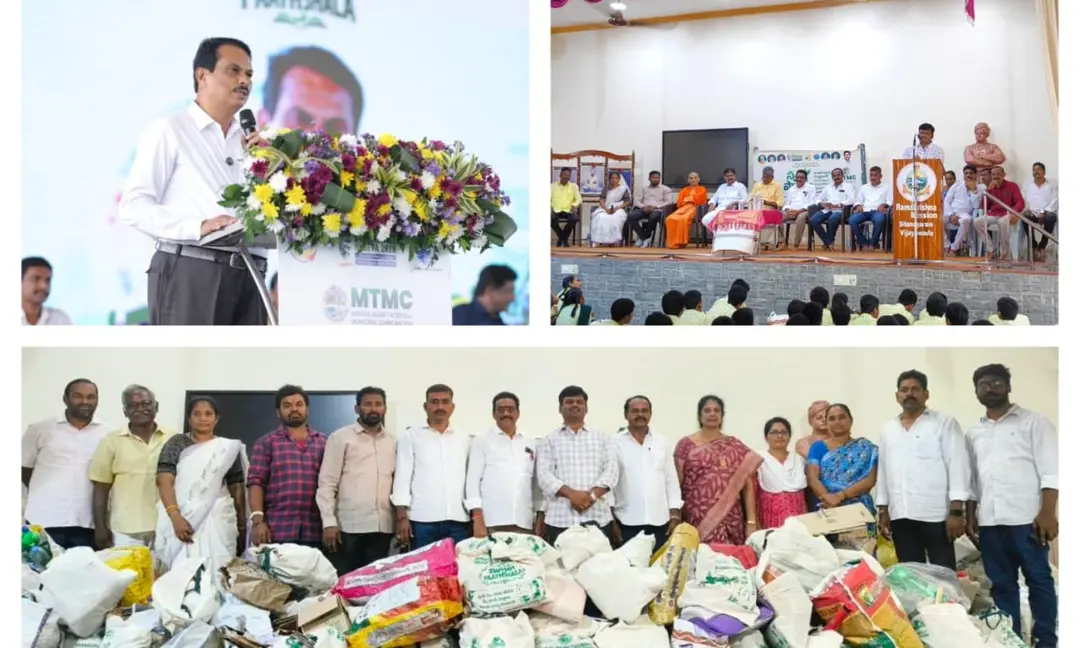
Mangalagiri civic body gets World Book of Records certificate
About 35,147 students from nearly 170 government and private schools joined the 'Swachh Pathasala' programme held by the Mangalagiri–Tadepalli Municipal Corporation under the Union government's 'Swachhata Hi Seva–2026'. Officials said students brought dry waste from their homes to collection points at schools, yielding around 50,000 kg. Dr Ullaji Eliazar, joint secretary of World Book of Records, London–South Region, reviewed the event at LEAP ZP High School, Nidamarru, and handed a certificate to commissioner Sheikh Aleem Basha.
Source
Mangalagiri — స్థానికం · read the original report ↗
Desk check · compared with the source
What the desk checked (4)
- 35,147 students from about 170 government and private schools took part in the 'Swachh Pathasala' programme. — Figure appears in source, presented as the corporation's own account; no independent verification cited.
- About 50,000 kg of dry waste was collected. — Attributed in source to officials ('అధికారులు తెలిపారు').
- World Book of Records, London–South Region joint secretary Dr Ullaji Eliazar attended the event at LEAP ZP High School, Nidamarru, and handed a certificate to commissioner Sheikh Aleem Basha. — Named individuals and venue appear in source; certification claim rests solely on the source's account.
- The programme was part of the Union government's 'Swachhata Hi Seva–2026'. — Stated in source without document or official order cited.
Analysts’ view opinion
On the surface this is a civic cleanliness drive; politically it is a well-timed visibility exercise for a municipal corporation that sits in the heart of Andhra Pradesh's capital region. A certification tied to a central government campaign lets local officials claim both administrative competence and alignment with a national flagship programme — a useful dual signal in a state where centre-state cooperation is itself a political talking point. The story is officials-led, with the commissioner as the public face and no political leader named, which is notable in itself.
- Mangalagiri–Tadepalli is a politically sensitive patch of the capital region, so any showcase of civic performance there carries weight beyond waste management.
- Linking the drive to the central 'Swachhata Hi Seva' campaign lets the corporation bank credit upward to Delhi and outward to local voters simultaneously.
- A record certification is low-cost, high-visibility governance optics — it generates headlines without the political risk that comes with contested infrastructure or welfare decisions.
- Mobilising 35,147 students across roughly 170 schools also means reaching tens of thousands of households, which is organisationally the same footprint any outreach campaign would want.
- With the commissioner, not an elected politician, receiving the certificate, the framing stays administrative — though credit for municipal performance typically flows to the ruling political layer regardless.
What to watch — Watch whether elected leaders at the state or national level amplify this certification in their own messaging, and whether the segregation habit is institutionalised through follow-up drives rather than left as a one-day event.
The story establishes the event, the participation figures as stated by officials and the certification, but not any political motive, party involvement, independent verification of the waste tonnage, or whether the programme will have lasting effect.
Deep dive
Research brief · 8 facts · 3 dates · exam-readyThe brief
Context
The Mangalagiri–Tadepalli Municipal Corporation in Andhra Pradesh held a 'Swachh Pathasala' (Clean School) drive as part of the Union government's 'Swachhata Hi Seva–2026' campaign. Students from government and private schools in the corporation's limits carried dry waste from their homes to special collection points set up in schools, and were taught to segregate paper, plastic and metal for scientific handling. The scale of participation drew an observer from the World Book of Records, London–South Region, who handed a certificate to the civic commissioner.
Key facts
- 35,147 students took part in the 'Swachh Pathasala' programme organised by the Mangalagiri–Tadepalli Municipal Corporation.
- Around 170 government and private schools within the corporation's limits participated.
- Roughly 50,000 kg of dry waste was collected, according to officials.
- Students brought dry waste from their homes to special collection centres set up in the schools.
- The drive was held under the Union government's 'Swachhata Hi Seva–2026' campaign.
- Dr Ullaji Eliazar, joint secretary, World Book of Records, London–South Region, inspected the event at LEAP Zilla Parishad High School, Nidamarru.
- The certificate was handed to Mangalagiri–Tadepalli Municipal Corporation Commissioner Sheikh Aleem Basha.
- Students were trained to separate paper, plastic, metal and other waste into distinct categories for scientific management.
Timeline
- Date not stated in the source'Swachh Pathasala' drive conducted across about 170 schools under the Mangalagiri–Tadepalli Municipal Corporation as part of Swachhata Hi Seva–2026; about 50,000 kg of dry waste collected.
- Same programme, at LEAP ZP High School, NidamarruWorld Book of Records (London–South Region) joint secretary Dr Ullaji Eliazar inspected the arrangements, student participation and waste collection.
- After the inspectionCertificate handed to Commissioner Sheikh Aleem Basha; prizes given to students who collected the most dry waste.
Who has a stake
- Mangalagiri–Tadepalli Municipal Corporation — Organiser of the drive; gains recognition and a channel to improve household-level waste segregation in its jurisdiction.
- 35,147 participating students — Learn source segregation habits; top collectors received prizes from the guests.
- About 170 government and private schools — Hosted special collection centres and mobilised students for the campaign.
- Commissioner Sheikh Aleem Basha — Received the certificate; publicly framed cleanliness as a continuous social responsibility, not a one-day event.
- World Book of Records, London–South Region — Verified the event through joint secretary Dr Ullaji Eliazar and issued the certificate.
- Union government / Swachhata Hi Seva–2026 — Campaign framework under which the local drive was held; depends on such civic mobilisation for outcomes.
Why it matters
Urban waste management in India fails mostly at the first step — segregation at source — and school-based drives aim to build that habit in households through children. A single corporation mobilising 35,147 students across 170 schools to collect about 50,000 kg of dry waste shows how civic bodies can convert a national campaign into measurable local action. The commissioner's point that cleanliness is a continuous social responsibility, not a one-day event, is the test such drives must pass.
UPSC angle
Prelims pointers
- 'Swachhata Hi Seva' is a Union government cleanliness campaign; this edition is referred to as Swachhata Hi Seva–2026.
- 'Swachh Pathasala' drive was conducted by the Mangalagiri–Tadepalli Municipal Corporation (Andhra Pradesh).
- Participation: 35,147 students from about 170 government and private schools; about 50,000 kg of dry waste collected.
- Certificate issued by World Book of Records, London–South Region; joint secretary Dr Ullaji Eliazar inspected the event.
- Venue of inspection: LEAP Zilla Parishad High School, Nidamarru; certificate received by Commissioner Sheikh Aleem Basha.
- Waste streams highlighted for segregation: paper, plastic and metal (dry waste), apart from wet waste at home.
Mains framing
India's urban sanitation challenge is less about collection capacity than about behaviour: unless wet and dry waste are separated at the household level, downstream processing and recycling break down. The Mangalagiri–Tadepalli Municipal Corporation's 'Swachh Pathasala' drive under Swachhata Hi Seva–2026 used schools as the entry point into homes — 35,147 students from about 170 schools brought dry waste to school-level collection centres, yielding roughly 50,000 kg, while being taught to sort paper, plastic and metal for scientific handling. The approach has clear merits: children act as change agents in their families, the exercise generates quantifiable outcomes, and competitive incentives (prizes for the highest collectors) sustain interest. The risks are equally clear — event-driven sanitation can peak on campaign days and fade afterwards, and record certificates measure scale rather than lasting change. As the commissioner himself argued, cleanliness is a continuous social responsibility; the way forward lies in converting such drives into routine household segregation, reliable separate collection by the civic body, and periodic reinforcement through schools rather than one-off mobilisations.
Key terms
- Swachhata Hi Seva–2026
- Union government cleanliness campaign under which the local 'Swachh Pathasala' drive was organised.
- Swachh Pathasala
- 'Clean School' programme in which students brought dry waste from home to collection centres set up in schools.
- Dry waste
- Non-biodegradable recyclable waste such as paper, plastic and metal, kept separate from wet (kitchen) waste.
- Mangalagiri–Tadepalli Municipal Corporation
- The Andhra Pradesh urban local body that organised the drive across about 170 schools in its limits.
- World Book of Records, London–South Region
- Record-certifying body whose joint secretary inspected the event and issued the certificate to the corporation.
- LEAP Zilla Parishad High School, Nidamarru
- The school where the record inspection and certificate handover took place.
Practice questions
- Source segregation, not collection infrastructure, is the weakest link in India's urban waste management. Examine with reference to school-based campaigns like 'Swachh Pathasala'.
- How can urban local bodies convert event-based cleanliness drives into sustained behavioural change in households? Illustrate with the Mangalagiri–Tadepalli example.
- Discuss the role of children and schools as agents of behavioural change in national sanitation campaigns such as Swachhata Hi Seva.
Grounded only in the source report — figures and dates are the source's, not inferred.