
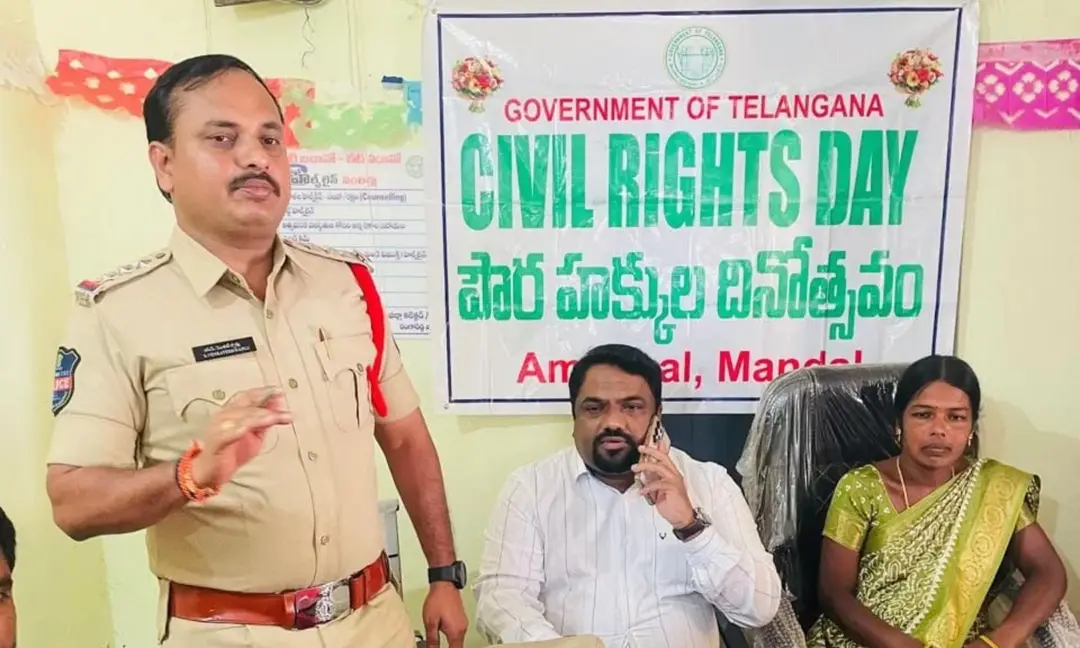
Civil Rights Day awareness programme held in Settipalli village
An awareness programme marking Civil Rights Day was held on Wednesday in Settipalli village of Amangal mandal, Rangareddy district. The tahsildar, deputy tahsildar, village sarpanch, ward members, police officers, village elders, women and residents took part. Officials explained civil rights, rights granted by the Constitution, equality and the eradication of untouchability. They also outlined key provisions of the SC, ST (Prevention of Atrocities) Act, victims' rights and available legal remedies, urging citizens to respect others' rights.
Source
Rangareddy — వార్తలు · read the original report ↗
Desk check · compared with the source
What the desk checked (5)
- A civil rights awareness programme was held on Wednesday in Settipalli village, Amangal mandal, Rangareddy district, to mark Civil Rights Day. — Stated directly in the source; day of week given without a calendar date.
- The tahsildar, deputy tahsildar, village sarpanch, ward members, police officers, village elders, women and residents attended. — Listed in the source by designation; no individual names provided.
- Officials explained civil rights, constitutional rights, equality and eradication of untouchability to villagers. — Attributed in the source to unnamed officials at the event.
- Officials outlined key provisions of the SC/ST (Prevention of Atrocities) Act, victims' rights and available legal remedies. — Appears in the source; no specific sections of the Act are cited.
- The programme concluded successfully in a peaceful atmosphere with enthusiastic participation. — Characterisation by the source with no source given; descriptive rather than checkable.
Analysts’ view opinion
On its face this is a routine administrative observance in one Rangareddy village, but the political signal sits in who showed up: revenue officials, police and the elected sarpanch and ward members on one stage. Civil Rights Day messaging built around equality, untouchability eradication and the SC/ST (Prevention of Atrocities) Act is where state machinery and local electoral politics meet, because the same village leadership that endorses the message is answerable to voters on whether it is enforced. The story records the event, not any shift in power — its value is as a marker of how Dalit-rights outreach is being pushed down to the gram panchayat level.
- Joint participation by tahsildar, deputy tahsildar and police alongside the sarpanch and ward members blends bureaucratic delivery with elected legitimacy, which typically raises the local credibility of such campaigns.
- Foregrounding the SC/ST atrocities law and victims' rights is politically significant in rural Telangana, where Dalit and tribal voters are a decisive bloc for every major party.
- For the sarpanch and ward members, visible association with a rights programme is low-cost political capital — but it also creates an expectation of follow-through on complaints.
- Awareness of legal remedies can translate into more formal complaints over time, which tests police responsiveness and can become a local political flashpoint either way.
- No party banners or political speeches are recorded here, so this reads as government-programme outreach rather than overt electoral mobilisation.
What to watch — Watch whether such village-level sessions are replicated across Amangal mandal and the wider district, and whether increased awareness shows up as more registered cases and faster official action.
The story does not establish who directed or funded the programme, how many people attended, any party involvement, or whether it will lead to any measurable change in enforcement or local attitudes.
Deep dive
Research brief · 8 facts · 1 dates · exam-readyThe brief
Context
Civil Rights Day is observed to spread awareness of the rights the Constitution guarantees citizens and of laws against untouchability and caste-based discrimination. Marking the occasion, revenue and police officials held an awareness programme on Wednesday in Settipalli village of Amangal mandal in Telangana's Rangareddy district. Officials used the village gathering to explain constitutional rights, equality, the eradication of untouchability and the main provisions of the SC, ST (Prevention of Atrocities) Act. The programme also covered victims' rights and the legal remedies available to protect those rights.
Key facts
- The awareness programme was held on Wednesday in Settipalli village, Amangal mandal, Rangareddy district, to mark Civil Rights Day.
- Participants included the tahsildar, deputy tahsildar, village sarpanch, ward members, police officers, village elders, women and other residents.
- Officials explained civil rights, rights conferred by the Constitution, equality and the eradication of untouchability.
- Key provisions of the SC, ST (Prevention of Atrocities) Act were explained to villagers.
- Officials outlined victims' rights and the legal measures available for protection of rights.
- Villagers were urged to know their own rights and also respect the rights of others.
- Officials called for equality to be practised in the spirit of the Constitution, without any room for discrimination.
- The source records that villagers participated enthusiastically and the programme concluded peacefully and successfully.
Timeline
- Wednesday (date not stated in the source)Civil Rights Day awareness programme held in Settipalli village, Amangal mandal, Rangareddy district, with officials explaining constitutional rights and the SC, ST (Prevention of Atrocities) Act.
Who has a stake
- Residents of Settipalli village — Direct beneficiaries of information on their constitutional rights, protection against untouchability and legal remedies.
- Tahsildar and deputy tahsildar (revenue administration) — Responsible for conducting the awareness drive and conveying rights and legal provisions at village level.
- Police officers — Enforcement of the SC, ST (Prevention of Atrocities) Act and handling of complaints and victim protection.
- Village sarpanch and ward members — Local elected representatives who mobilised participation and must sustain awareness in the panchayat.
- Scheduled Caste and Scheduled Tribe communities — Protected groups under the Act whose access to remedies depends on awareness of its provisions.
- Village elders and women participants — Community opinion-shapers whose involvement influences social practice on equality and untouchability.
Why it matters
Legal protections against untouchability and caste atrocities work only when the people they are meant to protect know the provisions and the remedies available. A village-level programme bringing together revenue officials, police and elected panchayat representatives shows how awareness of constitutional rights is delivered at the last mile. For citizens, knowing both one's own rights and the duty to respect others' rights is the practical content of constitutional equality.
UPSC angle
Prelims pointers
- Civil Rights Day awareness programme was held in Settipalli village, Amangal mandal, Rangareddy district (Telangana).
- The programme covered the SC, ST (Prevention of Atrocities) Act, victims' rights and legal remedies.
- Topics explained included civil rights, constitutional rights, equality and eradication of untouchability.
- Tahsildar and deputy tahsildar are revenue officials at mandal level; sarpanch heads the village panchayat.
- Officials stressed practising equality in the spirit of the Constitution, without discrimination.
Mains framing
Statutory safeguards against untouchability and caste-based atrocities often fail at the point of implementation because intended beneficiaries are unaware of the provisions, the procedure for lodging complaints and the protections available to victims. The Settipalli programme illustrates a corrective approach: the mandal revenue machinery (tahsildar, deputy tahsildar), the police and elected panchayat functionaries (sarpanch, ward members) jointly explain constitutional rights, equality and the key provisions of the SC, ST (Prevention of Atrocities) Act directly to villagers, including women and village elders who shape local social norms. Such outreach addresses the information gap that lies between legal entitlement and actual redress, and the inclusion of police officers signals that complaints will be received locally. The way forward implied by the source is a twin emphasis — citizens knowing their own rights while respecting those of others, and officials practising equality in the spirit of the Constitution without any room for discrimination. Sustained, repeated engagement at the panchayat level, rather than one-day observances alone, is what would translate awareness into behavioural and institutional change; the source does not detail any further follow-up measures.
Key terms
- Civil Rights Day
- The occasion marked by the Settipalli programme, used to create awareness of citizens' rights and the removal of untouchability.
- SC, ST (Prevention of Atrocities) Act
- Law whose key provisions, victims' rights and legal remedies were explained to villagers by officials.
- Tahsildar / Deputy Tahsildar
- Revenue officials at the mandal level who led the awareness programme.
- Sarpanch and ward members
- Elected head and members of the village panchayat who took part in the programme.
- Mandal
- Administrative sub-district unit in Telangana; Amangal mandal in Rangareddy district contains Settipalli village.
- Untouchability eradication
- One of the themes explained, tied to the constitutional guarantee of equality and non-discrimination.
Practice questions
- Why does awareness of legal provisions determine the effectiveness of laws such as the SC, ST (Prevention of Atrocities) Act? Discuss with reference to village-level outreach.
- Examine the role of mandal-level revenue officials, police and panchayat representatives in delivering constitutional rights awareness at the grassroots.
- 'Knowing one's rights is incomplete without respecting the rights of others.' Discuss this idea in the context of constitutional equality and the abolition of untouchability.
Grounded only in the source report — figures and dates are the source's, not inferred.