
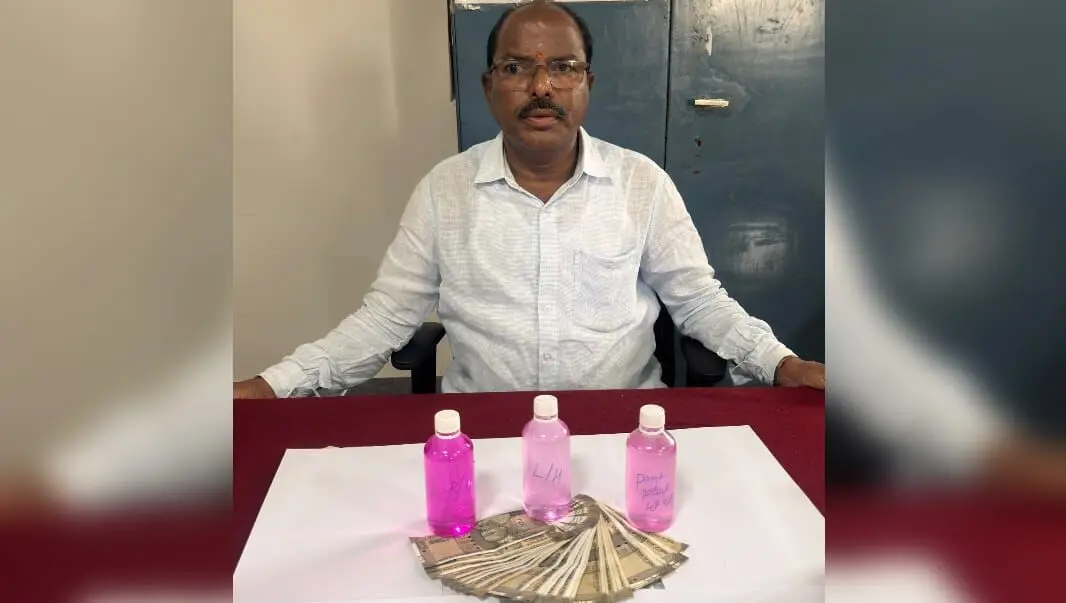
ACB catches Mahabubnagar survey official taking Rs 15,000 bribe
The Telangana Anti-Corruption Bureau on Wednesday caught Bommireddy Venkateshwar Reddy, Superintendent in the Office of the Assistant Director (Survey and Land Records), Mahabubnagar, while he was allegedly accepting a Rs 15,000 bribe. The ACB said he demanded the amount for placing a file before the Assistant Director to facilitate corrections in the village map of Karvena in Boothpur mandal. The tainted cash was recovered from him. He has been arrested and is being produced before the Additional Special Judge for SPE and ACB Cases, Nampally, for judicial remand. Investigation is on.
Source
Mahabubnagar — news · read the original report ↗
Desk check · compared with the source
What the desk checked (5)
- Bommireddy Venkateshwar Reddy, Superintendent in the Office of the Assistant Director (Survey and Land Records), Mahabubnagar, was caught accepting Rs 15,000 bribe. — Attributed to the Telangana ACB; named official and figure appear in source.
- The bribe was demanded for putting up a file to correct the village map of Karvena village, Boothpur mandal. — Attributed to ACB statement in source.
- Tainted cash of Rs 15,000 was recovered from the accused at his instance. — Stated by ACB in source; no independent verification possible.
- The accused is being produced before the Additional Special Judge for SPE and ACB Cases, Nampally, for judicial remand. — Figure appears in source as ACB procedure; outcome not yet reported.
- ACB helpline 1064 and WhatsApp number 9440446106 for bribery complaints. — Contact details appear in source as an ACB appeal.
Analysts’ view opinion
This follows the classic anti-corruption "trap" template — a complaint, a pre-arranged trap, and recovery of marked bribe money. Under India's anti-corruption law the prosecution must establish both the demand and the acceptance of an undue advantage; recovery of cash alone is settled not to be enough. That the money was allegedly sought for an ordinary, entitled service — a village map correction — tends to strengthen the "undue advantage" element, but at this stage everything remains an allegation and the presumption of innocence applies.
- Production before the Additional Special Judge for SPE and ACB Cases at Nampally reflects the designated special-court route prescribed for such prosecutions.
- The usual next steps are a judicial decision on remand, a bail application, completion of investigation, filing of a charge sheet, and then trial.
- Sanction for prosecution of a public servant is a crucial procedural gate in cases of this type; the story says nothing about its status here.
- The complainant's testimony, trap witnesses and the recovered marked currency will be the evidentiary spine of the case in court.
- Departmental disciplinary proceedings can run parallel to the criminal case and are legally independent of its outcome.
What to watch — Watch the court's order on remand or bail, whether a charge sheet is filed within the statutory period, and any announcement of suspension or departmental action.
Everything so far rests on the ACB's own account; the story does not establish guilt, the court's decision, or the accused official's version.
Deep dive
Research brief · 8 facts · 4 dates · exam-readyThe brief
Context
The Telangana Anti-Corruption Bureau (ACB) ran a trap operation in Mahabubnagar and caught a Superintendent in the Office of the Assistant Director (Survey and Land Records) allegedly accepting a Rs 15,000 bribe. The money was allegedly demanded for merely placing a file before the Assistant Director to enable corrections in a village map. The case, reported on 8 July 2026, highlights corruption in routine land record services, where citizens depend on officials to move files for map and record corrections. The accused has been arrested and is being produced before the Additional Special Judge for SPE and ACB Cases, Nampally, for judicial remand.
Key facts
- The accused is Bommireddy Venkateshwar Reddy, Superintendent in the Office of the Assistant Director (Survey and Land Records), Mahabubnagar.
- The bribe amount demanded and allegedly accepted was Rs 15,000.
- He was trapped by the ACB's Mahabubnagar Range Unit on Wednesday, following a complaint.
- The bribe was allegedly sought for putting up a file before the Assistant Director (Survey and Land Records) to facilitate corrections in the village map of Karvena village, Boothpur mandal, Mahabubnagar district.
- The tainted cash of Rs 15,000 was recovered from the accused's possession at his instance.
- The ACB stated the official allegedly performed his public duty improperly and dishonestly to obtain an undue advantage.
- The accused has been arrested and is being produced before the Additional Special Judge for SPE and ACB Cases, Nampally, for judicial remand; investigation is in progress.
- ACB urged citizens to report bribe demands on toll-free helpline 1064 or WhatsApp number 9440446106, assuring complainant confidentiality.
Timeline
- Before the trap (date not stated in the source)The Superintendent allegedly demanded Rs 15,000 from a complainant to put up a village map correction file before the Assistant Director.
- After the demandThe complainant approached the ACB, which laid a trap.
- Wednesday (as reported)ACB's Mahabubnagar Range Unit caught the official allegedly accepting the bribe; Rs 15,000 recovered from his possession.
- 8 July 2026 (report published 7:46 PM IST)News of the arrest reported; accused being produced before the Additional Special Judge for SPE and ACB Cases, Nampally, for judicial remand.
Who has a stake
- Bommireddy Venkateshwar Reddy, Superintendent (Survey and Land Records), Mahabubnagar — Arrested and facing judicial remand and prosecution in an ACB trap case; career and liberty at stake.
- Telangana Anti-Corruption Bureau (ACB), Mahabubnagar Range Unit — Conducted the trap and recovery; must now build and prove the case in court.
- The complainant — Sought corrections in the Karvena village map; was asked for money and chose to report; identity promised confidentiality.
- Office of the Assistant Director (Survey and Land Records), Mahabubnagar — Credibility of routine land record and map correction services under scrutiny.
- Residents of Karvena village, Boothpur mandal — Village map corrections affect land records and property clarity; delays caused by bribe demands hurt them.
- Additional Special Judge for SPE and ACB Cases, Nampally — Court before which the accused is produced for judicial remand and trial of ACB cases.
Why it matters
Land records and village maps are the foundation of property rights, and even a clerical step like placing a file before a senior officer became a point of extortion in this case. Such petty but systemic bribery raises the cost of basic entitlements for ordinary landholders and erodes trust in revenue and survey administration. The case also shows that citizen complaints routed through ACB helplines can translate into trap operations and arrests.
UPSC angle
Prelims pointers
- Telangana ACB toll-free anti-corruption helpline: 1064; WhatsApp complaint number: 9440446106.
- ACB trap cases in Telangana are tried before the Additional Special Judge for SPE and ACB Cases, Nampally.
- SPE stands for Special Police Establishment, part of the ACB court nomenclature in Telangana.
- The bribe case involved the village map of Karvena in Boothpur mandal, Mahabubnagar district.
- Village maps and land records are maintained by the Survey and Land Records department, headed at district level by an Assistant Director.
- The accused was a Superintendent, an office-level supervisory clerk post, caught with Rs 15,000 tainted cash.
Mains framing
Petty corruption in land administration thrives where discretion meets opacity: in this Mahabubnagar case, a Superintendent allegedly demanded Rs 15,000 simply to place a village map correction file before the Assistant Director (Survey and Land Records), showing how procedural gatekeeping becomes rent-seeking. The causes visible in the source are the citizen's dependence on an intermediary official to move a file, the absence of any visible alternative route to get the correction done, and the low-value, high-frequency nature of such demands that victims often pay rather than contest. The implications are direct: inflated transaction costs for landholders, distorted land records that can seed future disputes, and declining public trust in survey and revenue offices. The source shows one corrective mechanism working — a complaint to the ACB led to a trap, recovery of tainted cash, arrest and production before the Additional Special Judge for SPE and ACB Cases, Nampally. The way forward suggested by the facts at hand lies in encouraging citizens to use accessible reporting channels such as the ACB's 1064 helpline and WhatsApp line with guaranteed confidentiality, and in reducing the number of hands a routine file must pass through, though specific reform measures are not stated in the source.
Key terms
- Anti-Corruption Bureau (ACB)
- Telangana's state agency that investigates bribery by public servants and lays trap operations; here acted through its Mahabubnagar Range Unit.
- Trap case
- An operation where officials arrange for a bribe to be paid under surveillance so the accused is caught accepting marked or tainted cash.
- Tainted cash
- The bribe money, usually chemically treated or noted down, recovered from the accused as physical evidence of acceptance.
- Survey and Land Records department
- The wing that prepares and corrects village maps and survey records; at district level supervised by an Assistant Director.
- Judicial remand
- Court-ordered custody of an arrested accused in jail pending investigation or trial.
- SPE and ACB Special Court
- The Nampally court (Additional Special Judge for SPE and ACB Cases) designated to try corruption cases in Telangana.
Practice questions
- Petty corruption in land records administration undermines property rights more than it is usually acknowledged. Discuss with reference to recent anti-corruption trap cases.
- What institutional mechanisms exist in Indian states to detect and prosecute bribery by public servants? Evaluate their effectiveness using the Telangana ACB's approach as an example.
- How can procedural redesign of routine services like village map corrections reduce opportunities for rent-seeking by intermediary officials?
Grounded only in the source report — figures and dates are the source's, not inferred.