
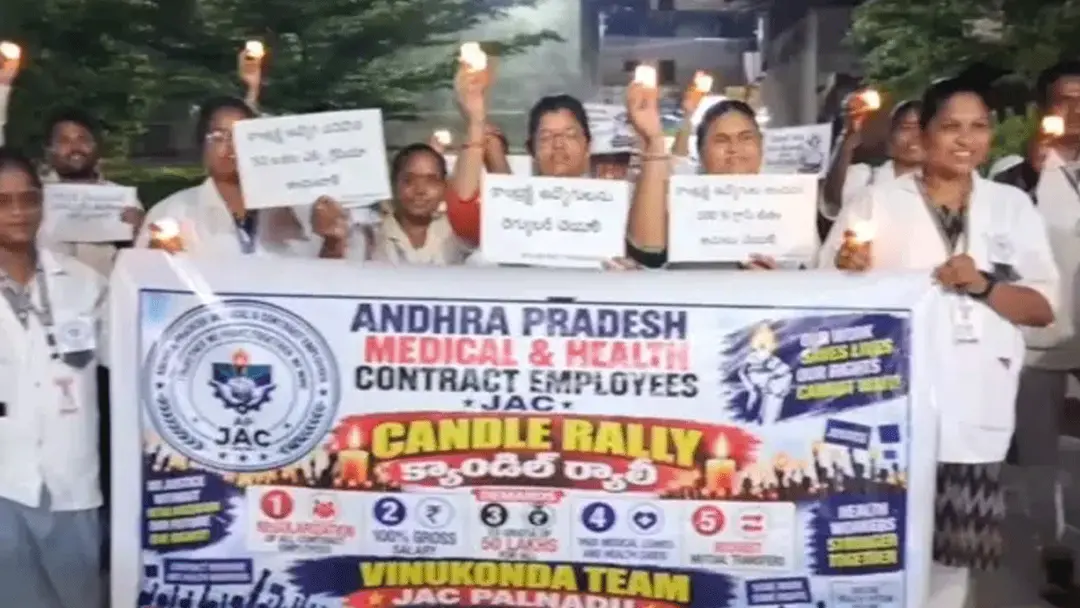
Contract medical employees hold candlelight rally in Vinukonda
Contract employees of the AP Medical and Health Contract Employees JAC, Palnadu and Vinukonda team, held a candlelight rally in Vinukonda urging the government to resolve pending issues. Their demands include regularisation, implementation of 100 percent gross salary, Rs 50 lakh ex gratia, paid medical leave, health cards and the option of mutual transfers. Leaders warned of a large-scale agitation otherwise. APNGO and other unions voiced support. JAC state vice chairman P. Sivaramakrishna, district chairman Nagaraju Kumari, Shanta Raju, joint secretary Koteswara Naik and state coordinator Satish took part.
Source
ఆంధ్రప్రదేశ్ వార్తలు — Andhra Pradesh · read the original report ↗
Desk check · compared with the source
What the desk checked (5)
- A candlelight rally was held in Vinukonda by the AP Medical & Health Contract Employees JAC, Palnadu and Vinukonda team. — Stated directly in the source as the central event; no official confirmation cited.
- Demands include regularisation, 100 percent gross salary, Rs 50 lakh ex gratia, paid medical leave, health cards and mutual transfers. — Figures and list appear in the source, attributed to JAC leaders.
- Leaders warned of a large-scale agitation if issues are not resolved. — Attributed to JAC leaders at the rally.
- APNGO and other employee unions expressed continued solidarity with the demands. — Attributed to union leaders in the source; no named APNGO spokesperson given.
- Participants included JAC state vice chairman P. Sivaramakrishna, district chairman Nagaraju Kumari, Shanta Raju, joint secretary Koteswara Naik and state coordinator Satish. — Names listed in the source; designations as given, not independently checked.
Analysts’ view opinion
This is more than a candlelight march in a small town — it is a signal of the design gaps in a public health system that runs substantially on contract staff. The demand list is telling: it is less about a pay rise and more about the absence of basic service conditions such as job security, health protection and transfer rights. Some demands — regularisation, 100 percent gross pay, Rs 50 lakh ex-gratia — carry real fiscal weight, while others such as health cards, paid medical leave and mutual transfers could largely be settled through administrative orders, and that distinction will shape how the government responds.
- Contract hiring was designed as a stop-gap arrangement, and when it hardens into a long-term staffing model, disputes over service conditions of this kind become almost inevitable.
- The demands fall into two baskets: fiscally heavy ones (regularisation, full gross pay, ex-gratia) and low-cost administratively deliverable ones (health cards, paid leave, mutual transfers).
- Regularisation is not purely a budget question — it intersects with recruitment rules, reservation and seniority, which is why such processes have historically moved slowly.
- That health workers are asking for health cards and paid medical leave points to a policy contradiction: those who run the system appear to lack the system's own protections.
- Expressions of solidarity from APNGO and other employee associations could lift this from a single-cadre grievance onto a wider organised-labour platform.
What to watch — Watch whether the protest scales from district level to a statewide agitation, or whether the government first moves on the cheaper demands — health cards, leave, transfers — to open a negotiating track.
The story sets out only the protesters' demands; it does not establish the government's position, the number of employees affected, current pay levels, any cost estimate, or whether talks are underway.
Deep dive
Research brief · 8 facts · 3 dates · exam-readyThe brief
Context
Contract employees working in Andhra Pradesh's public health system — hired on contract rather than regular government posts — have been pressing the state government to settle long-pending service demands. Under the banner of the AP Medical & Health Contract Employees JAC (Joint Action Committee), the Palnadu district and Vinukonda team held a candlelight rally in Vinukonda to push their charter of demands. The protest centres on regularisation of their jobs, full salary parity and welfare benefits such as health cards and paid medical leave. Other employee bodies, including the APNGO, have extended support.
Key facts
- A candlelight rally was held at Vinukonda by the AP Medical & Health Contract Employees JAC, Palnadu and Vinukonda team, demanding resolution of pending issues.
- The source is datelined October 1, 2026, 12:10 PM IST.
- Demands include regularisation of contract employees and implementation of 100 percent gross salary.
- Protesters sought ex gratia of Rs 50 lakh (amount as stated in the source).
- Other demands: paid medical leave, grant of health cards, and the option of mutual transfers.
- JAC leaders said contract employees serve continuously in the public health system on inadequate salaries.
- Leaders warned of a large-scale agitation if the demands are not resolved.
- APNGO and other employee union leaders said their solidarity and support for the demands would continue.
Timeline
- October 1, 2026 (report date)Candlelight rally held in Vinukonda by AP Medical & Health Contract Employees JAC, Palnadu and Vinukonda team.
- At the rallyJAC leaders listed demands — regularisation, 100 percent gross salary, Rs 50 lakh ex gratia, paid medical leave, health cards, mutual transfers — and warned of a larger agitation.
- Alongside the rallyAPNGO and other employee unions declared continued solidarity with the contract employees' demands.
Who has a stake
- Contract medical and health employees in Andhra Pradesh — Seek job security through regularisation, full gross salary, paid medical leave, health cards and mutual transfer options.
- AP Medical & Health Contract Employees JAC (Palnadu, Vinukonda team) — Leading the agitation and carrying the demands to the government; has warned of escalation.
- Government of Andhra Pradesh — Must decide on regularisation and pay parity, with fiscal and administrative implications for the health department.
- APNGO and other employee unions — Extending solidarity; their backing can widen the agitation across the state's employee movement.
- Patients and the public health system — Depend on contract staff for continuous service delivery; a large-scale agitation could disrupt healthcare.
- JAC office-bearers (P. Sivaramakrishna, Nagaraju Kumari, Shanta Raju, Koteswara Naik, Satish) — Mobilising members and negotiating with the government.
Why it matters
Contract staff form a working backbone of state public health delivery, and their grievances over pay and tenure directly affect service continuity in districts like Palnadu. The demands — regularisation, 100 percent gross salary and health cover — raise the broader question of equal treatment for contractual workers doing regular government work. With unions threatening a large-scale agitation, the state faces both a fiscal decision and a healthcare delivery risk.
UPSC angle
Prelims pointers
- Candlelight rally at Vinukonda (Palnadu district, Andhra Pradesh) by medical and health contract employees; report dated October 1, 2026.
- Organiser: AP Medical & Health Contract Employees JAC — Palnadu and Vinukonda team.
- Core demands: regularisation, 100 percent gross salary, Rs 50 lakh ex gratia, paid medical leave, health cards, mutual transfers.
- APNGO (Andhra Pradesh Non-Gazetted Officers' body) extended support to the contract employees.
- JAC state vice chairman named in the source: P. Sivaramakrishna; state coordinator: Satish.
Mains framing
The Vinukonda candlelight rally illustrates the structural problem of contractualisation in India's public health workforce: staff performing continuous, essential duties remain outside regular service rules, and as the JAC leaders argued, work on salaries they describe as inadequate. The demand set — regularisation, 100 percent gross salary, Rs 50 lakh ex gratia, paid medical leave, health cards and mutual transfers — maps onto three distinct deficits: tenure insecurity, pay parity, and the absence of social protection and mobility that regular employees enjoy. The causes lie in the use of contract appointments to expand health service coverage without expanding sanctioned regular posts; the implications are low morale, attrition risk and, as warned here, agitation that can interrupt service delivery in districts. The support of APNGO and other unions signals the potential for the dispute to widen beyond the health department. A way forward, grounded in what the source records, would involve the state engaging the JAC on its specific charter rather than allowing escalation — examining regularisation criteria, pay structure and welfare entitlements such as health cards and paid medical leave, so that service continuity in public health is not held hostage to unresolved employment terms.
Key terms
- JAC (Joint Action Committee)
- A coordinating platform of employee groups; here, the AP Medical & Health Contract Employees JAC leading the agitation.
- Regularisation
- Converting contract appointments into regular government posts with attendant service conditions and job security.
- 100 percent gross salary
- Demand that contract staff be paid the full gross pay of the corresponding post rather than a reduced consolidated amount.
- Ex gratia
- A discretionary compensatory payment; employees here demand Rs 50 lakh, as stated in the source.
- Health cards
- Cards entitling employees and families to government-covered medical treatment; the source does not detail the scheme.
- Mutual transfer
- Arrangement allowing two employees at different locations to exchange postings by consent.
Practice questions
- Contractualisation of the health workforce has expanded service coverage but created a two-tier employment structure. Discuss with reference to demands for regularisation and pay parity by state medical and health contract employees.
- Examine the implications for public health service delivery when contract employees resort to agitation. What institutional mechanisms can pre-empt such disputes?
- Critically evaluate the case for extending welfare entitlements such as paid medical leave and health cards to contractual government employees.
Grounded only in the source report — figures and dates are the source's, not inferred.