
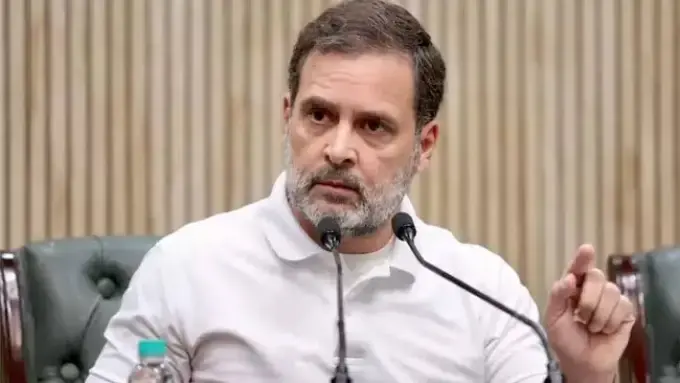
Rahul Gandhi asks EC who ordered Form-6 changes
Congress leader Rahul Gandhi asked the Election Commission to reveal on whose orders changes were made to the online Form-6 used for voter registration. On X, he asked who got the changes done through TCS, who approved them within the company and whether any pressure was applied. Reports said Commissioners S S Sandhu and Vivek Joshi objected to new SIR rules. Congress held protests nationwide seeking CEC Gyanesh Kumar's resignation. The father's and grandfather's name declaration was dropped from September 30 in states where SIR is complete.
Source
Eenadu (ఈనాడు) · read the original report ↗
Desk check · some claims need care
What the desk checked (5)
- Rahul Gandhi asked the Election Commission who ordered changes to online Form-6 and who approved them at TCS. — Attributed in source to Rahul Gandhi's posts on X; wording presented as his questions.
- Election Commissioners S S Sandhu and Vivek Joshi objected to new rules in the special intensive revision of electoral rolls. — Source attributes this only to 'news reports'; no official confirmation cited.
- Congress held protests in several places across the country demanding CEC Gyanesh Kumar's resignation. — Stated in source without naming locations or officials; no direct source given.
- EC added a declaration to Form-6 requiring new applicants to give father's and grandfather's names, and removed it from September 30 in states where SIR is complete. — Figure/date appears in source; attributed to the Election Commission, no document cited.
- Applicants complained the online portal did not proceed without these details. — Attributed in source to complaints by 'many people'; numbers not specified.
Analysts’ view opinion
The Congress is working to convert the electoral-roll revision (SIR) row from a technical, administrative issue into a political story about accountability and alleged misuse of authority. Rahul Gandhi's questions — on whose orders Form-6 was altered, and whether TCS was pressured — are aimed squarely at the institutional independence of the Election Commission. Reports of two commissioners objecting, followed by the withdrawal of the extra declaration in states where SIR is complete, feed the opposition's claim that pressure is working.
- By pairing a demand for the CEC's resignation with nationwide protests, Congress is scaling the issue from scattered voter complaints into a national campaign plank.
- Targeting the EC directly offers the opposition a double benefit — positioning itself as defender of voting rights while building an advance explanation for future defeats — but also exposes it to the charge of undermining a constitutional body.
- The father-and-grandfather declaration requirement carries immediate social and political bite because it most affects poorer, migrant and document-scarce voters.
- The uneven approach — dropping the rule where SIR is done but retaining it where SIR continues — is now the opposition's sharpest talking point.
- The EC has an administrative case to make about tightening enrolment and curbing duplication, but that argument is politically hard to sustain without a clear account of how the changes were approved.
What to watch — Whether the EC publicly explains the decision chain behind the Form-6 changes and responds to reports of internal disagreement will determine if this stays a street-protest issue or escalates to Parliament and the courts.
The story does not establish that TCS was pressured or on whose instructions the changes were made — these remain Rahul Gandhi's questions, and the commissioners' objections are reported rather than officially confirmed.
Deep dive
Research brief · 8 facts · 4 dates · exam-readyThe brief
Context
Form-6 is the application form used by new voters to enrol in the electoral roll. As part of the Special Intensive Revision (SIR) of electoral rolls, the Election Commission added an extra declaration to the online Form-6 requiring new applicants to disclose their father's and grandfather's names. Complaints followed that applications could not proceed online without these details, and a political row erupted after reports that two Election Commissioners objected to the new SIR rules. Congress leader Rahul Gandhi has now demanded that the EC disclose on whose orders the online form was changed through TCS.
Key facts
- Rahul Gandhi asked the Election Commission to reveal on whose orders changes were made to the online Form-6 used for voter registration.
- On X, he asked who got the changes done through Tata Consultancy Services (TCS), who inside TCS approved them, and whether any pressure was put on the company.
- Reports said Election Commissioners S S Sandhu and Vivek Joshi objected to the new rules in the Special Intensive Revision (SIR) of electoral rolls.
- Congress held protests at several places across the country demanding the resignation of CEC Gyanesh Kumar.
- The EC had added a declaration to Form-6 requiring new applicants to disclose the names of their father and grandfather.
- Many complained that applications would not proceed on the online portal unless these details were entered, raising fears of exclusion from voting.
- The EC removed the additional declaration requirement from September 30 in states where the SIR process is complete.
- In states where SIR is still under way, the additional declaration requirement continues as before.
Timeline
- During the SIR process (date not stated in the source)EC adds an extra declaration to Form-6 seeking father's and grandfather's names; applicants complain the online portal blocks submission without it.
- September 30EC withdraws the additional declaration requirement in states where the SIR process is complete; it remains in states where SIR is ongoing.
- Date not stated in the sourceReports emerge that Commissioners S S Sandhu and Vivek Joshi objected to the new SIR rules.
- Date not stated in the sourceCongress stages nationwide protests demanding CEC Gyanesh Kumar's resignation; Rahul Gandhi posts a series of questions on X about the EC's functioning.
Who has a stake
- Election Commission of India — Its credibility and the transparency of changes made to the online Form-6 and SIR rules are under question.
- CEC Gyanesh Kumar — Faces Congress demand for his resignation over the new SIR rules and form changes.
- Election Commissioners S S Sandhu and Vivek Joshi — Reported to have objected to the new SIR rules, pointing to internal disagreement within the Commission.
- Rahul Gandhi and the Congress party — Leading the political attack, demanding disclosure of who ordered the Form-6 changes through TCS.
- Tata Consultancy Services (TCS) — Named as the entity that carried out the changes; questioned on who approved them and whether it faced pressure.
- New voter applicants — Risk of being kept off the rolls if unable to furnish father's and grandfather's names on the online portal.
Why it matters
Form-6 is the gateway for a first-time voter to enter the electoral roll, so any additional documentary condition can directly decide who gets to vote. The dispute combines an administrative change made through a private technology vendor with reported dissent inside the Election Commission, raising questions of transparency and institutional process. With the requirement withdrawn only in states where SIR is complete, applicants in ongoing-SIR states still face it.
UPSC angle
Prelims pointers
- Form-6 is the application form used for new voter registration/enrolment in the electoral roll.
- SIR refers to the Special Intensive Revision of electoral rolls by the Election Commission.
- Tata Consultancy Services (TCS) is named as having made the changes to the online Form-6.
- Current Chief Election Commissioner named in the story: Gyanesh Kumar; Election Commissioners named: S S Sandhu and Vivek Joshi.
- The extra declaration seeking father's and grandfather's names was dropped from September 30 in states where SIR is complete.
Mains framing
The row over the online Form-6 declaration illustrates how a seemingly technical change in electoral administration can acquire constitutional significance. By requiring new applicants to disclose their father's and grandfather's names, with the online portal reportedly refusing to accept applications without them, the Election Commission created a documentary barrier that applicants feared would exclude them from the rolls. Two questions follow. First, process: who authorised the change, was it a decision of the full Commission, and what role did the vendor TCS play — issues sharpened by reports that Commissioners S S Sandhu and Vivek Joshi objected to the new SIR rules. Second, equity: the requirement has been removed from September 30 only where SIR is complete, leaving voters in ongoing-SIR states subject to a stricter standard. The way forward, on the facts available, lies in the Commission publicly explaining the authorship and rationale of such changes, ensuring uniformity across states, and ensuring that no documentary condition imposed through a software interface effectively narrows the franchise; the Congress demand for the CEC's resignation is the political, rather than institutional, response to the same concern.
Key terms
- Form-6
- The application form used by new voters to get enrolled in the electoral roll.
- SIR (Special Intensive Revision)
- The Election Commission's special intensive revision exercise of electoral rolls, under which the new Form-6 rules were introduced.
- Declaration (in Form-6)
- The additional entry added to Form-6 requiring new applicants to disclose their father's and grandfather's names.
- TCS (Tata Consultancy Services)
- The company that, per Rahul Gandhi's questions, carried out the changes to the online Form-6.
- CEC
- Chief Election Commissioner, who heads the Election Commission; currently Gyanesh Kumar, whose resignation Congress is demanding.
Practice questions
- The addition of a father's and grandfather's name declaration to Form-6 has raised fears of voter exclusion. Discuss the balance between verifying electoral rolls and protecting the right to vote.
- Examine the implications of involving private technology vendors in electoral roll management, with reference to the TCS-linked changes to the online Form-6.
- Reported differences among Election Commissioners over SIR rules have fuelled a political controversy. How important is institutional transparency within the Election Commission for public trust in elections?
Grounded only in the source report — figures and dates are the source's, not inferred.