
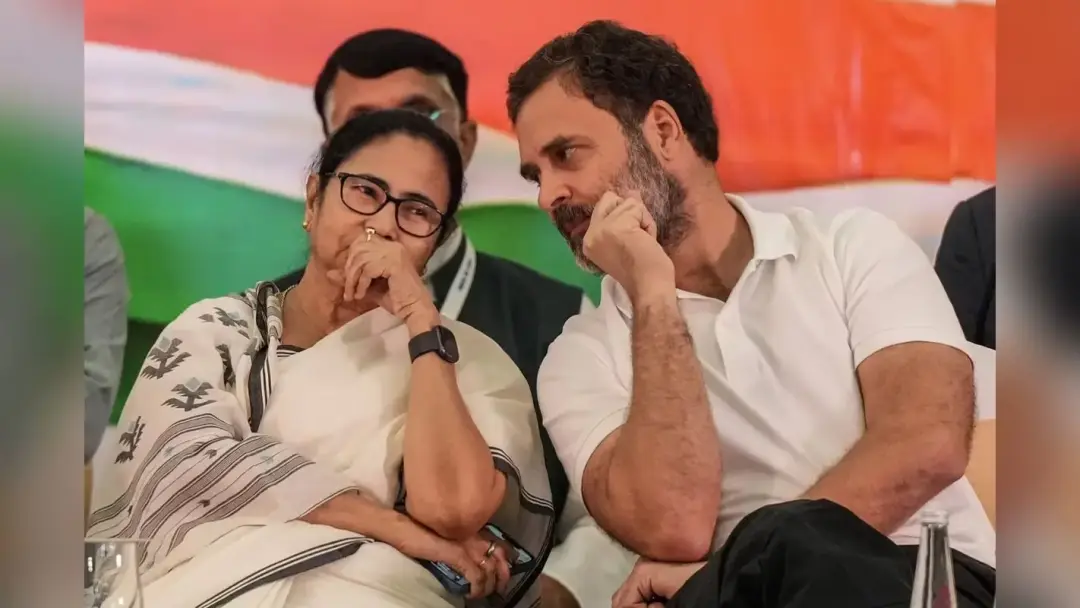
Mamata has no objection to Rahul as PM, say sources
West Bengal Chief Minister Mamata Banerjee told an INDIA alliance meeting that she has no objection to Rahul Gandhi becoming Prime Minister, sources said. According to them, she said Congress could get the PM post, that she had no ego on the matter, and that the decision must be taken with everyone's consent. Congress president Mallikarjun Kharge responded that the party was not fighting for the PM post or power but wanted to save the country and democracy.
Source
Politics · read the original report ↗
Desk check · some claims need care
What the desk checked (5)
- Mamata Banerjee said she has no objection to Rahul Gandhi becoming Prime Minister and that Congress can get the PM post, with a decision by consensus — Attributed in source only to unnamed 'sources' from an INDIA alliance meeting at the Constitution Club; no on-record confirmation given
- Congress president Mallikarjun Kharge said Congress is not fighting for the PM post or power but to save the country and democracy — Direct quote attributed to Kharge in the source; no venue or date specified
- Trinamool had earlier objected to Rahul Gandhi being projected as the PM face before the Lok Sabha elections, and Abhishek Banerjee questioned Rahul's political ability during SIR — Stated as background by the source without specific documentation or dates
- Rahul Gandhi backed Mamata's vote-rigging allegations citing an incident of an EVM being burnt in south Kolkata — Figure/incident appears in source as reported context; not independently verifiable here
- Uddhav Thackeray alleged an attempt to split Trinamool, comparing it to the split in his party — Direct quote attributed to Thackeray in the source
Analysts’ view opinion
Mamata Banerjee's apparent softening looks generous, but it is better read as a strategic adjustment born of her own political needs. The party that once objected strongly to Congress dominance and to Rahul Gandhi being projected as the prime ministerial face is now the party that needs opposition solidarity over the SIR and voter-roll grievances in Bengal. By attaching the condition of "consensus among all", she concedes nothing concrete while keeping veto-like leverage over the final call — and Kharge's reply, shifting the frame from the post to "country and democracy", is equally deft.
- A party whose leadership had publicly questioned Rahul Gandhi's political capability now saying it has no objection signals a tactical recalibration, not a conversion.
- The "decision by everyone's consensus" formula lets Mamata appear accommodating while retaining bargaining power over any announcement.
- Trinamool currently needs the sympathy of Rahul and other opposition leaders on the SIR and alleged polling irregularities in Bengal — the quid pro quo is visible.
- Kharge's line that Congress is not fighting for the PM post or power is designed to position the party as a defender of democracy rather than a claimant to office.
- Rahul's Kerala reference — rivals in the state, allies in Delhi — is a reminder to regional partners that national arithmetic must override local hostility.
What to watch — Watch whether Mamata or Abhishek Banerjee confirms this stance publicly, and whether the alliance sets any formal process or timeline for deciding a prime ministerial face.
The remarks rest on unnamed sources; the story does not establish on-record confirmation from Mamata, any formal alliance decision, or that Rahul Gandhi has been declared the opposition's PM candidate.
Deep dive
Research brief · 8 facts · 4 dates · exam-readyThe brief
Context
Ahead of national elections, the opposition INDIA alliance met at the Constitution Club in Delhi to discuss joint strategy. At that meeting, sources say, West Bengal Chief Minister and Trinamool Congress chief Mamata Banerjee said she had no objection to Rahul Gandhi becoming Prime Minister and that the Congress could get the PM's post, provided the decision was taken with everyone's consent. This marks a shift from Trinamool's earlier stance, when it strongly objected to Congress dominance in the alliance and to projecting Rahul Gandhi as the PM face, arguing Mamata was better placed to take on Narendra Modi. The meeting also discussed allegations of voter-roll manipulation and the SIR exercise in West Bengal.
Key facts
- Sources say Mamata Banerjee told the INDIA alliance meeting at the Constitution Club: "Congress can get the Prime Minister's post. I have no ego on this matter. We just have to take the decision with everyone's consent."
- Congress president Mallikarjun Kharge responded that the Congress is not fighting for the PM post or for power, but wants to save the country and democracy.
- Before the Lok Sabha election, Trinamool had strongly objected to Congress's dominance in the alliance and to Rahul Gandhi being projected as the PM face.
- Trinamool leadership had claimed Mamata Banerjee was far ahead of Rahul Gandhi in administrative experience, political struggle and national popularity.
- Abhishek Banerjee had questioned Rahul Gandhi's political capability and foresight during the SIR exercise.
- Rahul Gandhi backed Mamata's allegations of vote rigging in Bengal, citing an incident of an EVM being burnt in fire in south Kolkata.
- In the meeting Rahul Gandhi cited Kerala, where Congress and the Left fight each other while being united in Delhi, to argue for a broad national strategy.
- Shiv Sena (UBT) leader Uddhav Thackeray alleged that the conspiracy used to split his party is now being used against the Trinamool Congress; Omar Abdullah spoke for about four minutes on West Bengal's political situation.
Timeline
- Early days of the alliance's formationTrinamool's stance was that if Mamata Banerjee is to take on Narendra Modi, she must be the main face.
- Before the Lok Sabha electionTrinamool objected strongly to Congress's monopoly in the alliance and to Rahul Gandhi as the PM face.
- During the SIR exerciseAbhishek Banerjee questioned Rahul Gandhi's political capability and foresight.
- At the INDIA alliance Constitution Club meeting (date not stated in the source)Mamata said she had no objection to Rahul as PM; Kharge said Congress is not fighting for power; Rahul urged a broad national strategy.
Who has a stake
- Mamata Banerjee / Trinamool Congress — Seeking opposition sympathy over SIR and alleged vote rigging in Bengal and over claims of attempts to split her party; softening her earlier stand on the PM face.
- Rahul Gandhi — Named as an acceptable PM option by Mamata; pushing a broad national opposition strategy despite state-level rivalries.
- Mallikarjun Kharge / Congress — Publicly positioning the party as fighting to save the country and democracy rather than for the PM post or power.
- Abhishek Banerjee — Had publicly questioned Rahul Gandhi's political ability, now at odds with Mamata's conciliatory line.
- Uddhav Thackeray (Shiv Sena UBT) — Alleges the same conspiracy that split his party is being used against Trinamool.
- Omar Abdullah — Spoke at length on West Bengal's overall political situation, signalling regional parties' concern over electoral processes.
Why it matters
Leadership of the opposition bloc has been the INDIA alliance's most divisive question, and Mamata Banerjee's apparent concession on the PM post signals a possible recalibration of the Congress-regional party balance. At the same time, the meeting's focus on SIR, alleged vote rigging and attempts to split parties shows that opposition unity is now being built around electoral-process grievances rather than a declared leader.
UPSC angle
Prelims pointers
- Mamata Banerjee is West Bengal Chief Minister and Trinamool Congress chief; Mallikarjun Kharge is Congress president.
- The INDIA alliance meeting referred to in the story was held at the Constitution Club.
- Rahul Gandhi cited Kerala, where Congress and Left parties oppose each other while allying in Delhi, as an example of opposition contradictions.
- SIR-related disputes and allegations of vote rigging in West Bengal were raised by opposition parties at the meeting.
- Rahul Gandhi referred to an EVM being burnt in a fire in south Kolkata while backing Mamata's rigging allegations.
- Uddhav Thackeray leads the Shiv Sena (UBT) faction; Omar Abdullah also spoke on West Bengal at the meeting.
Mains framing
The INDIA alliance's recurring fault line has been the question of leadership: regional parties with strong state bases, such as the Trinamool Congress, have resisted Congress's claim to primacy, while Congress argues that only a national framework can take on the ruling party. Mamata Banerjee's reported statement that Congress could get the PM's post, with no ego on her part and subject to everyone's consent, suggests that pressure from state-level developments — the SIR exercise in West Bengal, allegations of voter-roll manipulation and claims of engineered splits in opposition parties — is pushing regional leaders towards accommodation in search of national solidarity. Kharge's framing of the Congress's fight as one to save the country and democracy rather than for power is an attempt to defuse the leadership contest altogether. Rahul Gandhi's Kerala example underlines the structural problem: parties that are allies nationally are rivals in states, which weakens credibility with voters. The way forward, as articulated in the meeting itself, lies in a broad, agreed national strategy with consensus-based decisions on seat-sharing and leadership, and a united response to disputes over electoral processes, rather than public contests over the prime ministerial face.
Key terms
- INDIA alliance
- The opposition bloc of Congress and regional parties whose meeting at the Constitution Club discussed strategy and leadership.
- Trinamool Congress (TMC)
- Mamata Banerjee's party, ruling in West Bengal, earlier opposed to Rahul Gandhi being projected as PM face.
- SIR
- The electoral roll exercise in West Bengal referred to in the source, around which opposition parties raised objections; details not stated in the source.
- EVM
- Electronic Voting Machine; Rahul Gandhi cited one burnt in a fire in south Kolkata to support rigging allegations.
- Shiv Sena (UBT)
- The Uddhav Thackeray faction of the Shiv Sena, which alleges its party was split by conspiracy.
Practice questions
- Leadership ambiguity has been both a strength and a weakness for India's opposition coalitions. Discuss with reference to the INDIA alliance.
- How do contradictions between state-level rivalry and national alliance-building affect coalition politics in India? Illustrate with examples from the story.
- Examine how disputes over electoral rolls and voting processes are shaping opposition unity in contemporary Indian politics.
Grounded only in the source report — figures and dates are the source's, not inferred.