
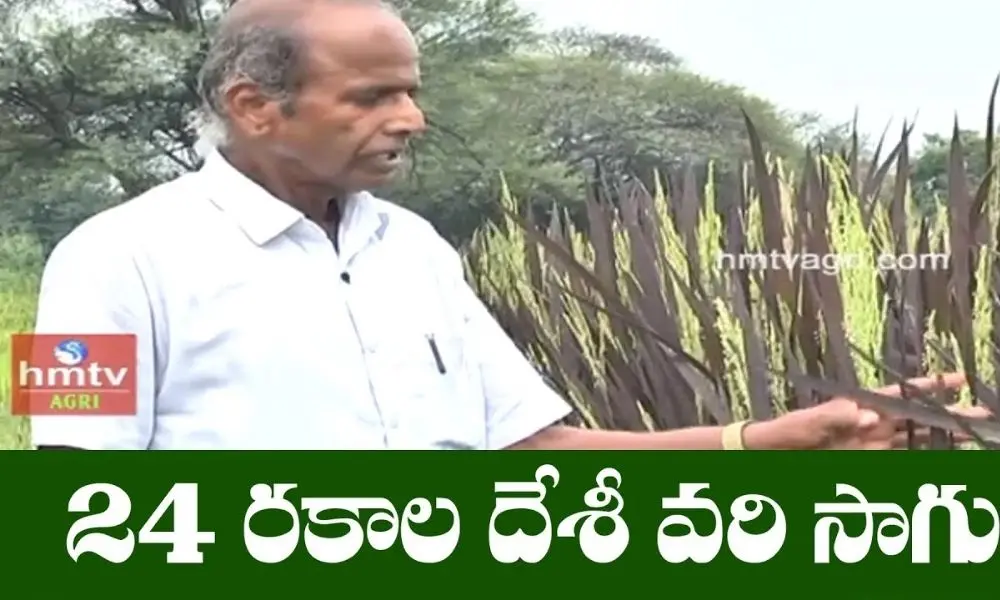
Nizamabad farmer grows 24 indigenous paddy varieties on three acres
Chinni Krishna, also known as Gangaram, of Chintal village in Telangana's Nizamabad district is cultivating 24 indigenous paddy varieties on his three acres of land. From a farming family, he collects traditional seed varieties and revives them on his own field, and has gathered more than 100 varieties so far. The crop shows green, red, black and brown shades. He also grows foreign paddy varieties and aims to cultivate 110 varieties.
Source
Krishna — వ్యవసాయం · read the original report ↗
Desk check · compared with the source
What the desk checked (5)
- Chinni Krishna alias Gangaram of Chintal village, Nizamabad district, grows 24 indigenous paddy varieties on three acres — Figure appears in source; based on the reporter's field account, no official verification cited.
- He has collected more than 100 traditional paddy varieties — Stated in source without documentary attribution.
- He aims to cultivate 110 paddy varieties — Presented in source as the farmer's stated goal; no source given.
- The crop appears in green, red, black and brown shades in his field — Descriptive observation by the reporter; not independently verifiable.
- He also cultivates foreign paddy varieties — Mentioned in source without details or attribution.
Analysts’ view opinion
Growing 24 traditional paddy varieties on three acres is more than a feel-good story — economically it is a low-cost private investment in seed diversity. A typical farmer optimises for yield from one high-performing variety; here the asset being built is variety and a seed stock, not tonnage. But the story gives no costs, yields or returns, and that gap is exactly what decides whether this model can scale beyond one field.
- Splitting three acres into many micro-plots reduces economies of scale in mechanisation, single-window harvesting and milling, and likely raises labour cost per quintal.
- Against that, staggered maturities and genetic variety spread weather and pest risk — effectively a form of self-insurance for a smallholder.
- Coloured rices such as red and black varieties can command premium prices in urban health-food segments, but capturing that premium needs direct marketing rather than the standard mandi chain.
- A collection of over a hundred varieties has long-term seed-bank value whose benefit spills over to other farmers later — a public good produced privately.
- Right now the farmer carries the full cost; without research-institution support, procurement assurance or a buyer network, such experiments tend to stay hobby-scale.
What to watch — As he moves toward the 110-variety goal, watch whether steady buyers, a price premium or seed-sale income emerge — that is what separates a hobby from a viable business model.
The story establishes no figures on yield, input cost, income, prices or market linkages, so it does not show whether this cultivation is financially profitable.
Deep dive
Research brief · 8 facts · 3 dates · exam-readyThe brief
Context
Indigenous (desi) paddy landraces have largely disappeared from Indian fields as high-yielding varieties spread, and their conservation now depends heavily on individual seed-saving farmers. In Chintal village of Telangana's Nizamabad district, a farmer named Chinni Krishna, also called Gangaram, has turned his three acres into what the source describes as a laboratory for paddy experiments. Raised in a farming family, he collects old seed varieties and revives them on his own plot, and is described as having become a "farmer-scientist". He is currently growing 24 indigenous paddy varieties and also cultivates foreign varieties.
Key facts
- Chinni Krishna alias Gangaram of Chintal village, Nizamabad district, Telangana, is cultivating 24 indigenous paddy varieties on three acres.
- He has collected more than 100 paddy varieties (vangadalu) so far, according to the source.
- His stated target is to cultivate 110 paddy varieties.
- The field shows green, red, black and brown shades, described in the source as 'saptavarna' (multi-hued).
- Besides indigenous landraces, he also grows foreign paddy varieties.
- He began as an ordinary farmer and turned his three-acre paddy plot into an experimental platform, earning the description 'farmer-scientist'.
- The report was published on 26 October 2020.
- Details of the specific varieties, their yields and cultivation methods are not stated in the source text.
Timeline
- Since childhoodChinni Krishna grows up in a farming family background and takes to experiments in paddy.
- Over timeHe makes a habit of collecting old paddy varieties and reviving them on his own field, gathering over 100 varieties.
- 26 October 2020 (publication date)He is reported cultivating 24 indigenous paddy varieties on three acres, with a goal of 110 varieties.
Who has a stake
- Chinni Krishna alias Gangaram, farmer of Chintal — Invests his three acres in conserving and reviving traditional paddy seed instead of conventional single-variety cultivation.
- Farmers of Nizamabad district and Telangana — A potential local source of traditional seed and of demonstration on growing multiple varieties on small holdings.
- Seed conservation and agricultural research community — On-farm revival of over 100 landraces preserves genetic diversity that formal gene banks alone may not sustain.
- Consumers seeking traditional rice — Availability of coloured and traditional rice types such as red, black and brown grained paddy.
Why it matters
Indigenous paddy landraces carry traits such as varied grain colour and local adaptation, and once lost they are hard to recover; a single farmer maintaining over 100 collected varieties is doing in-situ conservation on a working field. It shows that even a three-acre holding can host wide varietal diversity rather than a single high-yielding variety. Such farmer-led seed saving supplies both genetic material and a working model for diversified cultivation.
UPSC angle
Prelims pointers
- Chintal village, Nizamabad district, Telangana — site of the 24-variety indigenous paddy farm.
- Farmer Chinni Krishna alias Gangaram: over 100 paddy varieties collected; 24 in cultivation; target 110.
- Paddy grain/plant shades reported: green, red, black and brown.
- Landrace or desi variety ('vangadam') = traditional, locally evolved crop variety, distinct from modern high-yielding varieties.
- In-situ or on-farm conservation means maintaining varieties in cultivation, as against gene-bank storage.
- Report date: 26 October 2020.
Mains framing
The Nizamabad case illustrates how the erosion of crop genetic diversity — driven by the spread of a few high-yielding paddy varieties — is being resisted at the margins by individual seed savers rather than by formal systems alone. Chinni Krishna's three-acre plot, hosting 24 indigenous varieties out of more than 100 collected and with a target of 110, functions simultaneously as a live seed bank, a demonstration plot and an informal research station, with coloured grain types (red, black, brown) pointing to traits and niche demand that mainstream cultivation has ignored. The implications are threefold: genetic insurance against pest, disease and climate shocks; potential premium markets for traditional rice; and a decentralised seed supply independent of commercial channels. The limits are equally clear from the source, which does not report yields, prices, institutional support or scientific validation — indicating that such efforts remain individual and risk-bearing. A way forward consistent with the story would be to link such farmer-conservators to recognition and seed-multiplication networks so that revived varieties move from a single field to many, while documenting each variety's performance rather than leaving the knowledge with one cultivator.
Key terms
- Desi vangadam (indigenous variety)
- A traditional, locally evolved crop variety maintained by farmers, as opposed to a modern bred variety.
- Seed collection and revival
- The practice, followed here, of gathering old seed lots and growing them out on-farm to restore viable quantities.
- Farmer-scientist
- Term used in the source for a cultivator who runs systematic experiments on his own field, as Chinni Krishna does.
- Coloured rice
- Paddy types with red, black or brown grain/plant colour, seen in the reported field alongside green.
- Nizamabad district
- Telangana district where Chintal village and the 24-variety paddy farm are located.
Practice questions
- Farmer-led seed conservation is increasingly filling the gap left by formal agro-biodiversity institutions. Discuss with reference to indigenous paddy cultivation in Telangana.
- What are the agronomic and economic arguments for reviving indigenous paddy landraces, and what constraints do individual conservator-farmers face?
- Examine how in-situ, on-farm conservation of crop varieties differs from ex-situ gene-bank conservation, and why both are needed.
Grounded only in the source report — figures and dates are the source's, not inferred.