
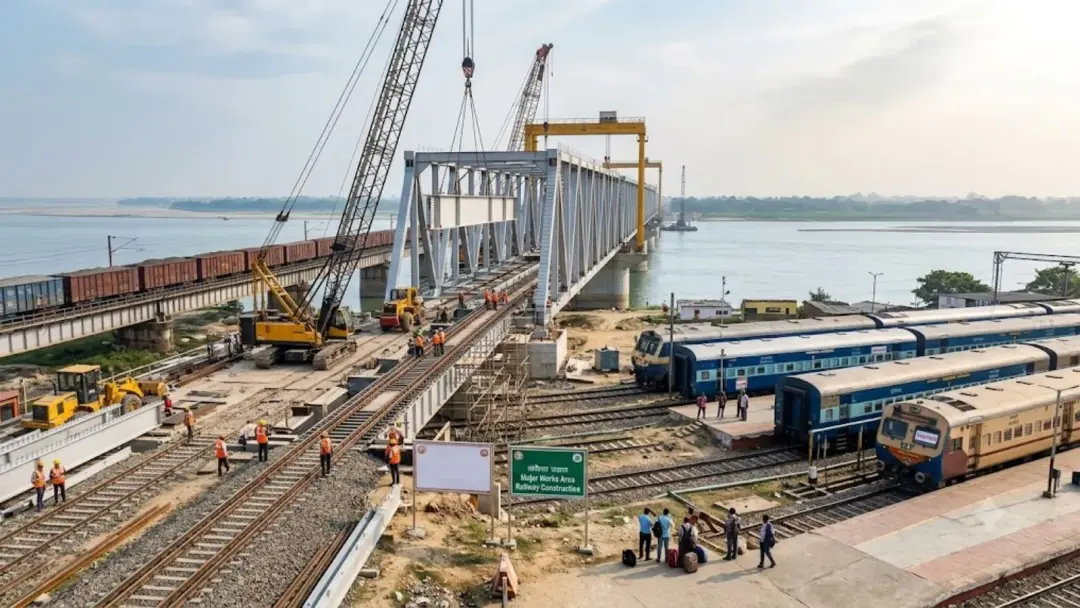
51 trains cancelled for new rail bridge work at Mokama
Indian Railways has cancelled 51 Bihar-bound trains, diverted 47 and short-terminated or short-originated 11 due to non-interlocking works at Rajendra Pul near Mokama in Bihar. East Central Railway CPRO Saraswati Chandra said the work is for commissioning a new rail bridge parallel to the existing Rajendra Bridge over the Ganga. The existing 1.9-km rail-cum-road bridge, in service since 1959, carries a single line. The new double-line bridge was approved in the 2015-16 Rail Budget at an estimated Rs 1,491.47 crore.
Source
Indian Express — India · read the original report ↗
Desk check · compared with the source
What the desk checked (5)
- 51 Bihar-bound trains cancelled, 47 diverted and 11 short-terminated/short-originated due to non-interlocking works at Rajendra Pul. — Figures appear in source and are backed by attached East Central Railway lists.
- Work is for commissioning a new rail bridge parallel to the existing Rajendra Bridge over the Ganga near Mokama. — Attributed to ECR CPRO Saraswati Chandra.
- The new double-line bridge was approved in the 2015-16 Rail Budget at an estimated cost of Rs 1,491.47 crore. — Direct quote attributed to CPRO Saraswati Chandra.
- The existing Rajendra Bridge is a 1.9-km rail-cum-road bridge in service since 1959 and carries a single railway line. — Attributed to the CPRO; no independent documentation cited.
- Cancellation lists are dated 24-26 September 2026. — Dates in the tables conflict with the article's 'today' framing; internal inconsistency an editor should check.
Analysts’ view opinion
The cancellation of 51 trains and diversion of 47 more for the parallel bridge work at Rajendra Pul near Mokama is a technical railway decision, but in Bihar rail travel is close to a livelihood issue, so a political frame is unavoidable. For the government side it is an infrastructure success story — moving from a single-line 1959 bridge to a new double-line crossing; for critics it is a reminder that a project sanctioned back in the 2015-16 Rail Budget is only now reaching commissioning. Which narrative sticks will depend on how quickly short-term passenger pain converts into visible gain.
- Replacing a single-line bridge in service since 1959 with a Rs 1,491.47 crore double-line structure gives incumbents a concrete, showable infrastructure outcome.
- Equally, the fact that a project approved in the 2015-16 Rail Budget is only being commissioned now offers the opposition a natural line of attack on delivery timelines.
- Because the cancelled list spans Howrah, Kolkata, Delhi, Patna, Jaynagar and Bhagalpur routes, the disruption reaches migrant workers and neighbouring-state passengers, not just Bihar residents.
- Skipped stoppages at places like Mokama, Barh and Barauni and the axing of MEMU passenger services put pressure on local representatives, since daily commuters absorb the worst of it.
- The railways framing this as pre-planned, safety-driven non-interlocking work is a useful technical shield that blunts some of the political criticism.
What to watch — Watch when and by whom the new bridge is formally commissioned, and whether local leaders and opposition figures turn passenger inconvenience into public statements.
The story records no political reaction, no electoral context and no date for the new bridge's opening — the political reading here is analysis, not reported fact.
Deep dive
Research brief · 8 facts · 5 dates · exam-readyThe brief
Context
Indian Railways is carrying out pre-non-interlocking and non-interlocking (NI) works at Rajendra Pul near Mokama in Bihar to commission a new rail bridge built parallel to the existing Rajendra Bridge over the Ganga. The existing 1.9-km rail-cum-road bridge, in service since 1959, links Mokama and Barauni but carries only a single railway line that cannot be doubled due to technical limitations. Signalling and interlocking changes of this kind require large-scale traffic blocks, so services on a busy Bihar corridor have been disrupted. East Central Railway has accordingly cancelled 51 trains, diverted 47 and short-terminated or short-originated 11.
Key facts
- Indian Railways cancelled 51 Bihar-bound trains, diverted 47 and short-terminated/short-originated 11 due to non-interlocking works at Rajendra Pul.
- The works are for commissioning a new rail bridge built parallel to the existing Rajendra Bridge over the Ganga near Mokama.
- The existing Rajendra Bridge is a 1.9-km rail-cum-road bridge connecting Mokama and Barauni, in service since 1959.
- The existing bridge carries only a single railway line and cannot be doubled due to technical limitations, as per ECR CPRO Saraswati Chandra.
- The parallel double-line bridge was approved in the 2015-16 Rail Budget at an estimated cost of Rs 1,491.47 crore.
- The new bridge will connect the existing network at Upper Hathidah Junction, Tal Junction, Rampur Dumra, Dinkar Gram Simaria and Barauni Junction.
- Pre-NI and NI works were planned at Rajendra Pul, Hathidah Junction Upper, TAL and Rampur Dumra in Danapur Division, and Dinkar Gram Simaria in Sonepur Division.
- Short-termination/origination list covers 11 trains dated 26-09-2026, with services regulated at Mokama, Barauni, Kiul, Hajipur and Sonpur-area points.
Timeline
- 1959The existing Rajendra Bridge, a 1.9-km rail-cum-road bridge over the Ganga between Mokama and Barauni, is put into service.
- 2015-16 Rail BudgetIndian Railways approves a parallel double-line rail bridge at an estimated cost of Rs 1,491.47 crore.
- 24-09-2026Cancellation list begins with train 17005 Hyderabad-Raxaul Express (date of origin at source).
- 25-09-2026Several trains cancelled and diverted, including Ganga Sagar Express, Patna-Malda Town Express and Amritsar-Howrah Mail.
- 26-09-2026Bulk of cancellations, 47 diversions and 11 short-termination/short-origination cases take effect due to NI work at Rajendra Pul.
Who has a stake
- East Central Railway (ECR) — Executing the pre-NI and NI works and regulating traffic; its CPRO Saraswati Chandra is the official voice on the disruption.
- Passengers on Bihar-bound routes — 51 cancellations, 47 diversions and 11 short-terminations disrupt travel to and from Patna, Jaynagar, Barauni, Bhagalpur and Howrah.
- Danapur and Sonepur Divisions — Host the affected locations - Rajendra Pul, Hathidah Junction Upper, TAL, Rampur Dumra (Danapur) and Dinkar Gram Simaria (Sonepur).
- Indian Railways — Rs 1,491.47 crore investment in a double-line bridge to remove the single-line bottleneck over the Ganga.
- Mokama and Barauni region — Stoppages skipped at Mokama and other stations now; better rail connectivity once the double-line bridge is commissioned.
Why it matters
The Rajendra Bridge has been a single-line choke point on the Ganga crossing between Mokama and Barauni since 1959, constraining train movement across north and south Bihar. Commissioning a parallel double-line bridge removes that bottleneck, but the signalling changeover requires a one-time hit of 51 cancellations, 47 diversions and 11 short-terminations. The episode shows how capacity addition on a saturated network comes with short-term passenger disruption.
UPSC angle
Prelims pointers
- Rajendra Bridge: 1.9-km rail-cum-road bridge over the Ganga connecting Mokama and Barauni, in service since 1959.
- Parallel double-line rail bridge at Rajendra Pul approved in the 2015-16 Rail Budget; estimated cost Rs 1,491.47 crore.
- Non-interlocking (NI) work at Rajendra Pul led to 51 cancellations, 47 diversions, 11 short-terminations/originations.
- New bridge will link Upper Hathidah Jn, Tal Jn, Rampur Dumra, Dinkar Gram Simaria and Barauni Jn.
- Affected zone: East Central Railway; affected divisions: Danapur and Sonepur.
- ECR Chief Public Relations Officer named in the story: Saraswati Chandra.
Mains framing
The Mokama disruption illustrates the trade-off between capacity creation and service reliability on India's most congested rail corridors. The 1959 Rajendra Bridge over the Ganga carries only a single railway line and, as ECR states, cannot be doubled due to technical limitations, which made a parallel double-line structure - approved in the 2015-16 Rail Budget at Rs 1,491.47 crore - the only route to higher throughput. Commissioning such an asset requires pre-NI and NI works, that is, rewiring signalling and interlocking at Rajendra Pul, Hathidah Junction Upper, TAL, Rampur Dumra and Dinkar Gram Simaria, which in turn demands traffic blocks: hence 51 cancellations, 47 diversions and 11 short-terminations or short-originations, with stoppages skipped at Mokama, Barah, Patna and other stations. The implications are immediate for passengers on Howrah, Delhi, Patna and Jaynagar-bound services, and structural for Bihar's north-south connectivity once the double line is live. The way forward, on the evidence in the source, lies in advance public notification through the zonal railway, clustering of pre-NI and NI blocks to minimise repeat disruption, and full use of the new bridge's linkages to Barauni Junction so the long project gestation from 2015-16 translates into durable capacity gains.
Key terms
- Non-interlocking (NI) work
- Railway work in which existing signalling and interlocking arrangements are modified or replaced to bring new tracks or bridges into the system, requiring traffic blocks.
- Pre-NI work
- Preparatory works carried out before the main non-interlocking changeover, planned here at Rajendra Pul, Hathidah Jn Upper, TAL, Rampur Dumra and Dinkar Gram Simaria.
- Short-termination / short-origination
- A train ending its run short of its scheduled destination, or starting from a station short of its scheduled origin; 11 such cases were notified for 26-09-2026.
- Rajendra Pul / Rajendra Bridge
- The 1.9-km rail-cum-road bridge over the Ganga linking Mokama and Barauni, in service since 1959 with a single railway line.
- East Central Railway (ECR)
- The Indian Railways zone handling this stretch; Danapur and Sonepur are the divisions where the affected locations lie.
- Stoppage skip chart
- An ECR notification listing trains whose scheduled halts at specified stations are skipped during NI works for safety reasons.
Practice questions
- Discuss how capacity bottlenecks on legacy rail bridges affect regional connectivity, using the Rajendra Bridge at Mokama as a case study.
- What are non-interlocking works in Indian Railways, and why do they require large-scale cancellation and diversion of trains? Explain with reference to the Rajendra Pul works.
- Examine the reasons for long gestation periods in Indian Railways infrastructure projects, referring to the parallel Ganga rail bridge approved in the 2015-16 Rail Budget.
Grounded only in the source report — figures and dates are the source's, not inferred.