
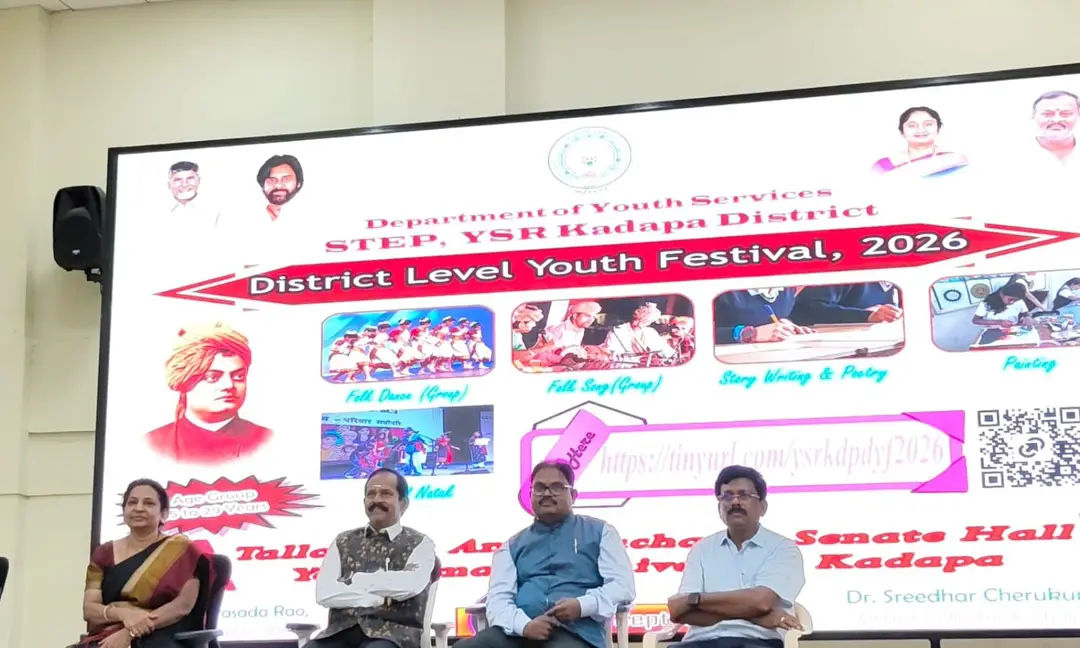
Kadapa district-level youth festival concludes at Yogi Vemana University
The district-level youth festival held under the state government's STEP programme at the Annamayya Seminar Hall of Yogi Vemana University concluded on Wednesday evening. Chief guest Dr Pasupuleti Shankar, Mydukur Special Judicial Second Class Magistrate, said art alone has the power to delight the mind and such festivals help identify rural talent. YVU Rector Prof Damu, former Registrar Prof Padma, STEP CEO Prasada Rao and Manager Subbarayudu spoke. Certificates and mementoes went to youths selected for state-level contests. Judges Sumana, Vijayabharathi, Padma, Riyazunnisa and Mrutyunjaya Rao were honoured. Nearly 300 youths participated.
Source
YSR Kadapa — వార్తలు · read the original report ↗
Desk check · compared with the source
What the desk checked (5)
- District-level youth festival concluded Wednesday evening at Annamayya Seminar Hall, Yogi Vemana University, under the state government's STEP programme. — Stated in source as event reporting; no external document cited.
- Special Judicial Second Class Magistrate Dr Pasupuleti Shankar attended as chief guest and said art alone has the power to delight the mind. — Attributed directly to the named magistrate in the source.
- Nearly 300 youths from across the district took part. — Approximate figure appears in the source; no source given for the count.
- YVU Rector Prof Damu, former Registrar Prof Padma, STEP CEO Prasada Rao and Manager Subbarayudu spoke at the event. — Names and designations appear in the source; remarks attributed.
- Certificates and mementoes were given to youths selected for state-level competitions, and five judges were honoured. — Stated in source with judges named; internally consistent.
Analysts’ view opinion
On the surface this is a routine cultural event; read politically, it is a state-government platform — ‘STEP’ — reaching young people directly at district level. In a politically sensitive district like Kadapa, gathering around 300 young participants on one stage and using a university campus adds to the visible footprint of government programmes. At the same time, the story mentions no elected representatives: a judicial officer as chief guest and university officials on stage give the event an administrative, non-partisan face.
- The district–state–national ladder gives a government scheme sustained visibility, a conventional political dividend in youth-focused policy.
- Having a judicial officer rather than an elected leader as chief guest keeps the event framed as administration rather than a party platform.
- The ‘recognising rural talent’ framing sits naturally alongside government messaging aimed at rural voters.
- Using Yogi Vemana University as the venue reflects educational institutions increasingly acting as delivery partners for state programmes — a point opposition voices commonly question.
- Reading broad political consequence into a single district event would be overreach; this is one step in an institutional process.
What to watch — Watch whether ministers and elected representatives take a more prominent role at the state-level stage, and how far STEP events become folded into government publicity.
The story establishes nothing about party involvement, funding or political intent; it is an event report, and this reading is inference, not reporting.
Deep dive
Research brief · 8 facts · 3 dates · exam-readyThe brief
Context
A district-level youth festival (yuvajanotsavalu) for Kadapa district was held at the Annamayya Seminar Hall of Yogi Vemana University (YVU) in Kadapa under the Andhra Pradesh government's STEP programme. The festival is a talent-scouting platform in which winners at the district level advance to state-level competitions and, from there, to the national level. The closing ceremony took place on Wednesday evening, with certificates and mementoes given to those selected for the state round. The source does not state the full form of STEP or the exact calendar dates of the festival.
Key facts
- The district-level youth festival was organised under the state government's STEP programme at YVU's Annamayya Seminar Hall in Kadapa city.
- The closing ceremony was held on Wednesday evening and ended with the singing of the national anthem.
- Nearly 300 young men and women from all parts of the district took part.
- Chief guest was Dr Pasupuleti Shankar, Mydukur Special Judicial Second Class Magistrate, who said art alone has the power to delight the mind.
- Dr Shankar said such festivals help identify rural youth with talent across varied fields, and that cultural participation alongside studies boosts mental cheer.
- YVU Rector Prof Damu urged youth to make good use of such opportunities; former Registrar Prof Padma asked state-level qualifiers to understand the rules there and reach the national level.
- STEP CEO Prasada Rao and Manager Subbarayudu were among those who spoke at the meeting.
- Certificates and mementoes were given by the chief guest to youths selected for state-level contests; judges Sumana, Vijayabharathi, Padma, Riyazunnisa and Mrutyunjaya Rao were honoured by STEP officials and staff.
Timeline
- Before the closing day (dates not stated in the source)District-level youth festival competitions held at YVU's Annamayya Seminar Hall under the STEP programme, with judges assessing entries.
- Wednesday eveningClosing ceremony: speeches, certificates and mementoes to state-level selectees, felicitation of judges, and national anthem.
- Next stage (date not stated in the source)Selected youths to compete at the state level, with further progression to the national level.
Who has a stake
- Nearly 300 participating youths of Kadapa district — A platform to showcase talent and win selection to state and national level competitions.
- STEP programme (state government), CEO Prasada Rao and Manager Subbarayudu — Organising and running the youth festival and identifying talent for higher levels.
- Yogi Vemana University, Rector Prof Damu, former Registrar Prof Padma — Hosting venue and guidance; linking higher education with cultural activity.
- Dr Pasupuleti Shankar, Mydukur Special Judicial Second Class Magistrate — Chief guest; distributed certificates and mementoes and advocated cultural participation by students.
- Judges Sumana, Vijayabharathi, Padma, Riyazunnisa, Mrutyunjaya Rao — Evaluated the competitions and were felicitated for their role.
- Rural youth of the district — Chance to be identified and promoted beyond the district, as highlighted by the chief guest.
Why it matters
Youth festivals of this kind are one of the few structured channels through which talent from rural mandals can be spotted and pushed up to state and national platforms. By routing the event through the government's STEP programme and a state university campus, the administration links cultural activity with education and youth development, which speakers said also improves students' mental well-being.
UPSC angle
Prelims pointers
- Venue: Annamayya Seminar Hall, Yogi Vemana University (YVU), Kadapa.
- Organising framework: state government's STEP programme; CEO Prasada Rao, Manager Subbarayudu.
- Chief guest: Dr Pasupuleti Shankar, Mydukur Special Judicial Second Class Magistrate.
- Participation: nearly 300 youths from across Kadapa district; event closed Wednesday evening with the national anthem.
- Progression ladder: district level to state level to national level competitions.
- YVU office-bearers present: Rector Prof Damu; former Registrar Prof Padma.
Mains framing
District youth festivals such as the Kadapa event under the state's STEP programme illustrate how cultural policy can be used as an instrument of youth development: by holding the competitions on a state university campus and creating a district-state-national progression, the government builds a visible pathway for talent that would otherwise remain unidentified in rural mandals. Speakers framed the rationale in two ways — equity (spotting rural youth with ability across varied fields) and well-being (cultural participation alongside academics improving mental cheer) — while the former Registrar pointed to a practical gap, namely that qualifiers must first understand the rules and norms of the higher-level contests if they are to convert selection into success. The implication is that the value of such festivals depends less on the event itself than on the follow-through: coaching, information on state and national procedures, travel and logistical support, and sustained mentoring for the selected participants. A way forward consistent with what the source records would be to institutionalise this handholding for state-level selectees, keep university campuses engaged as venues and knowledge partners, and ensure outreach reaches all corners of the district, as the participation of nearly 300 youths from across Kadapa suggests is possible.
Key terms
- STEP
- The state government programme under whose aegis the district-level youth festival was organised; full form not stated in the source.
- Yogi Vemana University (YVU)
- State university in Kadapa; its Annamayya Seminar Hall hosted the festival and its Rector addressed the closing ceremony.
- District-level youth festival (Yuvajanotsavalu)
- Competitive cultural festival for youths at district level, feeding winners into state and then national level contests.
- Special Judicial Second Class Magistrate
- A judicial officer post; Dr Pasupuleti Shankar holds it at Mydukur and was the festival's chief guest.
- Rector
- Senior university functionary; Prof Damu, YVU Rector, urged youth to use such opportunities well.
Practice questions
- How do district-level youth festivals help in identifying and nurturing talent from rural areas? Discuss with reference to the Kadapa festival held under the STEP programme.
- Examine the role of state universities as venues and partners in government youth and cultural development programmes.
- "Participation in cultural activities alongside academics improves students' mental well-being." Critically assess this claim in the context of youth development policy.
Grounded only in the source report — figures and dates are the source's, not inferred.