
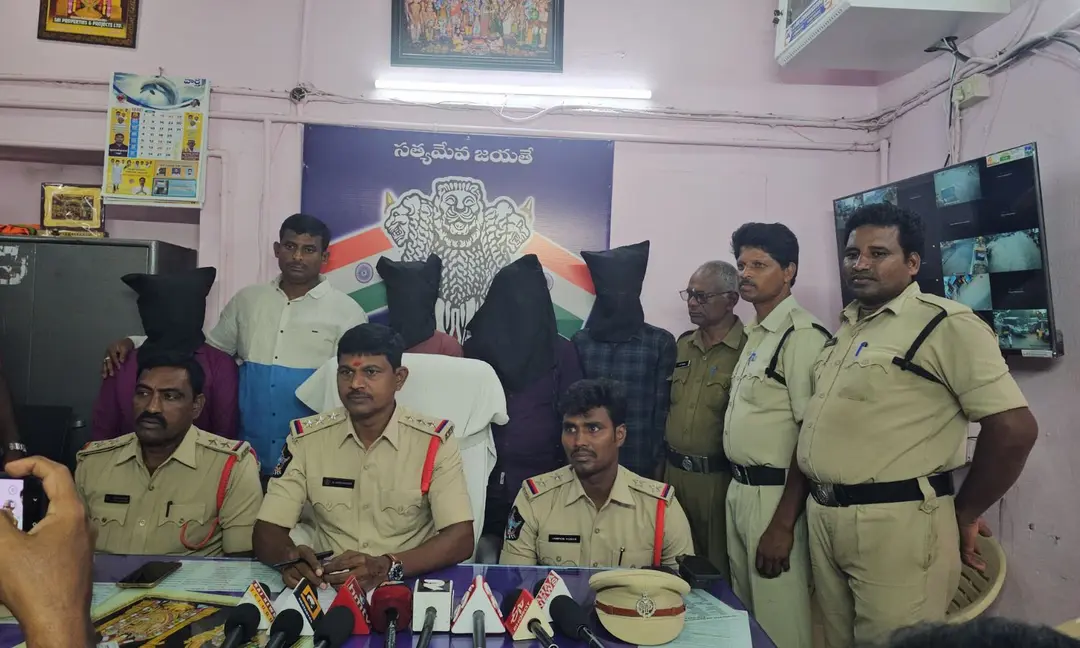
Four held for stealing copper wires from transformers in Atmakur
Police have arrested four people accused of stealing copper winding wires from electricity transformers within the Atmakur police station limits in Nellore district. Acting on prior information, police mounted surveillance and caught the accused red-handed while they were damaging a transformer and removing wires in farm fields at Nabbinagaram in Atmakur mandal. Police found the group had committed 19 thefts in the Atmakur sub-division. Wires worth Rs 2.31 lakh were seized. Atmakur CI Gangadhar said cases were registered and the accused remanded.
Source
Nellore — నేరాలు · read the original report ↗
Desk check · compared with the source
What the desk checked (5)
- Four accused were arrested for stealing copper winding wires from electricity transformers in Atmakur police station limits. — Attributed to police; figure appears in source.
- The accused were caught red-handed while dismantling a transformer in farm fields at Nabbinagaram in Atmakur mandal. — Attributed to police, who said they had acted on prior information; no independent corroboration in source.
- The gang committed 19 thefts in the Atmakur sub-division. — Stated as a police finding; figure appears in source.
- Copper winding wires worth Rs 2.31 lakh were seized from the accused. — Police-stated seizure value; figure appears in source.
- Cases were registered and the accused remanded. — Attributed to police; case details disclosed by Atmakur CI Gangadhar.
Analysts’ view opinion
This looks like an ordinary property theft, but legally it has two layers — theft of copper, and damage to public electricity infrastructure. The police claim of catching the accused red-handed, plus recovery of wires worth Rs 2.31 lakh, gives the prosecution a strong direct-evidence base; linking them to 19 thefts is a separate task, since each incident must be proved on its own evidence. Remand is not punishment — it is only the first step in the pre-trial process.
- Arrest at the scene along with recovered material is strong direct evidence, though the regularity of the seizure procedure and independent witnesses will be tested in court.
- Destroying a transformer opens the door to charges beyond simple theft, including damage to public property; the story does not state which sections were invoked.
- That police 'identified' 19 thefts is an investigative conclusion, not a legal finding — each case needs separate proof and identification.
- Confessions made in custody are not by themselves admissible; only information leading directly to recovery has limited evidentiary value.
- The accused remain at the investigation stage and retain the presumption of innocence, the right to legal representation and the right to seek bail.
What to watch — Watch which offences the chargesheet actually lists (theft alone or infrastructure damage too), whether the 19 incidents are tried together or separately, and how the court treats bail applications.
The story does not establish the sections invoked, the identities of the accused, any action against buyers of the stolen wire, or the evidentiary basis for the 19 thefts — all of it is so far the police version, not a judicial finding.
Deep dive
Research brief · 8 facts · 5 dates · exam-readyThe brief
Context
Police in Atmakur, Nellore district of Andhra Pradesh, have broken up a gang that was stealing copper winding wires from electricity distribution transformers installed in agricultural fields. Such transformers power irrigation pump sets, and are often left unattended in remote farm areas, making them easy targets for metal thieves who sell the copper. Acting on prior information, police set up surveillance and caught four accused in the act at Nabbinagaram in Atmakur mandal while they were damaging a transformer and pulling out its wires.
Key facts
- Four accused were arrested for stealing copper winding wires from electricity transformers within Atmakur police station limits, Nellore district.
- The gang was caught red-handed at Nabbinagaram in Atmakur mandal while damaging a transformer in farm fields and removing its wires.
- Police identified that the group had committed a total of 19 thefts within the Atmakur sub-division.
- Copper winding wires worth Rs 2.31 lakh were seized from the accused.
- The gang targeted transformers in crop fields at times when nobody was present, and sold the stolen wires.
- Police acted on prior information (mundastu samacharam) and mounted surveillance to trap the accused.
- Cases were registered against the accused and they were remanded, police said.
- Atmakur Circle Inspector Gangadhar disclosed the details of the case; report published 30 May 2026.
Timeline
- Prior to the arrestThe gang commits 19 thefts of copper winding wires from transformers across the Atmakur sub-division.
- On receipt of prior informationPolice set up surveillance in the Atmakur area to track the suspected gang.
- During the surveillance operationFour accused caught red-handed at Nabbinagaram, Atmakur mandal, while damaging a transformer and removing wires.
- After arrestCases registered, wires worth Rs 2.31 lakh seized, accused remanded to judicial custody.
- 30 May 2026Atmakur CI Gangadhar discloses case details; report published.
Who has a stake
- Atmakur police, Nellore district — Credited with the surveillance-based operation, arrests, seizure and registration of cases; CI Gangadhar announced the details.
- Farmers in Atmakur mandal — Transformers serving their crop fields were damaged, disrupting the power supply their pump sets and irrigation depend on.
- Electricity distribution utility (not named in the source) — Bears the loss from damaged transformers and stolen copper winding wires; repair and replacement costs.
- The four accused — Face criminal cases and have been remanded; linked to 19 thefts in the Atmakur sub-division.
- Buyers/receivers of stolen copper (not detailed in the source) — The gang reportedly sold the stolen wires, implying a market for stolen metal; details not stated in the source.
Why it matters
Transformer copper theft is not merely property crime: it cuts power to irrigation pump sets during the farming cycle and forces public utilities to spend on replacement, with the cost ultimately socialised. The case shows how intelligence-led surveillance, rather than post-facto complaints, can break a serial gang that had already struck 19 times in one sub-division.
UPSC angle
Prelims pointers
- Atmakur is a mandal and police sub-division in Nellore district, Andhra Pradesh.
- Four accused arrested for copper winding wire theft from electricity transformers; 19 thefts traced to them in Atmakur sub-division.
- Value of copper winding wires seized: Rs 2.31 lakh.
- Place of the red-handed arrest: Nabbinagaram, Atmakur mandal, in crop fields.
- Case details announced by Atmakur Circle Inspector (CI) Gangadhar.
- Copper winding wire is the conducting coil inside a distribution transformer, a common target of metal theft.
Mains framing
The Atmakur case illustrates how theft of public utility infrastructure has become an organised, repeat-offence activity driven by the resale value of non-ferrous metals. Distribution transformers standing unguarded in crop fields are structurally vulnerable: they are remote, unlit, unmanned for long hours, and their copper winding wire is high-value and easy to melt down and sell without traceability. The consequences fall disproportionately on farmers, who lose power for irrigation pump sets at critical points in the crop cycle, and on the distribution utility, which absorbs repair and replacement costs. The policing lesson here is the value of intelligence-led, preventive work: prior information plus sustained surveillance produced a red-handed arrest and the recovery of Rs 2.31 lakh worth of wire, and allowed police to link the gang to 19 earlier thefts in a single sub-division, which reactive complaint-driven investigation may not have achieved. A way forward suggested by the facts of the case, without going beyond them, lies in protecting and monitoring farm transformers, prompt reporting of outages as possible thefts, and tracking the downstream market that buys stolen copper, since the source notes the gang was selling the wires. The source does not state any specific scheme or policy response.
Key terms
- Distribution transformer
- Equipment that steps down high-voltage electricity for local use, such as farm pump sets; often installed unattended in fields.
- Copper winding wire
- The coiled copper conductor inside a transformer; valuable as scrap metal and hence a frequent theft target.
- Circle Inspector (CI)
- A police officer heading a circle within a sub-division; here, Atmakur CI Gangadhar briefed on the case.
- Police sub-division
- An administrative policing unit covering several stations; the gang's 19 thefts were traced across the Atmakur sub-division.
- Remand
- Court-ordered custody of an accused pending investigation or trial; the four accused were remanded after cases were registered.
- Caught red-handed
- Apprehended during the commission of the offence, as here while the transformer was being damaged and wires removed.
Practice questions
- Theft of public utility infrastructure such as transformer copper wiring imposes costs far beyond the value of the metal stolen. Discuss with reference to rural electricity supply.
- Examine how intelligence-led surveillance differs from complaint-driven investigation in tackling serial property crime, using the Atmakur copper wire theft case as an illustration.
- What institutional and technological measures can protect unattended rural electricity infrastructure from organised metal theft?
Grounded only in the source report — figures and dates are the source's, not inferred.