
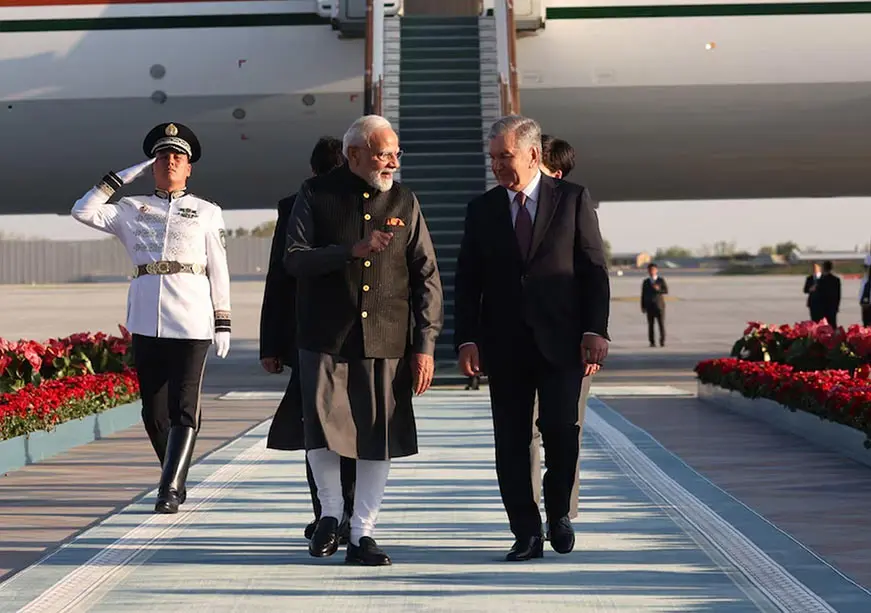
India, Uzbekistan elevate ties to Comprehensive Strategic Partnership
Prime Minister Narendra Modi began a four-day Central Asia trip on 29 August with a State Visit to Uzbekistan, followed by the Shanghai Cooperation Organisation summit in Kyrgyzstan. After talks with President Shavkat Mirziyoyev, the two countries elevated ties to a Comprehensive Strategic Partnership and signed agreements on trade, tourism, digital payments, minerals and culture, including a long-term uranium supply pact. They aim to raise bilateral trade from US$1 billion to US$5 billion by 2030.
Source
BRICS / G20 / SCO / Quad · read the original report ↗
Desk check · some claims need care
What the desk checked (5)
- Modi began a four-day Central Asia trip on 29 August, with a State Visit to Uzbekistan and the SCO summit in Kyrgyzstan. — Stated in the source as fact; no separate attribution or official document cited.
- India and Uzbekistan elevated ties to a Comprehensive Strategic Partnership and signed pacts on trade, tourism, digital payments, minerals and culture. — Appears in the source as reported fact; no official statement quoted.
- Bilateral trade target of US$5 billion by 2030, up from about US$1 billion now. — Figures appear in the source without attribution to an official release.
- India recorded GDP growth of 7.8 percent in the April-June quarter of fiscal year 2027. — Figure appears in the source, but the fiscal year label is internally implausible for a quarter already reported; editor should verify before use.
- Uzbekistan, the fifth-largest uranium producer, signed a long-term uranium supply agreement with India; India aims to raise nuclear capacity from 7,900 MW to 100 GW by 2047. — Stated in the source; ranking and capacity figures carry no citation.
Analysts’ view opinion
Elevating ties with Uzbekistan to a Comprehensive Strategic Partnership is less about protocol than about India buying itself a durable foothold in a region where China and Russia have long set the terms. The long-term uranium supply deal and the minerals MoU are the real strategic core: for a country targeting 100 GW of nuclear capacity by 2047 while importing most of its uranium, diversifying fuel and critical-mineral chains is a security question, not just a commercial one. The weak link remains physical connectivity — agreements are being signed faster than the routes that would carry the goods.
- The uranium agreement is fundamentally about supply security: locking in access from the world's fifth-largest producer spreads the risk in an import-dependent, IAEA-safeguarded civil nuclear programme.
- Minerals cooperation ties directly to India's growth story — over-concentration in critical mineral sourcing is now read as a strategic vulnerability, not merely a market issue.
- Central Asian states are hedging deliberately; BRI debt anxieties and post-Ukraine sovereignty concerns about Russia open space for India — but the EU, Türkiye, Japan and the US are competing for the same space.
- The UPI–Humo/Uzcard link looks technical but reflects a broader pattern of India using digital public infrastructure as a low-cost instrument of influence, without the balance-sheet exposure of big infrastructure lending.
- Creating a foreign-ministers' oversight mechanism reads as tacit acknowledgement that past announcements outran delivery; the test is implementation against timelines, not signatures.
What to watch — Watch whether cargo actually moves through Chabahar and the INSTC, and when the India–Central Asia Summit is reconvened — those are the tells for whether this partnership has moved past the announcement stage.
The story does not establish the volumes, pricing or duration of the uranium and minerals arrangements, and the US$5 billion trade target by 2030 is an aspiration, not evidence that the connectivity bottleneck has been solved.
Deep dive
Research brief · 8 facts · 6 dates · exam-readyThe brief
Context
Prime Minister Narendra Modi began a four-day Central Asia trip on 29 August with a State Visit to Uzbekistan, followed by the Shanghai Cooperation Organisation (SCO) summit in Kyrgyzstan. Talks with Uzbek President Shavkat Mirziyoyev produced an upgrade of ties to a Comprehensive Strategic Partnership along with agreements on trade, tourism, digital payments, minerals, culture and a long-term uranium supply pact. The visit is framed as part of India's evolving Eurasian strategy in a region where China is the leading external power and Russia remains the main security guarantor. Central Asian states, wary of Chinese debt-trap risks under the Belt and Road Initiative and unsettled by the Russia-Ukraine war, are diversifying partners under a multi-vector foreign policy.
Key facts
- Modi's four-day Central Asia trip began on 29 August, starting with a State Visit to Uzbekistan and followed by the SCO summit in Kyrgyzstan.
- India and Uzbekistan elevated ties to a Comprehensive Strategic Partnership and signed agreements on trade, tourism, digital payments, minerals and culture.
- Both sides agreed to a mechanism led by their foreign ministers to oversee implementation of agreements on time.
- Bilateral trade target set at US$5 billion by 2030, up from the current US$1 billion.
- NPCI International Payments Ltd and Uzbekistan's National Interbank Processing Centre signed an agreement to integrate India's UPI with Uzbekistan's Humo and Uzcard systems.
- India recorded GDP growth of 7.8 percent in the April-June quarter of fiscal year 2027, as stated in the source.
- An MoU was signed on cooperation in geology and mineral resources, covering exploration, resource development and technical collaboration.
- Uzbekistan, the world's fifth-largest uranium producer, signed a long-term uranium supply agreement with India; India aims to raise nuclear capacity from 7,900 MW to 100 GW by 2047.
Timeline
- Since 2015Domestic resistance to Chinese economic influence builds across Central Asia.
- 2022India-Central Asia Summit launched; Middle Corridor cargo volumes begin rising dramatically after the start of the Russia-Ukraine war.
- 29 AugustModi begins four-day Central Asia trip with a State Visit to Uzbekistan; holds talks with President Mirziyoyev; ties elevated to Comprehensive Strategic Partnership and agreements signed.
- After Uzbekistan legModi attends the SCO summit in Kyrgyzstan.
- By 2030Target to raise India-Uzbekistan bilateral trade to US$5 billion.
- By 2047India's target to expand nuclear capacity to 100 gigawatts.
Who has a stake
- India (Government of India) — Seeks new markets, critical minerals, uranium supply diversification and a firm foothold in Central Asia amid major-power contestation.
- Uzbekistan — Gains a diversified partner beyond China and Russia; supplies uranium and minerals and links its payment systems to UPI.
- Central Asian Republics (CARs) — Pursuing multi-vector foreign policy and strategic autonomy; view India as a stable, reliable, rising middle power and a hedge.
- China — Currently the leading external power in the region; faces unease over BRI debt-trap risks and domestic resistance to its economic influence.
- Russia — Remains key security guarantor via CSTO and Soviet-era equipment, but its position has weakened after the Ukraine war.
- NPCI International Payments Ltd and Uzbekistan National Interbank Processing Centre — Tasked with integrating UPI with Humo and Uzcard to enable digital payments and lift trade and tourism.
- EU, Türkiye, Japan and the United States — Competing and cooperating partners in Central Asian connectivity; EU invests billions of euros via Global Gateway and the Middle Corridor.
Why it matters
Central Asia is a theatre of major-power contestation, and the Uzbekistan upgrade gives India access to critical minerals, uranium for its nuclear expansion, and a digital payments foothold in a region dominated by China and Russia. It also positions India as an active stakeholder in regional security and economic frameworks rather than a distant partner. The main constraint remains poor physical connectivity, which limits trade, energy and mineral flows despite deep historical and cultural ties.
UPSC angle
Prelims pointers
- India-Uzbekistan ties elevated to Comprehensive Strategic Partnership during Modi's State Visit begun 29 August; SCO summit held in Kyrgyzstan.
- Bilateral trade target: US$5 billion by 2030, from US$1 billion currently.
- UPI to be integrated with Uzbekistan's Humo and Uzcard by NPCI International Payments Ltd and the Uzbekistan National Interbank Processing Centre.
- Uzbekistan is the world's fifth-largest uranium producer; India runs civilian nuclear reactors under IAEA safeguards and imports most of its uranium.
- India's nuclear capacity target: from 7,900 MW to 100 GW by 2047.
- Key platforms: India-Central Asia Summit (launched 2022), SCO, India-Central Asia Dialogue; connectivity via Chabahar port and INSTC.
Mains framing
India's upgrade of ties with Uzbekistan to a Comprehensive Strategic Partnership illustrates how New Delhi is converting historical and cultural affinity with Central Asia into hard strategic gains: uranium for a nuclear capacity target of 100 GW by 2047, MoUs on geology and mineral resources to diversify critical mineral supply chains, and UPI-Humo-Uzcard integration to push bilateral trade from US$1 billion to US$5 billion by 2030. The opening exists because Chinese BRI lending has raised debt-trap anxieties and provoked domestic resistance since 2015, while Russia's Soviet-era baggage and the Ukraine war have raised sovereignty concerns, prompting the Central Asian Republics to adopt a multi-vector policy drawing in the EU, Türkiye, Japan and the US, and boosting the Middle Corridor. India's comparative advantages lie in IT, pharmaceuticals, digital services and counterterrorism training; its core weakness is underdeveloped physical and logistical connectivity, only partly addressed by Chabahar and the INSTC. The way forward, as the source argues, is to use the new foreign ministers' mechanism to enforce timelines on critical minerals cooperation, replicate the Uzbekistan model across the other four Central Asian states instead of separate bilateral deals, and convene the India-Central Asia Summit early to take up connectivity, counterterrorism and mineral exploration.
Key terms
- Comprehensive Strategic Partnership
- The highest tier of bilateral engagement, to which India and Uzbekistan elevated their ties during Modi's visit.
- INSTC (International North-South Transport Corridor)
- Multimodal ship, rail and road network linking India to Central Asia, Russia and Europe.
- SCO (Shanghai Cooperation Organisation)
- Regional grouping whose summit Modi attended in Kyrgyzstan; a multilateral platform for India's Central Asia engagement.
- CSTO (Collective Security Treaty Organisation)
- Russia-led security bloc through which Moscow remains a key security guarantor in Central Asia.
- Middle Corridor
- Route linking Central Asia with Europe via the South Caucasus; cargo volumes have risen sharply since 2022, backed by EU Global Gateway funds.
- Humo and Uzcard
- Uzbekistan's national payment systems, to be integrated with India's UPI under the NPCI agreement.
Practice questions
- Examine how India's engagement with Central Asia balances bilateral partnerships with multilateral platforms such as the SCO and the India-Central Asia Summit. What are its principal limitations?
- "Connectivity is the weakest link in India's Central Asia policy." Discuss with reference to Chabahar port, the INSTC and the Middle Corridor.
- Assess the strategic significance of the India-Uzbekistan long-term uranium supply agreement for India's civil nuclear energy goals.
Grounded only in the source report — figures and dates are the source's, not inferred.