
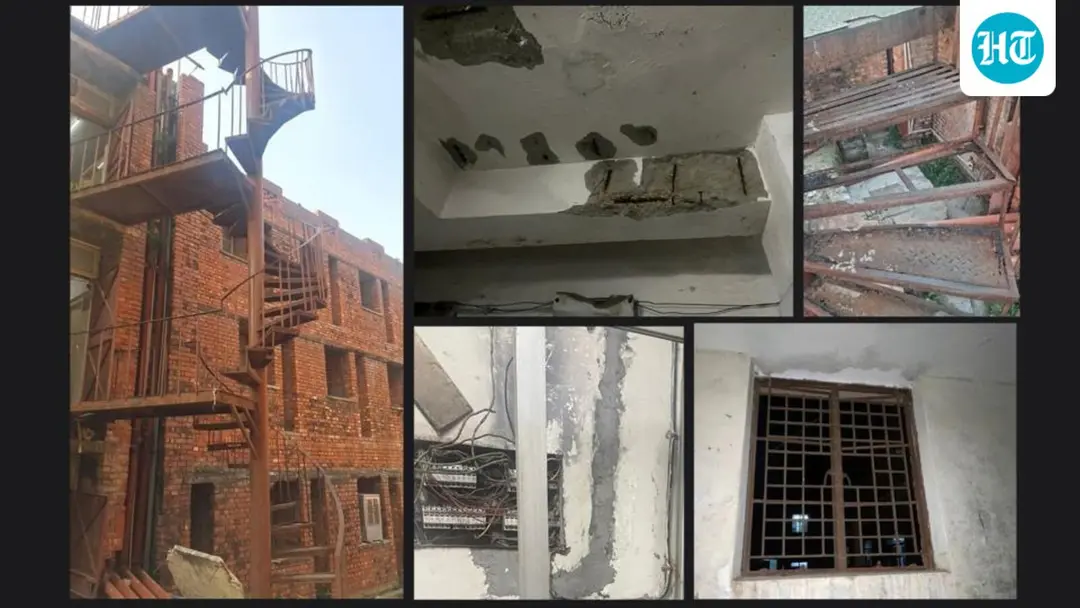
Ceiling fan falls at JNU hostel, students flag safety concerns
A ceiling fan fell in the women's wing of Jawaharlal Nehru University's Tapti Hostel on Tuesday, with no student in the room at the time. JNUSU alleged the administration had not acted despite protests, petitions and hunger strikes. Students cited crumbling plaster, rusted emergency exits, broken window panes and non-functional flushes. The hostel, built in 1997, has a capacity of 400. JNU did not respond to HT's queries.
Source
Hindustan Times — India · read the original report ↗
Desk check · compared with the source
What the desk checked (5)
- A ceiling fan fell in the women's wing of JNU's Tapti Hostel on Tuesday, with no student in the room. — Attributed to a JNUSU statement quoted in the source; no independent confirmation in the text.
- Tapti Hostel was built in 1997 for women students and expanded in 1999-2000 with a men's wing, with a capacity of 400. — Figures appear in the source, stated twice without attribution to a specific official document.
- A portion of the roof collapsed in the women's wing in July last year and window panes remained broken after a December complaint. — Attributed to an unnamed student residing in the hostel since July 2024.
- Non-functional flushes and common urinary tract infections in the women's wing. — Attributed to JNUSU joint secretary Danish Ali; health claim is anecdotal, not backed by medical data in the source.
- Administration cites lack of funds and did not respond to HT queries. — Fund claim attributed to PhD scholar Ranvijay; source explicitly states no response was received from JNU.
Analysts’ view opinion
This is less a story about one fan and more about how public universities budget for the maintenance of ageing assets. A hostel built in 1997 and expanded within three years into a 400-capacity co-ed facility is now at the stage of its life cycle where capital renovation, not patchwork repair, is the standard answer — and students say the administration's recurring response is that funds are unavailable. The pattern described, minor fixes only after a failure, is the classic signature of reactive maintenance in institutions that lack a ring-fenced upkeep budget and a published repair timeline.
- The governance gap here is not the incident itself but the absence of any stated preventive maintenance cycle for a building nearly three decades old.
- Students frame the issue as a safety question — rusted emergency exits with missing steps and exposed ceiling casting are code and life-safety concerns, not cosmetic ones.
- The reported 'no funds' response, if accurate, points to a resource allocation choice higher up the chain, which means accountability may not rest with hostel-level administration alone.
- Complaints channelled through protests, petitions and hunger strikes suggest routine grievance-redress mechanisms are either weak or seen as ineffective, which itself is a design failure.
- Women residents appear to bear a disproportionate share of the burden, with non-functional flushes and hygiene-linked health complaints raised specifically for that wing.
What to watch — Watch whether JNU responds with a funded, time-bound audit and renovation plan for its older hostels rather than another round of spot repairs, and whether any external safety inspection follows.
The story does not establish why the fan fell, the actual state of JNU's maintenance budget, or the administration's side — it did not respond to queries — and the students' accounts of past complaints remain allegations at this stage.
Deep dive
Research brief · 8 facts · 7 dates · exam-readyThe brief
Context
A ceiling fan collapsed in a room in the women's wing of Jawaharlal Nehru University's Tapti Hostel on Tuesday night, with no student inside at the time. The incident has revived long-standing complaints about decaying residential and academic infrastructure on the JNU campus. The Jawaharlal Nehru University Students' Union (JNUSU) says protests, petitions and hunger strikes over these issues have not produced meaningful corrective action, and invoked the Satya Niketan building collapse in which students died. JNU's administration did not respond to queries sent by Hindustan Times.
Key facts
- A ceiling fan fell in a room in the women's wing of JNU's Tapti Hostel on Tuesday; no student was present in the room at the time.
- Tapti Hostel was built in 1997 for women students and expanded in 1999-2000 with a wing for male students, becoming co-educational with a capacity of 400.
- JNUSU issued a statement on Wednesday alleging the university failed to act despite protests, petitions and hunger strikes by students.
- Students reported crumbling plaster, heavily rusted emergency exits with missing steps, and broken or missing window panes covered with mosquito nets or cardboard.
- A resident since July 2024 said a portion of the roof collapsed in the female students' wing in July last year and was repaired only in that area.
- The same student said broken glass panes flagged in December last year were replaced in only a few rooms, about two weeks after the complaint.
- JNUSU joint secretary Danish Ali said flushes in some washrooms do not work and urinary tract infections are common among students in the women's wing.
- PhD scholar and AISA activist Ranvijay said the administration's persistent response to maintenance demands is that there is no fund.
Timeline
- 1997Tapti Hostel built to accommodate women students at JNU.
- 1999-2000Hostel expanded with an additional wing for male students, making it co-educational with a capacity of 400.
- July 2024The student quoted in the story began residing in the hostel.
- July last yearA portion of the roof collapsed in the female students' wing; only that area was repaired.
- December last yearStudent raised concerns about broken window glass panes; panes added in a few rooms after nearly two weeks.
- Tuesday (night)Ceiling fan collapsed in a room in the women's wing of Tapti Hostel; no student inside.
- WednesdayJNUSU issued a statement alleging administrative inaction on infrastructure concerns.
Who has a stake
- Residents of Tapti Hostel (about 400 capacity) — Physical safety, health and hygiene; risk of injury from falling fixtures, leaks, damp walls and non-functional washrooms.
- JNUSU — Credibility of its long campaign through protests, petitions and hunger strikes for hostel and campus repairs.
- JNU administration — Accountability for maintenance and renovation; cites lack of funds, per students; did not respond to HT queries.
- All India Students' Association (AISA) — Activists such as PhD scholar Ranvijay are pressing for overall maintenance rather than piecemeal repairs.
- Women students in the hostel's female wing — Reported health issues including urinary tract infections linked to poor washroom facilities.
Why it matters
A falling ceiling fan in a hostel room signals that deferred maintenance in public universities can become a life-safety issue, not just a comfort complaint. Students explicitly link the JNU decay to the Satya Niketan building collapse where poor infrastructure cost students their lives. With residents alleging that funds are cited as the reason for inaction, the episode raises questions about maintenance budgets, safety audits and grievance redressal in central university hostels.
UPSC angle
Prelims pointers
- Tapti Hostel, JNU: built 1997 for women, expanded 1999-2000 into a co-educational hostel with capacity 400.
- JNUSU is the students' union of Jawaharlal Nehru University; its office is referred to as Teflas.
- AISA (All India Students' Association) activists were among those raising the maintenance issue.
- Students compared the JNU situation to the Satya Niketan building collapse in which students died.
- Ceiling fan collapse occurred on a Tuesday; JNUSU statement followed on Wednesday; JNU gave no response to HT.
Mains framing
The Tapti Hostel fan collapse illustrates how chronic under-maintenance of public university infrastructure translates into direct risks to student life and health. The causes visible in the source are structural ageing (a hostel built in 1997 and expanded in 1999-2000), a reactive repair culture in which, as students allege, minor repairs follow only after something major happens, and the administration's stated constraint of inadequate funds. The consequences are documented in students' accounts: exposed ceiling casting, crumbling plaster, rusted emergency exits with missing steps, monsoon leaks, unusable cupboards against damp walls, non-functional flushes and frequent urinary tract infections in the women's wing. Democratic channels — protests, petitions, hunger strikes — have, per JNUSU, failed to yield systemic action, and the university did not respond to media queries, pointing to a transparency and accountability gap. A grounded way forward, based only on the concerns raised, would involve comprehensive structural and safety audits instead of patchwork repairs, a planned renovation and maintenance programme with clear funding, priority attention to fire and emergency egress, sanitation upgrades, and a responsive grievance mechanism with published timelines for redressal.
Key terms
- JNUSU
- Jawaharlal Nehru University Students' Union, the elected student body that issued the statement on hostel safety.
- Tapti Hostel
- JNU residential facility built in 1997 for women, expanded in 1999-2000 for men, capacity 400.
- Teflas
- The JNUSU office space on campus, cited by the union as another example of visible infrastructural decay.
- AISA
- All India Students' Association, a student organisation whose activist Ranvijay spoke on hostel maintenance.
- Satya Niketan building collapse
- An incident referred to by JNUSU in which poor infrastructure caused student deaths, used as a warning parallel.
Practice questions
- Deferred maintenance in public universities is a student safety issue, not merely an administrative lapse. Discuss with reference to the JNU hostel infrastructure concerns.
- Examine why democratic student channels such as petitions, protests and hunger strikes often fail to secure infrastructural redressal in central universities, and suggest institutional remedies.
- What should a mandatory safety and structural audit framework for university hostels contain? Justify your answer using the deficiencies reported at Tapti Hostel.
Grounded only in the source report — figures and dates are the source's, not inferred.