
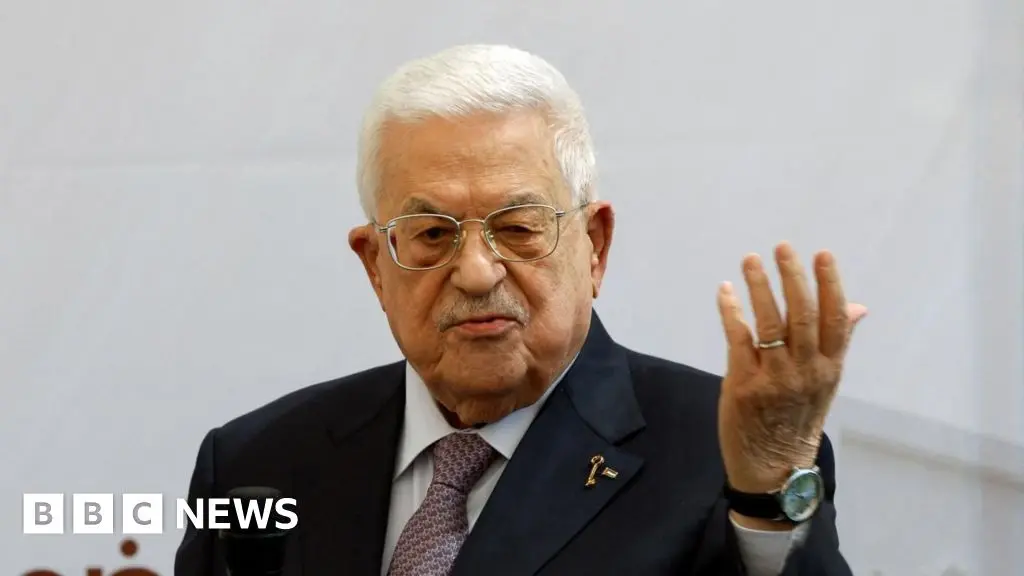
US denies Abbas visa for UN General Assembly in New York
The United States has denied Palestinian President Mahmoud Abbas an entry visa to attend next week's UN General Assembly in New York, two Palestinian sources told the BBC. Washington earlier said it was extending visa sanctions on Palestinian officials, accusing them of failing to meet peace process commitments. In August last year, 80 officials were denied visas. The Palestinian foreign ministry called the measure unjustified. The assembly's 193 members are expected to vote Thursday on letting Abbas address the meeting by video.
Source
United Nations / UNGA · read the original report ↗
Desk check · some claims need care
What the desk checked (5)
- The US denied Palestinian President Mahmoud Abbas an entry visa for the UN General Assembly in New York. — Attributed to two unnamed Palestinian sources speaking to the BBC; the US statement on extending visa sanctions did not name Abbas.
- Sanctions were first imposed in August last year, when 80 Palestinian officials were denied visas. — Figure appears in source; presented as the outlet's own reporting without further attribution.
- The US accused the PA and PLO of 'glorifying terrorism' and trying to 'internationalize' the conflict. — Direct quotes attributed to a US statement.
- All 193 UN General Assembly members are expected to vote Thursday on allowing Abbas to address the meeting by video. — Stated in source as expected procedure; no specific official cited.
- More than 73,790 people have been killed in Gaza since 7 October 2023, when about 1,200 were killed in Israel and 251 taken hostage. — Gaza toll attributed to the Hamas-run health ministry, which the source says the UN considers reliable; internally consistent.
Analysts’ view opinion
This looks like a visa technicality but functions as a pressure instrument — the effect is to narrow the space in which the Palestinian leadership can take its case to the world's most visible diplomatic stage. Washington's position is that it may refuse entry on security and foreign-policy grounds; the Palestinian position is that this cuts against the UN Headquarters Agreement obligations of a host state. Since the same thing happened last year and Abbas spoke by video, the assembly vote could reopen that route again — meaning the bigger strategic risk for Washington is isolation rather than leverage.
- The US is the only one of the Security Council's five permanent members not to have recognised a Palestinian state, so this move does not reflect a broad Western consensus.
- The clash between host-state obligations under the Headquarters Agreement and a claimed national-security exemption sets a precedent that could be invoked over other countries' delegations later.
- The vote by all 193 members is itself a strategic test: a lopsided majority for a video address would read as an implicit rebuke of the US decision.
- Visa denials to 80 officials last August apparently did not shift Palestinian positions, which suggests the tool has limited behaviour-changing power.
- Coming as the UN warns Gaza's humanitarian situation remains dire despite the ceasefire, the timing sharpens concerns about shrinking diplomatic channels.
What to watch — Watch the margin of Thursday's vote, how the UN Secretariat frames the host-state obligation, and whether other states respond by moving further on recognition or on alternative diplomatic venues.
The denial is sourced to two Palestinian sources only, the US statement did not name Abbas, and the story does not establish the full reasoning or legal basis behind the decision.
Deep dive
Research brief · 8 facts · 6 dates · exam-readyThe brief
Context
The United States has denied Palestinian President Mahmoud Abbas an entry visa to attend the UN General Assembly session in New York next week, two Palestinian sources told the BBC. The decision follows a US announcement extending visa sanctions on Palestinian officials, accusing the Palestinian Authority and the Palestine Liberation Organisation of "glorifying terrorism" and trying to "internationalize" the Israeli-Palestinian conflict. A similar step in August last year saw 80 Palestinian officials denied visas, after which Abbas addressed the Assembly by video. Under the UN Headquarters Agreement the US must allow foreign diplomats access to the UN in New York, though Washington says it may deny visas on security, extremism and foreign policy grounds.
Key facts
- Two Palestinian sources told the BBC the US denied President Mahmoud Abbas an entry visa for the UN General Assembly in New York next week.
- The US said it was extending visa sanctions against Palestinian officials without naming Abbas, citing failure to live up to peace process commitments.
- Sanctions were initially imposed in August last year, when 80 Palestinian officials were denied visas for the annual UN meeting in New York.
- The US statement accused the Palestinian Authority and the Palestine Liberation Organization of "glorifying terrorism" and attempting to "internationalize" the Israeli-Palestinian conflict.
- All 193 members of the General Assembly are expected to vote on Thursday on whether Abbas may address the gathering by video, as he did last year.
- Of the UN Security Council's five permanent members, the US is the only one that has not recognised a Palestinian state.
- The Gaza war was triggered by the Hamas-led attack on southern Israel on 7 October 2023, in which about 1,200 people were killed and 251 taken hostage.
- More than 73,790 people have been killed in Gaza according to the Hamas-run health ministry, whose figures the UN considers reliable.
Timeline
- 7 October 2023Hamas-led attack on southern Israel kills about 1,200 people and takes 251 hostages, triggering the Gaza war.
- August last yearUS imposes visa sanctions; 80 Palestinian officials denied visas for the annual UN meeting in New York.
- UN General Assembly last yearAbbas addresses the gathering of leaders and heads of state via video instead of in person.
- October last yearA ceasefire is agreed in Gaza, but the UN warns the humanitarian situation remains dire.
- Thursday (as reported)US extends visa sanctions; Palestinian foreign ministry issues statement calling the measure unjustified; 193 Assembly members expected to vote on a video address by Abbas.
- Next weekUN General Assembly meeting in New York, which Abbas has been denied a visa to attend.
Who has a stake
- Mahmoud Abbas, Palestinian President — Denied a visa to attend the UNGA in person; may address it only by video if the Assembly votes to allow it.
- United States government — Extending visa sanctions on Palestinian officials while bound by the UN Headquarters Agreement to allow diplomats access to the UN.
- Palestinian Authority and PLO — Accused by the US of glorifying terrorism and internationalising the conflict; their diplomatic access to the UN is curtailed.
- Palestinian foreign ministry — Says the sanctions are unjustified and undermine trust, Palestinian-US relations and the two-state solution.
- UN General Assembly (193 members) — Must vote on whether to permit a video address, testing the host state's obligations under the Headquarters Agreement.
- Civilians in Gaza — UN says the humanitarian situation remains dire despite the October ceasefire, with strikes causing casualties and displacement.
- Israel and its military — Rejects Palestinian accountability claims; says it killed a Hamas commander in southern Gaza and a fighter in the north.
- Medical Aid for Palestinians (UK charity) — Says a patient was killed by an Israeli drone at a health centre it supports in Jabalia; Israeli military says it is unaware of the incident.
Why it matters
The denial of a visa to a head of the Palestinian Authority raises the question of whether the United States, as host state, is meeting its obligation under the UN Headquarters Agreement to grant diplomats access to the UN. It also signals a hardening of US policy at a moment when the US is the only permanent member of the Security Council not to have recognised a Palestinian state, and when the UN says Gaza's humanitarian situation remains dire despite the October ceasefire.
UPSC angle
Prelims pointers
- UN Headquarters Agreement obliges the US to allow foreign diplomats access to the UN in New York; Washington claims exceptions for security, extremism and foreign policy.
- The UN General Assembly has 193 member states; a vote was expected on allowing Abbas to address it by video.
- The Palestinian Authority was established by the Oslo peace accords; the PLO was recognised as the official representative of the Palestinian people after the same process.
- The US is the only one of the UN Security Council's five permanent members not to have recognised a Palestinian state.
- August last year: 80 Palestinian officials were denied US visas for the annual UN meeting.
- Gaza war trigger: Hamas-led attack of 7 October 2023, about 1,200 killed and 251 taken hostage; over 73,790 killed in Gaza since, per the Hamas-run health ministry.
Mains framing
The visa denial to Mahmoud Abbas illustrates the tension between a host state's national foreign policy and its treaty obligations as custodian of an international organisation's headquarters. The US justifies extended visa sanctions by accusing the Palestinian Authority and the PLO of failing to honour peace process commitments, of \"glorifying terrorism\" and of seeking to \"internationalize\" the conflict; Palestinian officials counter that they are exercising a right under international law to seek accountability against an occupying force, and that the step contradicts the UN Headquarters Agreement. The immediate consequence is procedural — the 193-member Assembly must vote to permit a video address, as it did last year — but the wider implication is a narrowing of Palestinian diplomatic space at a time when the US remains the only P5 member not recognising a Palestinian state and when the UN reports a dire humanitarian situation in Gaza despite the October ceasefire. A way forward, on the source's own terms, would rest on restoring the political climate the Palestinian foreign ministry invokes — rebuilding trust and Palestinian-US relations to implement a two-state solution — while ensuring host-state visa decisions do not erode multilateral access to the UN.
Key terms
- UN General Assembly
- The UN's plenary organ of all 193 member states, which meets annually in New York for its leaders' session.
- UN Headquarters Agreement
- Accord under which the US, as host state, must allow foreign diplomats access to the UN in New York.
- Palestinian Authority (PA)
- Governing body established by the Oslo peace accords, headed by President Mahmoud Abbas.
- Palestine Liberation Organisation (PLO)
- Recognised after the Oslo process as the official representative of the Palestinian people, in return for recognising Israel and renouncing violence.
- Two-state solution
- Framework, cited by the Palestinian foreign ministry, of Israeli and Palestinian states coexisting as the basis for peace.
- Visa sanctions
- US denial of entry visas to targeted Palestinian officials, first imposed in August last year against 80 officials.
Practice questions
- Does the denial of an entry visa to the Palestinian President violate the United States' obligations as host state under the UN Headquarters Agreement? Discuss.
- Examine how host-state control over visas can affect the functioning and universality of multilateral institutions, using the case of Mahmoud Abbas and the UN General Assembly.
- Assess the implications of the US being the only permanent member of the UN Security Council not to have recognised a Palestinian state for the prospects of a two-state solution.
Grounded only in the source report — figures and dates are the source's, not inferred.