
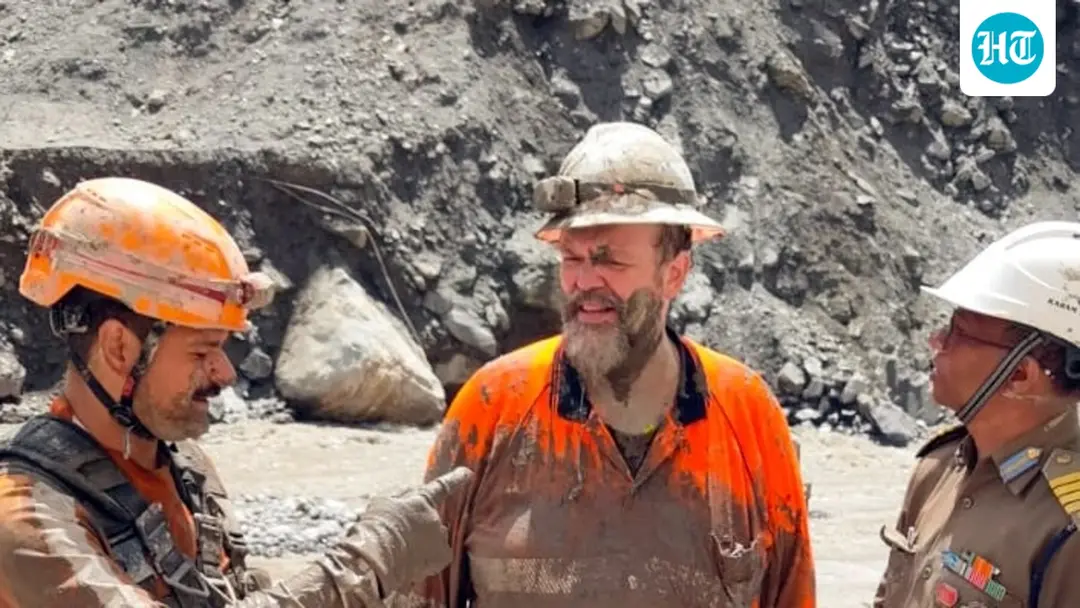
Chilime disaster a 'Mahapralaya', says expert Arnold Dix
Australian tunnel rescue expert Arnold Dix, known for the 2023 rescue of 41 workers from the Silkyara tunnel, said people caught in the first inrush of water, mud and debris at Nepal's Chilime hydropower project had no possibility of survival. He called it a 'Mahapralaya' and said it was not caused by negligence or failure by Nepal or its engineers. NDRRMA data at 7 pm on September 18 put the toll at 1,410, with 6,055 missing and 13,756 rescued. India sent another 11 tonnes of relief.
Source
Hindustan Times — India · read the original report ↗
Desk check · compared with the source
What the desk checked (5)
- Those caught in the first inrush of water, mud and debris at Chilime had no possibility of survival. — Stated as the professional conclusion of Arnold Dix, based on site evidence and talks with responders; opinion attributed, not independently verified.
- Dix described the disaster as 'Mahapralaya' and among the most severe natural disasters of the modern recorded era. — Direct quotes attributed to Dix in the source.
- Dix said the disaster was not due to negligence or failure by Nepal or its engineers. — Attributed opinion from Dix; no counter-view or official finding cited in source.
- Death toll stands at 1,410, with 6,055 missing and 13,756 rescued. — Attributed to NDRRMA data released at 7 pm on September 18; figures appear in source.
- India dispatched another 11 tonnes of relief material on Saturday. — Figure appears in source; no specific official named.
Analysts’ view opinion
Chilime is not only a humanitarian emergency — it is a strategic signal about how exposed critical infrastructure in the Himalaya has become. Hydropower tunnels, powerhouses and transmission links can no longer be treated as purely commercial assets; they are national-security assets vulnerable to natural forces. Arnold Dix's insistence that this was not negligence shifts the frame from blame to technical assessment, though it does not close the wider debate on risk-based design standards.
- NDRRMA's figures of 1,410 dead and 6,055 missing place this well beyond a site-level accident, with likely long-run consequences for Nepal's power-sector planning.
- India's dispatch of a further 11 tonnes of relief, including forensic supplies, alongside a joint technical team at the tunnel, fits its established posture as a first responder in the neighbourhood.
- Simultaneous damage across multiple projects, with access routes and communications destroyed, illustrates how deep systemic vulnerability can run without any adversary involved.
- The presence of international experts such as Dix helps protect Nepal's engineering credibility while further normalising foreign rescue and technical assistance in such crises.
- For every party investing in Himalayan hydropower, the key question now is whether insurance terms, lending conditions and hazard-assessment norms tighten.
What to watch — Watch for Nepal's official inquiry, any revision of hazard and design standards for Himalayan hydropower, and what shape regional cooperation on early-warning systems takes.
Dix's assessment is a professional judgment, not a finding of fact, and the story does not establish what an official investigation will conclude about causes or whether design shortcomings played any role.
Deep dive
Research brief · 8 facts · 5 dates · exam-readyThe brief
Context
Nepal has been devastated by floods and landslides linked to a Himalayan glacier collapse, which struck several hydropower projects including the Chilime hydropower project in Rasuwa district. Australian tunnel rescue expert Arnold Dix — internationally known for his role in the 2023 rescue of 41 workers from the Silkyara tunnel in Uttarakhand — joined the emergency search operation at the flood-hit Chilime tunnel. He has publicly described the event as a "Mahapralaya" and concluded that those caught in the first inrush of water, mud and debris could not have survived. India has been sending humanitarian relief to Nepal as the search and recovery continues.
Key facts
- Arnold Dix said those caught in the direct path of the first inrush of water, mud and debris at Chilime had "no possibility of survival" and that "death was instantaneous".
- Dix is known in India for his role in the successful rescue of 41 workers from the Silkyara tunnel in 2023.
- Dix called the Chilime disaster a "Mahapralaya" — from Nepali and Sanskrit tradition, meaning "the great dissolution".
- NDRRMA data released at 7 pm on September 18 put the death toll at 1,410, including 525 human body remains.
- NDRRMA said 6,055 people remain missing and 13,756 people have been rescued.
- India dispatched another 11 tonnes of relief material on Saturday, including medicines, forensic supplies, tents, hygiene kits and sleeping bags.
- Dix said immense flows of water, mud, giant rocks and debris struck multiple hydropower projects simultaneously in some of the most inaccessible terrain on Earth.
- Dix said rocks "the size of a bus" tore almost instantly through the entire tunnel system and into the powerhouse, making it "more destructive" than a bomb at the tunnel entrance.
Timeline
- 2023Arnold Dix leads the successful rescue of 41 workers trapped in the Silkyara tunnel, making him widely known in India.
- About three weeks before Dix's statementChilime, per Dix, "stood as a proud achievement of Nepali engineering".
- September 18, 7 pmNDRRMA data records 1,410 dead (including 525 human body remains), 6,055 missing and 13,756 rescued.
- WednesdayDewatering and slush removal activities carried out at the Chilime tunnel in Rasuwa by a joint technical team from India, with Dix present.
- SaturdayIndia dispatches a further 11 tonnes of relief material to flood-hit Nepal.
Who has a stake
- Families of workers at Chilime — Await news of 6,055 people still missing; Dix's assessment indicates no survival for those in the direct path of the first inrush.
- Nepal's Army, Police and rescue services — Leading the search in extremely difficult conditions; praised by Dix for continuing operations.
- Nepali engineers and the hydropower sector — Facing suggestions of failure or negligence, which Dix explicitly rejected; multiple hydropower projects lie damaged.
- Government of India / MEA — Providing humanitarian assistance including 11 tonnes of relief and a joint technical team for dewatering and slush removal at the tunnel.
- NDRRMA (Nepal's disaster authority) — Official source of casualty, missing and rescue figures guiding the response.
- Arnold Dix / international rescue teams — Providing technical judgment on survivability and guiding the underground search operation.
Why it matters
A globally recognised underground-emergency expert has placed the Chilime event in the class of the most severe natural disasters of the modern recorded era, shifting the frame from blame to the sheer scale of a Himalayan hazard. With 1,410 dead and over 6,000 still missing, the disaster raises hard questions about hydropower infrastructure in fragile, glacier-fed mountain terrain. It also underlines India's role as a first responder in its neighbourhood, with relief supplies and a joint technical team at the tunnel site.
UPSC angle
Prelims pointers
- Arnold Dix: Australian tunnel rescue expert; led the 2023 Silkyara tunnel rescue of 41 workers in India.
- Chilime hydropower project is located in Rasuwa, Nepal.
- NDRRMA is Nepal's disaster risk reduction and management authority, which released the casualty data.
- As on 7 pm, September 18: Nepal toll 1,410 (including 525 body remains), 6,055 missing, 13,756 rescued.
- India's latest consignment: 11 tonnes of relief — medicines, forensic supplies, tents, hygiene kits, sleeping bags.
- "Mahapralaya" means "the great dissolution" in the Nepali linguistic and Sanskrit philosophical tradition.
Mains framing
The Chilime tunnel disaster illustrates the compounding risk profile of hydropower development in the high Himalaya, where glacier collapse, steep and inaccessible terrain, and concentrated underground infrastructure combine to produce catastrophic outcomes. Arnold Dix's assessment is instructive on two counts: first, that the physics of the event — an instantaneous flow of water, mud and bus-sized rocks moving through the entire tunnel system into the powerhouse, including plant rooms and living and rest areas — left no survival window for those in its direct path; second, that this was a hazard of extreme magnitude rather than a failure of Nepali engineering or negligence. Yet the search was rightly continued, because responsible practice requires exhausting possible places of survival before abandoning hope, a principle with clear implications for rescue protocol in underground works. The implications extend to siting and design of tunnels and powerhouses in glacier-fed valleys, worker accommodation within underground systems, early-warning and communications redundancy, and multi-site simultaneous-failure planning. The response also shows the value of regional cooperation, with India sending relief material and a joint technical team for dewatering and slush removal, alongside Nepal's Army, Police and international rescue teams. The way forward lies in hazard mapping of glacial and mass-movement risks, disaster-resilient project design, and institutionalised cross-border rescue capacity, rather than in post-facto attribution of blame.
Key terms
- Mahapralaya
- A term from Nepali linguistic and Sanskrit philosophical tradition meaning "the great dissolution" — a catastrophe so overwhelming the known world appears unmade.
- NDRRMA
- Nepal's disaster management authority whose data released at 7 pm on September 18 recorded the toll, missing and rescued figures.
- Chilime hydropower project
- Hydropower project in Rasuwa, Nepal, whose tunnel and powerhouse were destroyed by an inrush of water, mud, rocks and debris.
- Silkyara tunnel rescue (2023)
- Operation in India in which 41 trapped workers were rescued; Arnold Dix's role in it made him widely known in India.
- Dewatering and slush removal
- Operations at the Chilime tunnel by a joint technical team from India to clear water and mud so the underground works could be entered and searched.
- Powerhouse
- The plant section of a hydropower project housing generating machinery and control rooms; at Chilime the debris flow reached it through the tunnel system.
Practice questions
- Discuss the risks of large hydropower development in glacier-fed Himalayan valleys in light of the Chilime tunnel disaster. What design and disaster-preparedness measures does it call for?
- "Rescue operations must continue even when expert judgment suggests low survivability." Examine this principle with reference to Arnold Dix's assessment at Chilime.
- Evaluate India's humanitarian assistance and technical cooperation in Nepal following the 2025 floods as an instrument of neighbourhood diplomacy.
Grounded only in the source report — figures and dates are the source's, not inferred.