
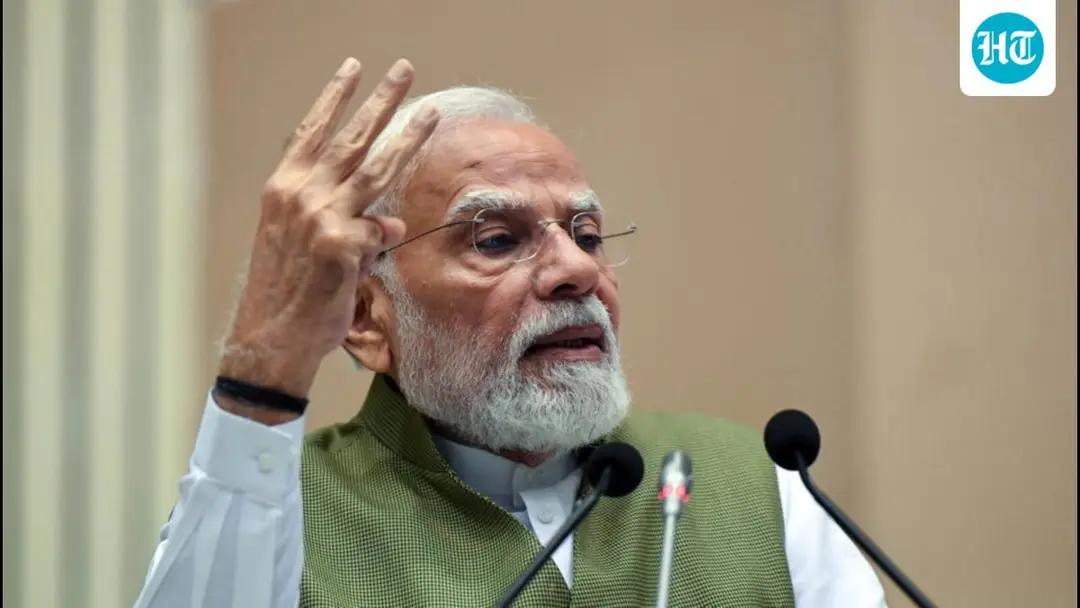
51,000 handed Union government job letters at 20th Rozgar Mela
More than 51,000 young people received appointment letters for Union government jobs on Saturday at the 20th Rozgar Mela, announced through video conferencing at programmes held simultaneously in 45 locations. The recruits will join ministries including revenue and financial services, railways, home affairs, health and family welfare, and defence. The government said the initiative has now issued about 12.75 lakh appointment letters. Prime Minister Narendra Modi urged the recruits to serve citizens with efficiency, honesty and a public-welfare focus.
Source
Hindustan Times — India · read the original report ↗
Desk check · compared with the source
What the desk checked (4)
- Over 51,000 young people received Union government appointment letters at the 20th Rozgar Mela on Saturday. — Figure appears in source and relates to the official event.
- Programmes were held simultaneously at 45 locations, with appointments announced via video conferencing. — Stated in source; no named source given.
- Total appointment letters under Rozgar Mela are about 12.75 lakh. — Explicitly attributed to the government in the source.
- Modi urged recruits to work with efficiency, honesty and a citizen-first approach. — Attributed to Modi and supported by a direct quote in the source.
Analysts’ view opinion
The Rozgar Mela is no longer just a recruitment exercise — it has become a structured political platform through which the Centre answers criticism on jobs. Holding events at 45 locations simultaneously, with the Prime Minister himself joining by video conference, converts an administrative process into a visual moment credited directly to central leadership. With the 20th edition pushing the cumulative figure to about 12.75 lakh appointment letters, that number becomes the government's headline reply to opposition attacks on unemployment.
- Simultaneous events across 45 locations amount to a political communication model that delivers one national message to many regions at once.
- Recruits joining ministries as varied as railways, home affairs, defence and health means beneficiaries are spread geographically and socially, letting the government present the gain as broad rather than sectional.
- Modi's explicit nod to recruits' families and his framing of their work around the 2047 developed-India goal turns a job letter into part of a longer national narrative, not just a benefit.
- His point that an employee's conduct shapes how citizens experience the state reflects an awareness that everyday governance experience carries electoral weight.
- The opposition can be expected to ask whether these are genuinely new jobs or the filling of long-sanctioned vacancies — a distinction the story does not settle.
What to watch — Watch where future editions are held relative to upcoming election calendars, and how opposition parties contest the cumulative recruitment figures.
The story reports government-stated figures; it does not establish independent verification of them or what net difference they make to overall employment.
Deep dive
Research brief · 8 facts · 3 dates · exam-readyThe brief
Context
The Rozgar Mela is a Union government recruitment drive under which appointment letters for central government jobs are handed out in batches at events addressed by Prime Minister Narendra Modi. At the 20th edition, held on a Saturday through video conferencing across 45 locations, more than 51,000 young people received appointment letters. The recruits are joining ministries and departments including revenue and financial services, railways, home affairs, health and family welfare, and defence. The government says the initiative has now issued about 12.75 lakh appointment letters in total.
Key facts
- More than 51,000 appointment letters for Union government jobs were handed out at the 20th Rozgar Mela on Saturday.
- The event was held simultaneously at 45 locations, with the announcement made through video conferencing.
- Total appointment letters issued through the Rozgar Mela initiative now stand at about 12.75 lakh, according to the government.
- Under PM-SETU, 1,000 government industrial training institutes are being modernised with an investment of Rs 60,000 crore and greater industry participation.
- The Pradhan Mantri Viksit Bharat Rozgar Yojana has an allocation of about Rs 1 lakh crore and offers incentives of up to Rs 15,000 for first-time workers; it is expected to benefit around two crore first-time workforce entrants.
- Modi cited a 7.8% growth rate in the first quarter of the current financial year and an investment increase of about 12%.
- More than 1.7 crore government employees have joined the Karmayogi platform under Mission Karmayogi.
- Modi said half of India's recognised startups are located in tier-2 and tier-3 cities, and referred to free trade agreements with around 40 countries.
Timeline
- First quarter of the current financial yearIndia recorded a 7.8% growth rate and an investment increase of about 12%, as cited by the Prime Minister.
- Saturday (date not stated in the source)20th Rozgar Mela held at 45 locations; over 51,000 appointment letters issued; PM Modi addresses recruits via video conferencing.
- 2047Target year for making India a developed country, to which Modi linked the recruits' entry into government service.
Who has a stake
- The 51,000-plus new recruits and their families — Secure Union government employment; expected to serve with efficiency, honesty and a citizen-first approach.
- Union ministries and departments (revenue and financial services, railways, home affairs, health and family welfare, defence) — Receive fresh manpower to fill vacancies and deliver services.
- Prime Minister Narendra Modi / PMO — Drives the Rozgar Mela initiative and links it to the Viksit Bharat 2047 goal and administrative responsiveness.
- Citizens dependent on government services - pensioners, students awaiting scholarships, farmers seeking benefits — Their experience of the state is shaped by the conduct and efficiency of individual officials.
- Young jobseekers and first-time workers — Targeted by schemes such as Pradhan Mantri Viksit Bharat Rozgar Yojana, Skill India, PMKVY and apprenticeship expansion.
- Serving government employees — Over 1.7 crore have joined the Karmayogi platform for skill upgradation and familiarity with emerging technologies.
Why it matters
Central government recruitment is both an employment measure and a service-delivery question, since a citizen's experience of the state usually depends on the individual official they meet. The 20th Rozgar Mela links large-scale hiring to the Viksit Bharat 2047 goal and to a wider skilling and employment push covering ITI modernisation, first-time-worker incentives and continuous training of existing staff. The cumulative figure of about 12.75 lakh appointment letters also makes the initiative a benchmark against which the government's employment claims will be judged.
UPSC angle
Prelims pointers
- 20th Rozgar Mela: over 51,000 appointment letters, 45 locations, cumulative total about 12.75 lakh.
- PM-SETU: modernisation of 1,000 government ITIs with Rs 60,000 crore investment and industry participation.
- Pradhan Mantri Viksit Bharat Rozgar Yojana: about Rs 1 lakh crore allocation; up to Rs 15,000 incentive for first-time workers; about two crore beneficiaries expected.
- Mission Karmayogi: more than 1.7 crore government employees on the Karmayogi platform.
- Economy cited: 7.8% growth in Q1 of current financial year; investment up about 12%; FTAs with around 40 countries.
- Half of India's recognised startups are in tier-2 and tier-3 cities.
Mains framing
The Rozgar Mela model addresses two linked concerns: the scale of unfilled Union government posts amid high youth aspiration for public-sector jobs, and the quality of citizen-facing administration. The 20th edition, with over 51,000 appointment letters across 45 locations and a cumulative 12.75 lakh, was framed by the Prime Minister not merely as job creation but as an induction into national service tied to the Viksit Bharat 2047 goal, with recruits urged to remove the very difficulties they and their families faced in accessing public services. Around it sits a supply-side skilling architecture - the National Education Policy, Skill India, Pradhan Mantri Kaushal Vikas Yojana, expanded apprenticeships and PM-SETU's Rs 60,000 crore modernisation of 1,000 ITIs - along with demand-side support through the roughly Rs 1 lakh crore Pradhan Mantri Viksit Bharat Rozgar Yojana and its up to Rs 15,000 incentive for first-time workers. Continuous capacity building via Mission Karmayogi, which now covers more than 1.7 crore employees, is presented as the mechanism to keep administration technology-ready and responsive. The way forward, on the government's own framing, lies in aligning education and skills with industry needs, widening entrepreneurship beyond metros - half of recognised startups are already in tier-2 and tier-3 cities - and leveraging free trade agreements with around 40 countries, while ensuring that recruitment numbers translate into measurable improvements in service delivery.
Key terms
- Rozgar Mela
- Union government drive under which appointment letters for central jobs are distributed in batches at events addressed by the Prime Minister.
- PM-SETU
- Programme under which 1,000 government industrial training institutes are being modernised with Rs 60,000 crore and greater industry participation.
- Pradhan Mantri Viksit Bharat Rozgar Yojana
- Employment scheme with about Rs 1 lakh crore allocation, offering incentives up to Rs 15,000 for first-time workers; around two crore expected beneficiaries.
- Mission Karmayogi
- Capacity-building initiative for government employees; its Karmayogi platform has over 1.7 crore users for skills and emerging-technology training.
- Pradhan Mantri Kaushal Vikas Yojana
- Skill development scheme cited as part of efforts to align education and skills with industry requirements.
- Viksit Bharat 2047
- Goal of making India a developed and self-reliant country by 2047, to which the recruits' service was linked.
Practice questions
- Critically examine the Rozgar Mela initiative as an instrument of employment generation and administrative capacity building in India.
- Discuss how skilling programmes such as PM-SETU, Skill India and the Pradhan Mantri Kaushal Vikas Yojana can be aligned with industry requirements to improve employability of Indian youth.
- 'A citizen's experience of the state depends on the individual official.' In this light, evaluate the role of capacity-building missions like Mission Karmayogi in improving public service delivery.
Grounded only in the source report — figures and dates are the source's, not inferred.