
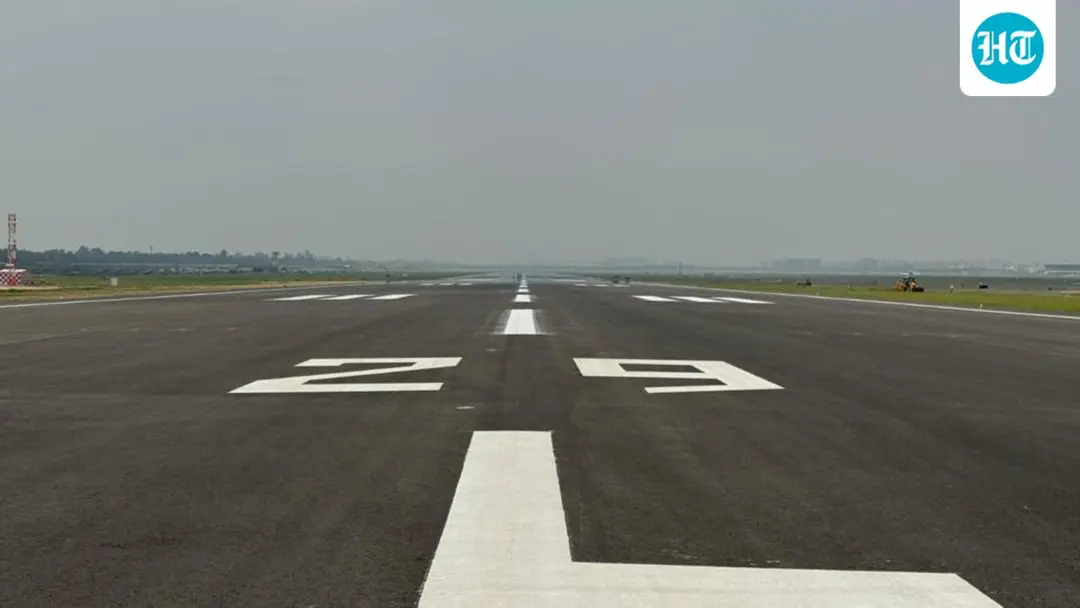
Delhi airport's third runway to reopen on September 20
Delhi's Indira Gandhi International Airport will reopen its third runway, 11R/29L, from Sunday, September 20, after seven months of repairs, operator DIAL said on Saturday. The rehabilitation, begun in February 2026, included resurfacing, pavement strengthening, lighting upgrades, permanent threshold displacement of runway 29L and a new Rapid Exit Taxiway (RET Z1). DIAL said all inspections and regulatory clearances were completed. Commissioned in 2008, the runway had been in service for 17 years.
Source
Hindustan Times — India · read the original report ↗
Desk check · compared with the source
What the desk checked (5)
- Runway 11R/29L, Delhi airport's third runway, will be operational from September 20 after seven months of repairs. — Attributed to a DIAL statement issued on Saturday; figure appears in source.
- The rehabilitation project commenced in February 2026 and received all necessary regulatory approvals. — Quoted directly from DIAL statement; date is internally consistent with the seven-month figure but not independently verifiable here.
- Work included resurfacing, permanent threshold displacement of 29L, a new Rapid Exit Taxiway (RET Z1), lighting upgrades and pavement strengthening. — Itemised list attributed to DIAL.
- The runway was commissioned in 2008 and was in service for 17 years, with minor rehabilitation in 2017. — Stated in source without separate attribution; internally consistent.
- Work was completed in coordination with DGCA, AAI, ATC and airlines. — Attributed to DIAL; no independent confirmation from the agencies in the source.
Analysts’ view opinion
On paper this is a pure infrastructure notice, but Delhi airport is among the most politically visible pieces of infrastructure in India — used daily by ministers, MPs and the national media. After seven months of closure and the congestion complaints that inevitably accompany such shutdowns, the reopening lands as a relief message for both the government side and the DIAL/GMR consortium. This is not a story that shifts power; it is delivery-credit politics.
- For the civil aviation establishment, this is a clean "we finished what we started" talking point, reinforced by the story's emphasis on coordination with DGCA, AAI and ATC.
- DIAL can use a completed, regulator-cleared rehabilitation as an argument in favour of the privately operated airport model whenever that model is questioned.
- Passenger inconvenience during closures is standard fodder for opposition and local Delhi political criticism, so closing that chapter works in the government's favour.
- Infrastructure milestones are routinely folded into campaign narratives, and capital-city connectivity fits such a narrative easily.
- If travellers do not actually feel fewer delays, any political dividend from this announcement will be short-lived.
What to watch — Watch whether delays and congestion measurably ease after reopening — that will decide who gets to claim this politically.
The story carries no political reaction, no opposition criticism, no project cost and no assessment of losses during the closure; it rests entirely on the operator's own statement.
Deep dive
Research brief · 8 facts · 5 dates · exam-readyThe brief
Context
Delhi's Indira Gandhi International Airport (IGIA), operated by Delhi International Airport Limited (DIAL), a GMR Aero-led consortium, shut its third runway 11R/29L for seven months for a comprehensive rehabilitation programme. The runway, commissioned in 2008, had been in continuous service for 17 years, with a minor rehabilitation in 2017. DIAL announced on Saturday that the upgraded runway will be operational from September 20 after all inspections, validations and regulatory clearances. The work was carried out in coordination with DGCA, AAI, ATC and airlines.
Key facts
- Runway 11R/29L, Delhi airport's third runway, will resume operations from September 20 after seven months of repair work.
- The rehabilitation project commenced in February 2026, according to DIAL's statement.
- The runway was commissioned in 2008 and had been in continuous service for 17 years, with minor rehabilitation in 2017.
- Works included runway resurfacing, pavement strengthening and upgrades to airfield ground lighting systems.
- A permanent threshold displacement of runway 29L was carried out as part of the programme.
- A new Rapid Exit Taxiway (RET Z1) was constructed to reduce runway occupancy time.
- DIAL said the runway is ready for use after all required inspections, validations and regulatory clearances.
- The project was executed in coordination with DGCA, Airports Authority of India, Air Traffic Control and airlines.
Timeline
- 2008Runway 11R/29L, Delhi airport's third runway, is commissioned.
- 2017Runway undergoes minor rehabilitation as part of regular maintenance.
- February 2026Comprehensive rehabilitation programme of the third runway commences; runway shut for seven months.
- Saturday (day before reopening)DIAL announces the runway will be operational from September 20 after regulatory approvals.
- September 20 (Sunday)Runway 11R/29L reopens for operations.
Who has a stake
- Delhi International Airport Limited (DIAL) — GMR Aero-led consortium operating IGIA; executed the rehabilitation and is responsible for capacity, safety and reliability.
- Directorate General of Civil Aviation (DGCA) — Regulator whose approvals and clearances were required before the runway could be recommissioned.
- Airports Authority of India (AAI) and Air Traffic Control — Coordinated on airside works and aircraft movement management during and after the closure.
- Airlines operating at IGIA — Runway availability affects aircraft movements, runway occupancy time and schedule reliability.
- Passengers — Stand to gain from improved operational efficiency and reliability in varying weather conditions.
- Pradeep Panicker, CEO, DIAL — Called the recommissioning a milestone in building future-ready aviation infrastructure.
Why it matters
Delhi airport is one of India's busiest aviation gateways, and the loss of one of its runways for seven months constrained capacity at a time of growing air traffic. The upgraded runway, new rapid exit taxiway and enhanced lighting are meant to cut runway occupancy time and improve reliability in poor weather, a recurring problem in Delhi. It also signals how brownfield airport capacity is expanded through periodic rehabilitation under regulatory oversight.
UPSC angle
Prelims pointers
- Runway 11R/29L is Delhi IGIA's third runway, commissioned in 2008.
- DIAL, a GMR Aero-led consortium, manages and operates Indira Gandhi International Airport.
- DGCA is the civil aviation regulator that issues clearances for runway recommissioning.
- Rapid Exit Taxiway (RET) helps aircraft vacate the runway faster, reducing runway occupancy time.
- Threshold displacement of runway 29L was made permanent during the 2026 rehabilitation.
- Airports Authority of India and Air Traffic Control were project stakeholders alongside airlines.
Mains framing
The reopening of Delhi airport's third runway illustrates the trade-off in Indian aviation between maintaining ageing airside assets and sustaining capacity at congested hubs. A runway in continuous service for 17 years since 2008, with only a minor rehabilitation in 2017, required a seven-month closure from February 2026 for resurfacing, pavement strengthening, airfield ground lighting upgrades, permanent threshold displacement of 29L and a new Rapid Exit Taxiway (RET Z1) — works that DIAL says will optimise aircraft movement, cut runway occupancy time and improve reliability across weather conditions. The episode shows that safety and standards compliance are non-negotiable and require regulatory sign-off from the DGCA, but also that prolonged single-runway outages at a hub handling large traffic volumes impose coordination costs on airlines, ATC and passengers. The way forward lies in phased, well-sequenced maintenance planning, transparent advance communication with airlines, closer coordination among DIAL, DGCA, AAI and ATC as demonstrated in this project, and investment in redundancy so that future rehabilitation does not compress capacity at India's busiest gateways.
Key terms
- DIAL
- Delhi International Airport Limited, a GMR Aero-led consortium that manages and operates Indira Gandhi International Airport.
- Runway 11R/29L
- Delhi airport's third runway, commissioned in 2008 and recommissioned on September 20 after rehabilitation.
- Rapid Exit Taxiway (RET)
- A taxiway allowing aircraft to leave the runway quickly; RET Z1 was newly built to reduce runway occupancy time.
- Threshold displacement
- Shifting the point where the usable landing portion of a runway begins; made permanent for runway 29L.
- DGCA
- Directorate General of Civil Aviation, the regulator whose inspections and clearances preceded the runway's reopening.
- Airfield ground lighting
- Runway and taxiway lighting systems guiding aircraft; upgraded during the rehabilitation for all-weather reliability.
Practice questions
- Discuss how periodic rehabilitation of airside infrastructure at congested hub airports affects aviation capacity, and suggest measures to minimise disruption.
- Examine the role of the DGCA and the Airports Authority of India in ensuring compliance with global aviation safety and infrastructure standards.
- What is a Rapid Exit Taxiway, and how do features such as threshold displacement and airfield ground lighting upgrades improve runway efficiency?
Grounded only in the source report — figures and dates are the source's, not inferred.