
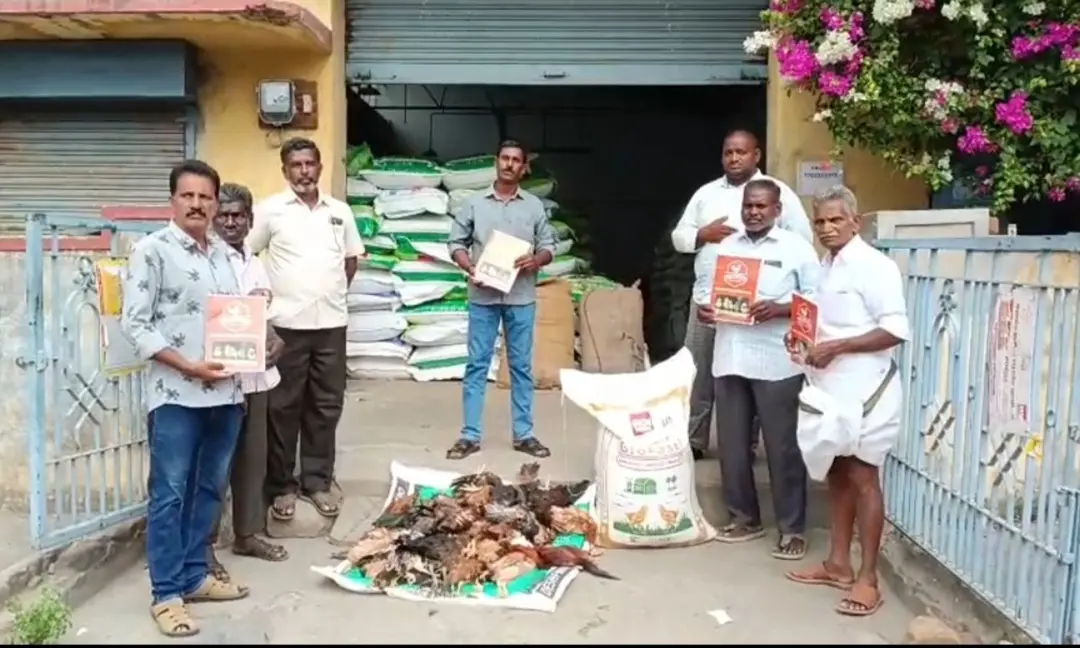
Poultry farmers protest in Chittoor over alleged substandard feed
Twenty-five poultry farmers protested on Tuesday at the SKM poultry feed centre in Chittoor, alleging their birds died after consuming substandard feed sold there. They brought dead chickens to the centre, located opposite Little Flower School on CB Road, and said they had suffered heavy losses. The farmers said the management did not respond despite repeated representations, and sought a detailed inquiry and compensation. They said they complained against the owner to the Animal Husbandry Deputy Director.
Source
Chittoor — crime & civic · read the original report ↗
Desk check · some claims need care
What the desk checked (5)
- 25 poultry farmers protested at the SKM poultry feed centre in Chittoor city — Figure appears in source; attributed to the report, no official confirmation cited
- Chickens died after consuming substandard feed sold by the centre — Allegation attributed to the protesting farmers only; no laboratory or official finding given in source
- Protest was held Tuesday at the centre opposite Little Flower School on Chittoor CB Road — Location and day appear in source; unattributed reporting detail
- Farmers say they repeatedly approached the feed centre management, which did not respond — Farmers' claim; feed centre management's version not included in source
- Farmers said they complained to the Animal Husbandry Deputy Director against the centre's owner — Attributed to farmers; no confirmation from the official quoted in source
Analysts’ view opinion
This looks like a small local protest, but the economics behind it are not small: feed is the single largest cost in poultry rearing, so any failure in feed quality lands directly on the farmer's balance sheet. When birds die mid-cycle, the loss is not just the market value of the birds — it is all the feed, labour, power and medication already sunk into them. Twenty-five farmers say they have taken losses; the story does not put a number on birds lost or rupees involved, and the feed centre's side is not on record, so liability remains for the inquiry to settle.
- Because feed dominates the cost structure of poultry, a quality problem can erase a farmer's entire margin on a batch almost overnight.
- Bird mortality converts already-spent inputs — feed, labour, electricity, vaccines — into unrecoverable sunk costs, making the real loss larger than the birds' resale value.
- For small, credit-dependent farmers, one bad batch can break cash flow and delay or shrink investment in the next cycle.
- Any local supply dip could nudge prices at the margin, but nothing in the story suggests an incident at one feed centre is large enough to move broader market prices.
- The core economic question is who absorbs the loss — supplier, insurer, or the farmer — and without lab testing and documented purchase records the burden tends to stay with the farmer.
What to watch — Watch the animal husbandry department's inquiry: feed sample test results, a formal loss assessment, and whether the centre's management responds on compensation will decide if farmers actually recover anything.
The story does not establish that substandard feed caused the deaths, nor does it give the number of birds lost, the value of the damage, or the feed centre owner's response.
Deep dive
Research brief · 8 facts · 4 dates · exam-readyThe brief
Context
Twenty-five poultry farmers in Chittoor town, Andhra Pradesh, staged a protest on Tuesday at the SKM poultry feed centre, alleging that substandard chicken feed bought there caused large numbers of their birds to die. They carried the dead chickens to the outlet, located opposite Little Flower School on CB Road, to display their losses. The farmers said the feed centre's management ignored their repeated representations, so they took the matter to the Animal Husbandry Deputy Director and demanded an official inquiry and compensation. Poultry is a heavily input-dependent enterprise where feed accounts for the bulk of costs, making feed quality a direct determinant of farmers' survival.
Key facts
- 25 poultry farmers protested at the SKM poultry feed centre in Chittoor town on Tuesday, as reported on 18 August 2026.
- The farmers alleged their chickens died after consuming substandard (nasirakam) poultry feed sold at the centre.
- The protest venue was the SKM feed centre on CB Road, opposite Little Flower School, Chittoor.
- Farmers brought the carcasses of the dead chickens to the feed centre as part of their protest.
- The farmers said large numbers of birds died, causing them severe financial losses.
- They alleged that despite representing their losses to the feed centre management several times, there was no response.
- The farmers demanded a comprehensive official inquiry into the sale of substandard feed and compensation for their losses.
- The protesters said they had met the Animal Husbandry Deputy Director (DD) and lodged a complaint against the owner of the SKM feed centre.
Timeline
- Before the protest (dates not stated in the source)Farmers say they represented their losses to the SKM feed centre management several times but got no response.
- Tuesday25 poultry farmers protest with dead chickens at the SKM poultry feed centre on CB Road, Chittoor.
- Around the protestFarmers say they met the Animal Husbandry Deputy Director and filed a complaint against the feed centre owner.
- 18 August 2026The protest is reported, with farmers demanding an inquiry and compensation.
Who has a stake
- The 25 protesting poultry farmers of Chittoor — Loss of large numbers of birds and heavy financial damage; they seek an inquiry, redress and compensation.
- SKM poultry feed centre and its owner — Accused of selling substandard feed; faces a complaint with the Animal Husbandry Deputy Director; its response is not stated in the source.
- Animal Husbandry Department, Deputy Director — Received the farmers' complaint; expected to investigate the feed quality allegation and act on it.
- District administration / officials in Chittoor — Farmers have asked officials to conduct a comprehensive inquiry into the sale of substandard feed and award compensation.
- Other poultry farmers and consumers in the region — Feed quality affects flock health, production costs and confidence in the local poultry input supply chain.
Why it matters
Feed is the single largest recurring input in commercial poultry rearing, so allegations of substandard feed strike at the economic viability of small poultry farmers, who bear the loss of bird mortality with no automatic insurance or redress. The Chittoor protest shows farmers falling back on street agitation and a complaint to the Animal Husbandry Deputy Director because, they say, the supplier did not respond. It raises the wider question of how feed quality is tested, certified and enforced at the retail level, and how farmers can be compensated when inputs fail.
UPSC angle
Prelims pointers
- Chittoor is a district in Andhra Pradesh; the protest site was the SKM poultry feed centre on CB Road, opposite Little Flower School.
- Number of protesting poultry farmers: 25; protest held on a Tuesday, reported 18 August 2026.
- The complaint against the feed centre owner was made to the Animal Husbandry Department's Deputy Director (DD).
- Farmers' two central demands: a comprehensive official inquiry into the substandard feed sale, and compensation for losses.
- Feed quality regulation and animal health fall under the State Animal Husbandry Department's administrative remit.
Mains framing
The Chittoor episode, where 25 poultry farmers protested with dead birds outside the SKM feed centre alleging that substandard feed killed their flocks, illustrates the input-risk that small livestock producers carry. Poultry rearing is capital-intensive and feed-dominated, yet the farmer at the retail end has little ability to verify feed composition before purchase and little recourse after mortality occurs; here, farmers say repeated representations to the seller went unanswered, pushing them to agitation and to a complaint before the Animal Husbandry Deputy Director. The implications are threefold: livelihood loss concentrated on individual farmers, weakened trust in local input suppliers, and pressure on the Animal Husbandry Department to establish liability through testing and inquiry. The way forward suggested by the farmers' own demands is a time-bound, evidence-based inquiry into the feed sold, transparent sampling and laboratory testing, clear determination of accountability, and a mechanism for compensating verified losses. The source does not describe any specific scheme, testing protocol or the seller's response, so the broader corrective framework must be read as a question the incident poses rather than as action already taken.
Key terms
- Substandard poultry feed (nasirakam meta)
- Feed alleged to be of poor or below-specification quality; here blamed by farmers for large-scale bird deaths.
- SKM poultry feed centre
- The feed retail outlet in Chittoor on CB Road, opposite Little Flower School, where the protest took place.
- Animal Husbandry Deputy Director (DD)
- District-level officer of the State Animal Husbandry Department with whom the farmers lodged their complaint against the feed centre owner.
- Compensation demand (parihaaram)
- The farmers' claim for monetary redress for the value of birds lost, to be paid after an official inquiry establishes the losses.
- Bird mortality
- Death of poultry birds in a flock; here alleged by farmers to have occurred in large numbers after feeding.
Practice questions
- Feed quality failures can wipe out a small poultry farmer's entire investment. Discuss the institutional gaps in input quality regulation in the livestock sector and suggest a redress mechanism, using the Chittoor protest as a reference.
- Examine the role of district-level Animal Husbandry officials in enforcing feed and animal-health standards. What procedural steps should an inquiry into alleged substandard feed follow?
- Why do farmers in India often resort to protest rather than formal grievance channels in disputes with input suppliers? Analyse with reference to the Chittoor poultry farmers' agitation.
Grounded only in the source report — figures and dates are the source's, not inferred.