
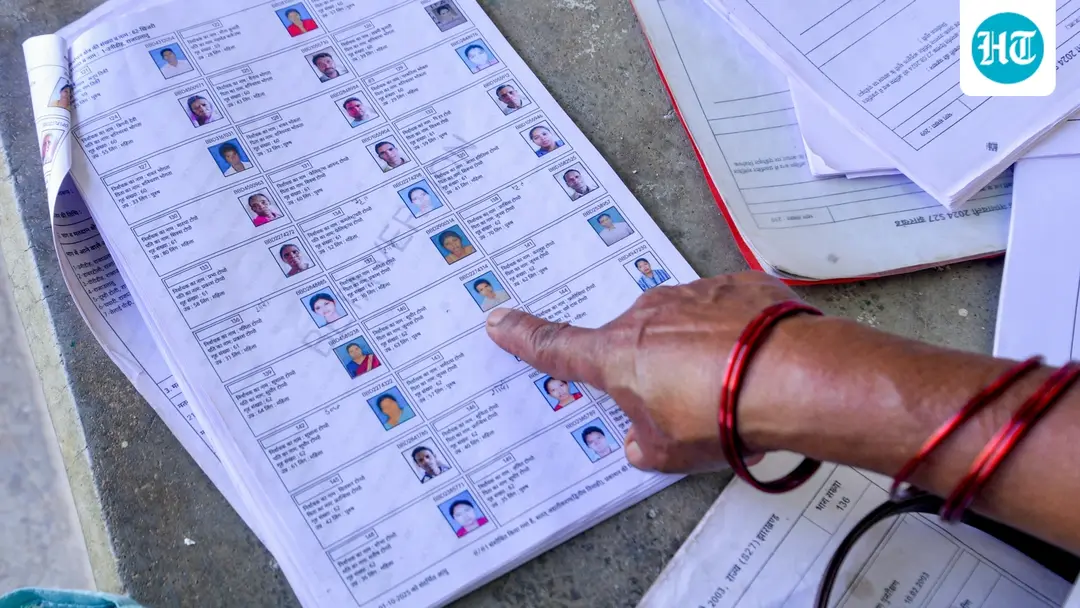
ECI issues notices to 3.31 million Delhi voters after SIR
The Election Commission has issued notices to 3.31 million people on Delhi's draft electoral roll, published on August 31 after the first phase of the Special Intensive Revision. Per the list uploaded by Delhi's Chief Electoral Officer, 94% have a single reason listed. Not being mapped to the last SIR accounts for 42% of notices (1.38 million), name mismatches 41% and age differences 16%. Some 59,791 notices list no reason. The median age of those noticed is 40.
Source
Hindustan Times — India · read the original report ↗
Desk check · compared with the source
What the desk checked (5)
- 3.31 million voters on Delhi's draft roll received ECI notices, 94% with a single reason listed — Figure appears in source, attributed to the list uploaded by Delhi's Chief Electoral Officer.
- Not being mapped to the last SIR accounts for 42% of notices (1.38 million people) — Figure appears in source; derived from HT's analysis of the CEO list.
- Name mismatches account for 41% of notices and age-difference discrepancies 16% — Source states HT counted repeated reasons multiple times to rank them; method disclosed in source.
- 59,791 notices list no reason; oldest person noticed is 125-year-old Shyam Mukhija of Sadar Bazar AC — Both details appear in source with the CEO list as the stated basis; not independently verifiable here.
- Four of 14,947 booths had no list uploaded as of 6pm on September 20 — Caveat stated explicitly by the source.
Analysts’ view opinion
Notices to 3.31 million people on Delhi's draft roll is not just an administrative exercise — it is politically combustible. The dominant reasons are database issues: non-mapping with the previous SIR, name mismatches and age gaps, which supports the argument that this is verification, not deletion. But the 59,791 notices with no reason listed at all hands the opposition a clean transparency question, and the spread across seats — 22.7% in Matia Mahal to 44.2% in Badarpur — is where the political fight will concentrate.
- With 94% of notices carrying a single reason, most appear to stem from record-matching gaps, strengthening the ECI's likely position that this is a verification stage rather than mass exclusion.
- The 59,791 notices with no reason recorded, plus booths whose lists were not uploaded, give critics a concrete process-integrity argument rather than a purely rhetorical one.
- A median age of 40 among those noticed — higher than Delhi's overall median — could feed a narrative that long-standing adult voters are being asked to re-prove themselves.
- Because notice rates vary almost twofold between constituencies, each party may claim its strongholds were disproportionately hit; the story itself offers no party-wise breakdown.
- A 125-year-old receiving a notice, and reports of prominent public figures being flagged, give the opposition easy material to question the exercise's quality.
What to watch — Watch how many of those noticed respond and survive into the final roll, and whether the ECI publicly explains the notices issued with no reason attached.
The story does not establish that any voter has been deleted, does not show which party gains or loses, and offers no evidence of deliberate bias in how notices were distributed.
Deep dive
Research brief · 8 facts · 3 dates · exam-readyThe brief
Context
The Election Commission of India (ECI) is carrying out a Special Intensive Revision (SIR) of electoral rolls, and Delhi's draft roll from the first phase was published on August 31. Following this, notices have been issued to 3.31 million people on the draft roll whose entries show discrepancies, with the list uploaded by Delhi's Chief Electoral Officer (CEO) from September 19 onwards. An HT analysis of that list shows the biggest trigger is voters not being mapped to the previous SIR, followed by name mismatches and implausible age gaps within families. A notable gap in the process is that 59,791 notices carry no reason at all.
Key facts
- Notices have been issued to 3.31 million people on Delhi's draft electoral roll, published on August 31 after the first phase of SIR.
- 3.11 million (94%) of those noticed have a single reason listed; 4% have multiple reasons.
- Not being mapped to the previous SIR is the top reason, accounting for 42% of notices, i.e. 1.38 million people.
- Name mismatches account for 41% of notices: 'Parent Name Mismatch' 24% and 'Self Name Mismatch' 17%.
- Age-difference discrepancies account for 16%: Progeny Age Gap<9 Month 6.4%, Parent Age Difference <15 5%, Parent Age difference >50 2.5%, Grandparent Age difference <40 2.3%.
- 59,791 notices have no reason listed; about 128,000 have two reasons, 9,000 have three and over 400 have four.
- Median age of a person issued a notice is 40; average age is 40; oldest is Shyam Mukhija, 125, of Sadar Bazar AC, noticed for self-name mismatch.
- Notice share varies by assembly constituency: 22.7% of draft-roll electors in Matia Mahal to 44.2% in Badarpur.
Timeline
- August 31Delhi's draft electoral roll published after the first phase of the Special Intensive Revision (SIR).
- September 19Delhi CEO's website begins uploading the list of persons issued notices; PDFs for nearly 400 booths said 'No Notices generated for this Part No'.
- September 20 (by 6pm)Most of those booth PDFs updated with tables; only 4 of 14,947 booths still had no list uploaded.
Who has a stake
- Election Commission of India (ECI) — Credibility of the SIR exercise and of the notices it has generated, including 59,791 with no reason listed.
- Chief Electoral Officer (CEO), Delhi — Responsible for publishing the draft roll and uploading booth-wise notice lists; data gaps reflect on transparency.
- 3.31 million noticed voters in Delhi — Must respond to discrepancy notices to protect their place on the final electoral roll.
- Elderly and very old electors — Oldest 20% noticed are aged 54 or above, oldest 10% are 62 or above, and one elector is recorded as 125 years old.
- Transgender electors — Half of the 447 transgender people on the draft roll have received notices, far above the overall rate.
- Voters in high-notice constituencies like Badarpur — 44.2% of draft-roll electors noticed, versus 22.7% in Matia Mahal, implying uneven verification burden.
Why it matters
Electoral rolls determine who can vote, so the volume and quality of SIR notices directly affects franchise in the capital. With 3.31 million notices, 59,791 of them carrying no stated reason, and wide constituency-level variation, questions arise about how discrepancies are flagged and how easily ordinary voters can contest them. Data anomalies such as a 125-year-old elector and disproportionate flagging of transgender voters also point to underlying roll-quality issues.
UPSC angle
Prelims pointers
- Special Intensive Revision (SIR): ECI exercise to intensively revise electoral rolls; Delhi's first-phase draft roll published August 31.
- 3.31 million Delhi voters issued notices; 1.38 million (42%) for not being mapped to the last SIR.
- Name mismatch reasons: Parent Name Mismatch 24%, Self Name Mismatch 17% of notices.
- Delhi has 14,947 polling booths; lists for 4 booths were not uploaded as of 6pm, September 20.
- National Commission on Population projects India's median age in March 2026 at 30.27 years and Delhi's at 31.91 years.
- Gender split of notices: 34.5% of men and 33.4% of women on the draft roll; 50% of the 447 transgender electors.
Mains framing
Delhi's first-phase SIR shows how algorithmic and record-matching checks on electoral rolls can generate mass notices: 3.31 million electors have been flagged, 42% simply for not being mapped to the last SIR, 41% for name mismatches and 16% for implausible parent, progeny or grandparent age gaps. Such reasons largely reflect legacy data quality problems in the rolls - inconsistent transliteration of names, missing linkages to older revisions, erroneous ages (an elector recorded as 125 years) - rather than proven ineligibility, yet the burden of proof shifts to the voter. Transparency deficits compound this: 59,791 notices list no reason, nearly 400 booth PDFs initially showed no lists and four booths remained unpublished as of September 20, while notice rates vary from 22.7% in Matia Mahal to 44.2% in Badarpur, and half of the 447 transgender electors were flagged. The way forward lies in reasoned, individually intelligible notices, machine-readable and complete booth-wise publication, targeted assistance for older and marginalised electors, and clear audit of the matching logic so that data-cleaning does not become de facto disenfranchisement.
Key terms
- Special Intensive Revision (SIR)
- An intensive ECI revision of electoral rolls; Delhi's first-phase draft roll under it was published on August 31.
- Draft electoral roll
- The provisional voter list published for public scrutiny and objections before the final roll is notified.
- Chief Electoral Officer (CEO)
- State-level officer of the ECI; Delhi's CEO uploaded the booth-wise list of persons issued notices.
- Reason for discrepancy
- Field in the notice list stating why an elector was flagged, such as not mapped to last SIR, name mismatch or age gap.
- EPIC number
- Elector's Photo Identity Card number, used in the uploaded notice tables to identify voters.
- Median age
- Middle value of an ordered set; median age of those noticed in Delhi is 40 years.
Practice questions
- Discuss how data-driven verification in electoral roll revision can affect the right to vote, using the Delhi SIR notices as an example.
- What are the main reasons for the 3.31 million notices issued after Delhi's first-phase SIR, and what do they reveal about electoral roll quality?
- Examine the transparency obligations of the ECI and state CEOs while publishing discrepancy notices during an intensive roll revision.
Grounded only in the source report — figures and dates are the source's, not inferred.