
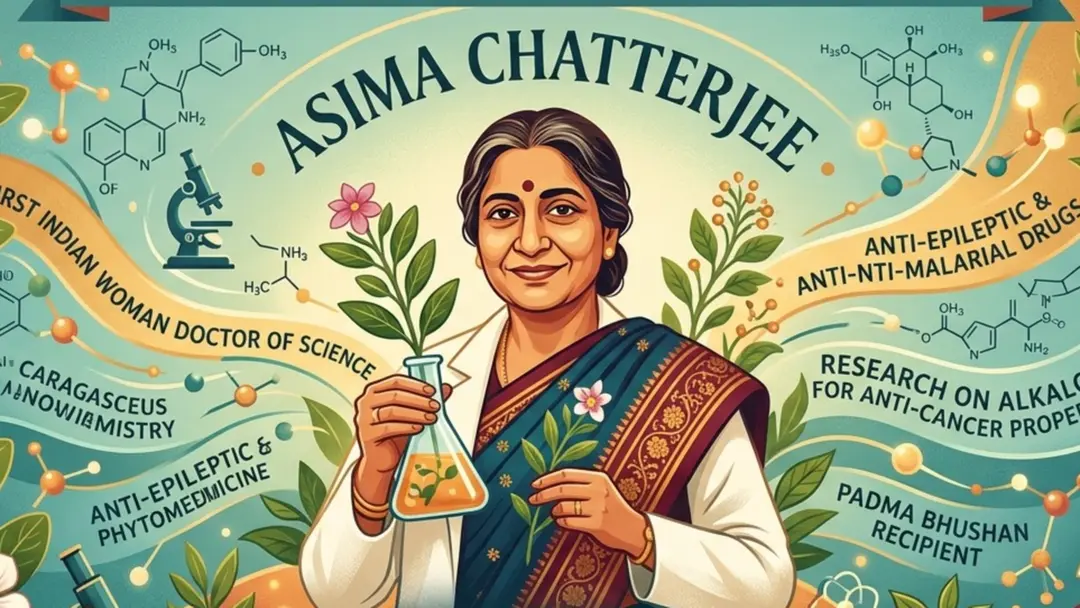
Phytochemistry pioneer Asima Chatterjee marked on 109th birth anniversary
Indian chemist Asima Chatterjee was born 109 years ago on September 23. She was the first Indian woman awarded a Doctor of Science by an Indian university. Her isolation of the chemical constituents of Marsdenia tinctoria led to an anti-epileptic drug later marketed as Ayush-56. She also worked on plant-derived anti-malarial drugs and on alkaloids of Caranthus roseus, advancing understanding of anti-cancer compounds. In 1961 she became the first woman to receive the Shanti Swarup Bhatnagar Prize, and got the Padma Bhushan in 1975.
Source
Breaking — national · read the original report ↗
Desk check · compared with the source
What the desk checked (5)
- Asima Chatterjee was the first woman to receive the Shanti Swarup Bhatnagar Prize in Chemical Sciences, in 1961. — Stated in the source headline and text; no external source cited.
- She was born on September 23, 109 years ago, and was the first Indian woman awarded a Doctor of Science by an Indian university. — Figure and claim appear in the source; attributed to 'history records'.
- Her work on Marsdenia tinctoria led to the anti-epileptic drug marketed as Ayush-56. — Appears in source text without citation of the underlying research.
- She received the Padma Bhushan in 1975 as the first woman scientist to do so, plus CV Raman and PC Ray awards. — Figures appear in source; no source given.
- Photo accompanying the article was generated with the help of AI. — Explicitly disclosed in the source photo credit.
Analysts’ view opinion
Asima Chatterjee's birth anniversary is not merely a science remembrance — it lands on two of the most politically sensitive terrains in India today: the scientific validation of traditional medicine, and symbols of women's advancement. Framing her legacy as a bridge between Ayurvedic knowledge and rigorous modern chemistry hands useful ground to those who champion AYUSH-linked research; equally, the fact that her method was rigorous validation gives critics of unvalidated traditional remedies their own argument. Her Bengal roots and long career at the University of Calcutta add a regional-pride dimension that could be picked up locally.
- Claiming nationally honoured figures for one's own narrative is a low-cost, high-return move for every party, and Chatterjee is an easy candidate because her record is uncontroversial.
- Her association with a plant-derived anti-epileptic formulation later marketed as Ayush-56 strengthens the 'scientific credibility' case made by advocates of traditional systems of medicine.
- Conversely, her achievements flowed from meticulous chemical analysis and documented methodology — ammunition for those who insist traditional remedies must clear rigorous validation before promotion.
- The story's point that she won recognition in her lifetime yet stayed absent from mainstream narratives feeds the ongoing policy debate on women's representation in science.
- Her honours span different eras of governance — the Bhatnagar Prize in 1961 and the Padma Bhushan in 1975 — which makes exclusive political ownership of her legacy hard for any single camp.
What to watch — Watch whether the anniversary draws any official or party-level signal — funding announcements for plant-based or AYUSH research, institutions named after her, or references in women-in-science schemes.
The story records no political or governmental reaction to the anniversary and no official announcement; what is offered here is contextual political reading, not reported fact.
Deep dive
Research brief · 8 facts · 7 dates · exam-readyThe brief
Context
Asima Chatterjee was an Indian organic chemist and phytochemist whose work turned India's plant biodiversity into clinically useful drugs. Born on September 23, 109 years before this article, she became the first Indian woman awarded a Doctor of Science degree by any Indian university, in pre-independence India. Her research spanned anti-epileptic and anti-malarial compounds and the alkaloid chemistry of the Madagascar periwinkle, which fed into the understanding of anti-cancer compounds. The story marks her birth anniversary and notes that despite recognition in her lifetime, she remained largely absent from mainstream and global histories of science.
Key facts
- Asima Chatterjee was born on September 23, 109 years before the article's publication (published September 20, 2026).
- She was the first Indian woman to be awarded a Doctor of Science degree by any Indian university, specialising in phytochemistry.
- She isolated the chemical constituents of Marsdenia tinctoria, leading to an anti-epileptic drug later marketed as Ayush-56.
- Her extensive research on alkaloids of Caranthus roseus (Madagascar periwinkle) advanced understanding of compounds with anti-cancer properties.
- In 1961 she became the first woman to receive the Shanti Swarup Bhatnagar Prize in Chemical Sciences, an award introduced in 1958.
- She received the Padma Bhushan in 1975, the first woman scientist to be so honoured.
- She trained in research methodology at the University of Wisconsin, Madison, and the California Institute of Technology before returning to India.
- She was professor of chemistry at the University of Calcutta and later held the prestigious Khaira Professorship of Chemistry.
Timeline
- September 23, 109 years before publicationAsima Chatterjee is born.
- Pre-independence IndiaCompletes her Doctor of Science degree in phytochemistry, the first Indian woman to receive a D.Sc. from an Indian university.
- After doctorateGains research expertise at University of Wisconsin, Madison, and California Institute of Technology, then returns to India.
- 1958The Shanti Swarup Bhatnagar Prize, India's top science award, is introduced.
- 1961Becomes the first woman to receive the Shanti Swarup Bhatnagar Prize in Chemical Sciences.
- 1975Awarded the Padma Bhushan, the first woman scientist to receive it.
- September 20, 2026Article published marking her 109th birth anniversary.
Who has a stake
- Asima Chatterjee — Her legacy as a pioneering phytochemist and institution builder, recognised in her lifetime but largely missing from mainstream narratives.
- University of Calcutta — Her academic home; she taught chemistry there amid intense gender barriers and held the Khaira Professorship.
- Indian Science Congress Association — She was the first female scientist elected as its General President.
- Indian National Science Academy — She was elected a Fellow, marking institutional recognition of her research.
- Women in Indian science — Her breaking of the glass ceiling opened and continues to inspire careers in the sciences.
- Pharmaceutical and traditional-medicine sectors — Her methods bridged Ayurvedic knowledge and rigorous chemical analysis, relevant to current debates on validating traditional medicine.
Why it matters
Chatterjee's work shows how India's plant biodiversity can be converted, through rigorous chemical analysis, into clinically useful medicines for epilepsy, malaria and cancer. Her career is also a marker of how far women had to push against academic gender barriers, and of how unevenly Indian science remembers its women. As the country debates scientifically validating traditional systems of medicine, her method of bridging Ayurvedic knowledge with modern chemistry offers a precedent.
UPSC angle
Prelims pointers
- Asima Chatterjee: first Indian woman awarded a Doctor of Science by an Indian university.
- Shanti Swarup Bhatnagar Prize introduced in 1958; Chatterjee was its first woman recipient in Chemical Sciences (1961).
- Ayush-56: anti-epileptic drug formulated from the chemical constituents of Marsdenia tinctoria.
- Caranthus roseus (Madagascar periwinkle): its alkaloids were central to her anti-cancer-related research.
- Padma Bhushan 1975; also CV Raman Award and PC Ray Award.
- First female scientist elected General President of the Indian Science Congress Association; Fellow, Indian National Science Academy.
Mains framing
Asima Chatterjee's career illustrates both the promise of phytochemistry as a route to indigenous drug development and the structural barriers women faced in Indian science. Working in pre- and post-independence India, she used physical and chemical methods to determine the complex molecular structures of numerous organic compounds, isolating constituents of Marsdenia tinctoria that led to the anti-epileptic Ayush-56, developing plant-derived anti-malarials, and mapping the alkaloid chemistry of Caranthus roseus that advanced understanding of anti-cancer compounds. Her meticulous documentation laid a foundation for modern pharmaceutical chemistry in India and, crucially, bridged traditional Ayurvedic knowledge with rigorous chemical analysis, a bridge central to today's debate on scientifically validating traditional medicine. Yet the story notes she never received the adulation her male peers did and remained largely absent from mainstream and global histories of science. The way forward, as suggested by the article's framing, lies in properly recording and celebrating such legacies, sustaining institution-building and mentorship of the kind she practised as professor and Khaira Professor at the University of Calcutta, and continuing to harness India's plant biodiversity for validated, clinically useful drugs.
Key terms
- Phytochemistry
- The study of the chemical constituents of plants; Chatterjee's field of specialisation in her D.Sc.
- Phytomedicine
- Using plant extracts to treat and even prevent conditions, a sub-category of her organic chemistry work.
- Ayush-56
- Anti-epileptic drug marketed from her isolation of the chemical constituents of Marsdenia tinctoria.
- Caranthus roseus
- The Madagascar periwinkle, whose alkaloid chemistry she researched, aiding understanding of anti-cancer compounds.
- Shanti Swarup Bhatnagar Prize
- India's top science award, introduced in 1958; she was its first woman recipient in Chemical Sciences in 1961.
- Khaira Professor of Chemistry
- A prestigious chair at the University of Calcutta to which Chatterjee was appointed.
Practice questions
- Discuss the contribution of phytochemistry to indigenous drug development in India, with reference to the work of Asima Chatterjee.
- How can traditional systems of medicine be scientifically validated? Examine with examples of plant-derived drugs.
- Examine the structural barriers faced by women scientists in India and the role of pioneers in overcoming them.
Grounded only in the source report — figures and dates are the source's, not inferred.