
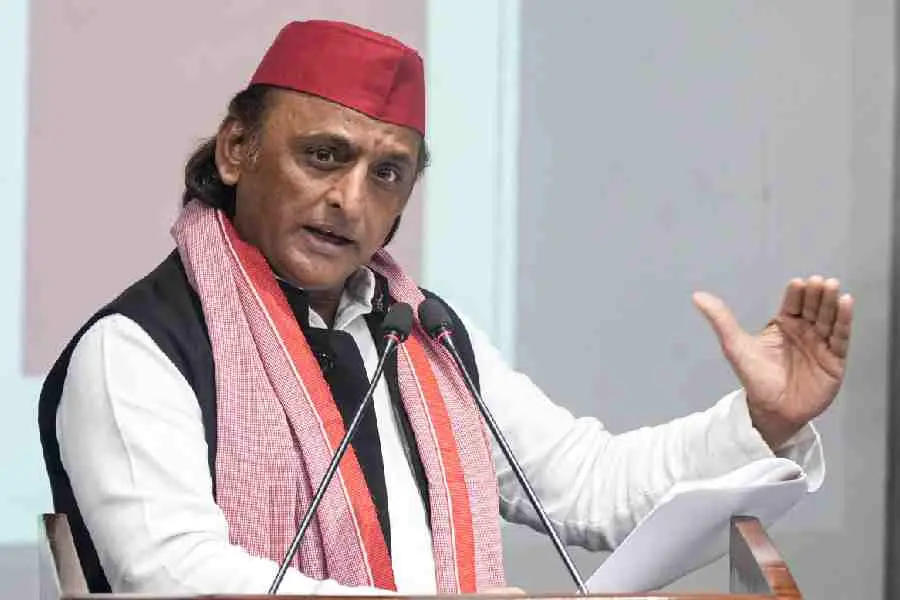
Akhilesh targets BJP on price rise, Dalit issues before 2027 UP polls
Samajwadi Party chief Akhilesh Yadav said on Sunday that the BJP was "not only anti-Constitution but also anti-Ambedkar". Speaking at the party's state executive committee meeting, he alleged that prices of diesel, petrol and all essential items were rising. He claimed an average of 15 Ambedkar statues were damaged every year under BJP rule, with 151 statues desecrated in all, most cases from Ballia, Azamgarh, Mathura and Gorakhpur. He said the SP would restore Babasaheb's honour after forming government in 2027.
Source
SP (Akhilesh Yadav) · read the original report ↗
Desk check · some claims need care
What the desk checked (5)
- BJP is 'not only anti-Constitution but also anti-Ambedkar' — Direct quote attributed to Akhilesh Yadav at the SP state executive committee meeting; opinion, not fact.
- An average of 15 Ambedkar statues damaged every year under BJP rule, with 151 statues desecrated in total — Figures stated by Akhilesh Yadav, said to be documented by the SP; no official or third-party source cited.
- Most cases of desecration reported from Ballia, Azamgarh, Mathura and Gorakhpur — Attributed to Akhilesh Yadav; no supporting data in source.
- Uttar Pradesh reported the most number of paper leaks and promised investments did not materialise — Unattributed to any data; presented as Akhilesh Yadav's claim only.
- SP is focusing on PDA (OBC, Dalit, Muslim) votes ahead of polls next year — Reported by the correspondent as context; consistent with the rest of the article.
Analysts’ view opinion
Akhilesh Yadav is locking in his 2027 campaign frame early — welding the PDA social coalition (OBC, Dalit, minority) to an economic grievance about rising prices. Foregrounding attacks on Ambedkar statues has a clear strategic logic: stake a claim to Dalit votes at a time when the BSP's hold has weakened, while shedding the SP's old Yadav-Muslim-only image. Naming Ballia, Azamgarh, Mathura and Gorakhpur — the last being the chief minister's own constituency — is a deliberate attempt to put a governance failure charge directly at Yogi Adityanath's door.
- Choosing the state executive meeting as the venue signals this is a campaign script for his own cadre first, voters second.
- The "anti-Constitution, anti-Ambedkar" language transplants the constitution-protection narrative that worked for the opposition in 2024 onto a state contest.
- Prices, paper leaks, unrealised investments and farmland acquisition are bundled to pull youth, farmers and the middle class under one umbrella.
- A Dalit-focused pitch challenges not just the BJP but also the BSP and Congress, since opposition space in UP is itself contested.
- The BJP's natural counter will be its law-and-order record and welfare delivery, plus reminders of crime under previous SP governments.
What to watch — Watch whether the BJP rebuts the statue-desecration numbers with its own data, and how the BSP responds to this direct outreach to its traditional base.
These are Akhilesh's allegations alone; the story carries no independent verification of the 151-statue figure and no BJP response.
Deep dive
Research brief · 8 facts · 3 dates · exam-readyThe brief
Context
Samajwadi Party chief Akhilesh Yadav, a former Uttar Pradesh chief minister, used a meeting of his party's state executive committee to set the tone for the SP's campaign ahead of the UP Assembly election. He accused the BJP of being "not only anti-Constitution but also anti-Ambedkar", linking price rise, paper leaks and failed investment promises to what he called disrespect for Dalits. The SP is building its campaign around the PDA formula — Peechchra (OBC), Dalit and Alpsankhyak (Muslim) voters. Akhilesh promised to restore "Babasaheb's honour" after forming government in 2027.
Key facts
- Akhilesh Yadav said on Sunday that the BJP was "not only anti-Constitution but also anti-Ambedkar", speaking at the SP state executive committee meeting.
- He alleged that on an average 15 statues of Babasaheb Bhimrao Ambedkar have been damaged every year under BJP rule.
- He said the SP documented 151 desecrated Ambedkar statues in all.
- Most such cases, he claimed, were reported from Ballia, Azamgarh, Mathura and Gorakhpur; he said many attacks in Gorakhpur "couldn't be listed".
- Gorakhpur is the constituency of Chief Minister Yogi Adityanath, as noted in the report.
- Akhilesh alleged prices of diesel, petrol and all essential items were rising, and that supply was blocked to create a perception of crisis.
- He claimed Uttar Pradesh reported the most number of paper leaks and that promised investments did not materialise.
- He alleged land was taken from farmers without adequate compensation but industries did not come up.
Timeline
- Sunday (ahead of publication)Akhilesh Yadav addresses the SP state executive committee meeting, attacking the BJP as anti-Constitution and anti-Ambedkar.
- 21 September 2026, 07:10 AMThe report on his remarks is published.
- 2027 (UP Assembly election, described as next year)Akhilesh says the SP will restore Babasaheb's honour after forming the government.
Who has a stake
- Akhilesh Yadav / Samajwadi Party — Seeking to consolidate PDA (OBC, Dalit, Muslim) votes and return to power in the 2027 UP Assembly election.
- BJP and Chief Minister Yogi Adityanath — Facing charges of being anti-Constitution and anti-Ambedkar, price rise, paper leaks and unfulfilled investment promises; Gorakhpur is Adityanath's constituency.
- Dalit voters in Uttar Pradesh — Statue desecration and questions of dignity are central to the political appeal being made to them.
- Farmers in UP — Alleged to have lost land without adequate compensation while promised industries did not come up.
- Students and aspirants in UP — Affected by what Akhilesh described as the highest number of paper leaks in the state.
- SP state executive committee and cadres — Receiving the campaign line and issues to carry into the Assembly election.
Why it matters
Uttar Pradesh sends the largest bloc of MLAs and MPs in the country, and the SP's pitch shows how Ambedkar's legacy, Dalit dignity and cost of living are becoming the central axes of its 2027 campaign. By pairing symbolic issues like statue desecration with material ones like fuel prices, paper leaks and farmland acquisition, the party is testing whether the PDA coalition can be widened beyond its traditional base.
UPSC angle
Prelims pointers
- PDA in SP's usage = Peechchra (OBC), Dalit and Alpsankhyak (Muslim).
- Akhilesh Yadav is Samajwadi Party chief and a former Uttar Pradesh chief minister.
- Gorakhpur, named among districts with most alleged statue desecrations, is CM Yogi Adityanath's constituency.
- Akhilesh's claim: 151 Ambedkar statues desecrated in all, averaging 15 a year under BJP rule.
- Districts named for most such cases: Ballia, Azamgarh, Mathura, Gorakhpur.
- Next Uttar Pradesh Assembly election: 2027, per Akhilesh's statement in the report.
Mains framing
Akhilesh Yadav's address to the SP state executive committee illustrates how identity symbolism and economic grievance are being fused in Uttar Pradesh's pre-election politics. The charge that the BJP is \"anti-Constitution and anti-Ambedkar\" rests on documented claims of statue desecration — 151 in all, an average of 15 a year — concentrated, he says, in Ballia, Azamgarh, Mathura and Gorakhpur, while the economic critique covers rising diesel, petrol and essential commodity prices, alleged supply manipulation, the highest number of paper leaks, and land acquired from farmers without adequate compensation for industries that never arrived. Analytically, this reflects the SP's PDA strategy of aggregating OBC, Dalit and Muslim constituencies by combining dignity politics with livelihood distress, in a state where Dalit votes have historically been mobilised through Ambedkarite symbolism. The counterpoint is that such claims are the assertions of an opposition party and are not independently verified in the source; any assessment would require official data on statue vandalism, recruitment examination irregularities, investment realisation against MoUs, and compensation under land acquisition law. The way forward suggested by the debate is greater transparency in examination conduct, verifiable reporting of investment and compensation outcomes, and firm law-enforcement responses to attacks on statues of constitutional figures.
Key terms
- Samajwadi Party (SP)
- Uttar Pradesh-based party led by Akhilesh Yadav, currently in opposition in the state.
- PDA
- SP's electoral formula: Peechchra (OBC), Dalit and Alpsankhyak (Muslim) voters.
- Babasaheb Bhimrao Ambedkar
- Architect of the Indian Constitution and icon of Dalit assertion; his statues are at the centre of the dispute.
- State executive committee
- A party's state-level decision-making body, where Akhilesh set the campaign tone.
- Paper leak
- Leakage of examination question papers before an exam; Akhilesh claimed UP reported the most such cases.
Practice questions
- How does the use of Ambedkar's legacy shape electoral mobilisation in Uttar Pradesh? Discuss with reference to the SP's PDA strategy.
- Examine the interplay between symbolic identity politics and material issues such as price rise, paper leaks and land acquisition in state election campaigns.
- Attacks on statues of constitutional icons raise questions of law and order as well as constitutional morality. Critically examine.
Grounded only in the source report — figures and dates are the source's, not inferred.