
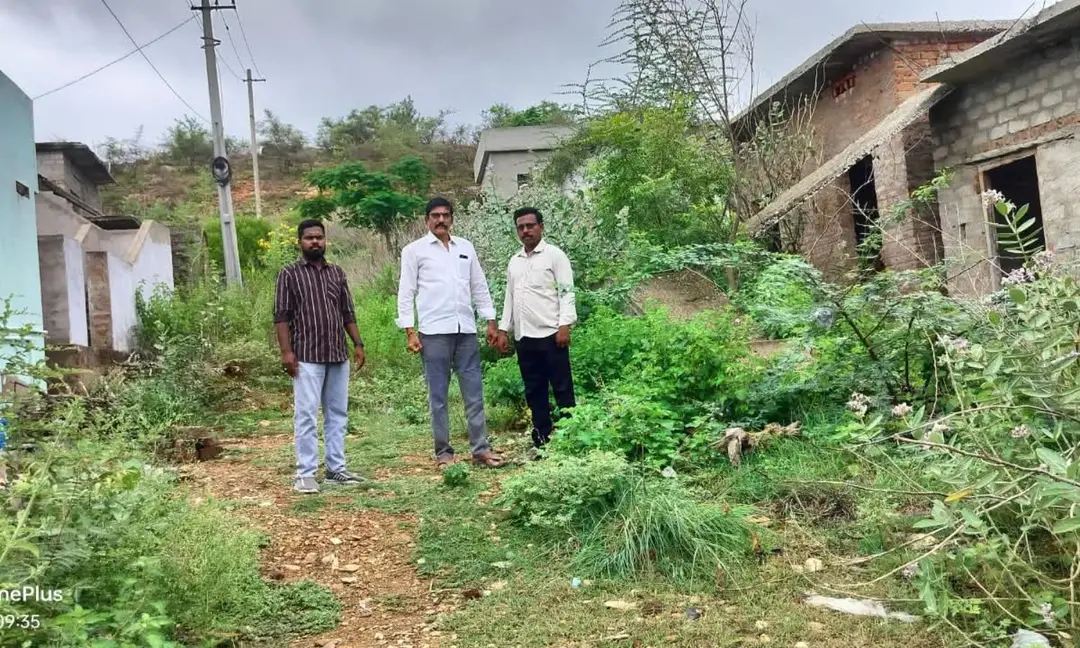
Residents flag lack of basic amenities in Porumamilla colony
All India Human Rights members visited Jagananna Colony in the Kalvakatta area of Porumamilla, YSR Kadapa district, and heard residents' grievances. Residents said 70 to 80 houses were sanctioned but only 12 families live there now. They alleged some people from adjoining Rajiv Nagar turn the valve, cutting their water supply, and that repeated complaints to the panchayat secretary went unresolved. Without street lights, they face scorpions and snakes at night. State secretary Phani Rao, K. Praveen Babu and Srinu sought drinking water and street lights, warning of a collectorate complaint.
Source
Kadapa — స్థానికం · read the original report ↗
Desk check · compared with the source
What the desk checked (5)
- Around 70-80 houses were sanctioned in the colony but only 12 families live there now — Figures appear in source, attributed to local residents; not independently confirmed
- Some people from adjoining Rajiv Nagar divert the colony's water supply by turning the valve — Allegation attributed to residents; no response from those named or from officials
- The issue was brought to the panchayat secretary's notice several times without resolution — Attributed to residents; panchayat secretary's version not in source
- Absence of street lights exposes residents to scorpions and snakes at night — Attributed to residents as stated grievance
- State secretary Phani Rao, office secretary K. Praveen Babu and organiser secretary Srinu said they will complain at the collectorate if issues persist — Named attribution in source; statement of intent only
Analysts’ view opinion
The very name of the colony makes this politically sensitive — complaints of missing basic amenities in a housing colony branded after the previous government's flagship scheme raise awkward questions for both those now in power and those who were. Residents' claim that 70-80 houses were sanctioned but only 12 families live there points to the gap between "houses delivered" as a statistic and "houses liveable" as an outcome. For now this is a village-level grievance, but examples like it are exactly the raw material for the larger political argument about scheme branding versus delivery.
- When a welfare scheme carries a leader's name, every visible shortfall in such a colony becomes a reputational cost to that brand — an inbuilt risk of personalised housing branding.
- The distance between sanctioned houses and occupied houses strengthens the critique that numerical achievement did not translate into on-ground outcomes.
- That the complaint is being raised by a rights body rather than a political party lends it a non-partisan voice, while also leaving it open for any party to adopt for its own messaging.
- The alleged diversion of water by residents of an adjacent locality signals competition among beneficiaries themselves — an uncomfortable test for panchayat-level leadership.
- The threat to petition the collectorate is a familiar escalation tactic: lifting the issue from panchayat level to district administration to increase pressure.
What to watch — Watch whether the matter actually reaches the collectorate and how quickly officials respond on drinking water and street lights; delay could turn such colonies into talking points in local political campaigning.
The story does not establish, through any official explanation or government response, whether missing amenities are the sole reason houses lie unoccupied or who is responsible for the disrupted water supply — these remain residents' allegations at this stage.
Deep dive
Research brief · 8 facts · 3 dates · exam-readyThe brief
Context
Jagananna Colony in the Kalvakatta area of Porumamilla, YSR Kadapa district (Andhra Pradesh), is a government housing layout where houses were sanctioned to beneficiaries. Members of the All India Human Rights organisation visited the colony and recorded residents' grievances about the absence of drinking water and street lights. Residents say the lack of basic infrastructure is the reason most sanctioned beneficiaries have not moved in, leaving the colony largely unoccupied.
Key facts
- Around 70 to 80 houses were sanctioned in Jagananna Colony, Kalvakatta area of Porumamilla, YSR Kadapa district.
- Only 12 families currently live in the colony, according to residents.
- Residents alleged that some people from the adjoining Rajiv Nagar turn the valve, diverting the water supplied to the colony.
- Residents said the water issue was brought to the panchayat secretary's notice several times but remained unresolved.
- The colony has no street lights; residents reported trouble from scorpions, snakes and other insects at night.
- Residents said lack of proper basic amenities is why many beneficiaries are unable to move in and live there.
- All India Human Rights State Secretary Phani Rao, Office Secretary K. Praveen Babu and Organiser Secretary Srinu demanded continuous water supply and street lights.
- The members warned they would complain at the collectorate if the problems are not resolved.
Timeline
- Before the visit (date not stated in the source)Residents repeatedly took the water diversion issue to the panchayat secretary; no resolution followed.
- Day of the visit (date not stated in the source)All India Human Rights members visited Jagananna Colony and heard residents' grievances.
- After the visitOffice-bearers demanded drinking water, street lights and other amenities, and warned of a collectorate complaint if unresolved.
Who has a stake
- Residents of Jagananna Colony (12 families) — Lack of drinking water and street lights; risk from scorpions, snakes and insects at night.
- Beneficiaries of the 70-80 sanctioned houses — Unable to occupy allotted houses due to absence of basic infrastructure.
- All India Human Rights (Phani Rao, K. Praveen Babu, Srinu) — Taking up residents' grievances with officials and threatening escalation to the collectorate.
- Panchayat secretary and local officials — Accused of not resolving repeated complaints about the water valve diversion.
- Residents of adjoining Rajiv Nagar — Alleged by colony residents to be turning the valve and cutting off their water supply.
- YSR Kadapa district collectorate — Named as the next forum where a formal complaint may be filed.
Why it matters
Sanctioned housing alone does not create habitable settlements; without water, lighting and other services, houses stay empty and public money yields no shelter. The Porumamilla case shows how a single unresolved civic dispute, such as a diverted water valve, can keep an entire colony uninhabitable and push citizens towards rights groups and the collectorate for redress.
UPSC angle
Prelims pointers
- Jagananna Colony is located in the Kalvakatta area of Porumamilla, YSR Kadapa district, Andhra Pradesh.
- Houses sanctioned in the colony: about 70-80; families currently residing: 12.
- Grievances flagged: no continuous drinking water supply and no street lights.
- Water diversion allegedly caused by people from adjoining Rajiv Nagar turning the valve.
- Panchayat secretary is the first local authority approached; collectorate is the escalation forum.
- All India Human Rights office-bearers named: State Secretary Phani Rao, Office Secretary K. Praveen Babu, Organiser Secretary Srinu.
Mains framing
The Porumamilla episode illustrates the gap between housing sanction and habitability in rural service delivery. Around 70-80 houses were sanctioned in Jagananna Colony, but only 12 families live there, with residents attributing low occupancy directly to missing basic amenities. The immediate cause is a water supply dispute, where residents allege that persons from adjoining Rajiv Nagar turn the valve and divert supply, and repeated representations to the panchayat secretary did not yield a remedy; the absence of street lights adds a safety dimension, with residents reporting scorpions, snakes and insects at night. The implications are twofold: public investment in housing remains underutilised, and citizens must rely on a civil society body, All India Human Rights, to escalate a routine civic problem to the collectorate. The way forward suggested within the story is official action to ensure continuous water supply, install street lights and provide remaining amenities so that all beneficiaries can occupy the sanctioned houses safely; the broader lesson is that housing schemes need convergent provision of water, lighting and last-mile grievance redress at the panchayat level.
Key terms
- Jagananna Colony
- The government housing colony in Kalvakatta area of Porumamilla where houses were sanctioned to beneficiaries.
- All India Human Rights
- The organisation whose members visited the colony, heard grievances and demanded amenities from officials.
- Panchayat secretary
- Village-level official to whom residents repeatedly reported the water problem without resolution.
- Collectorate
- District administration office where the members said they would file a complaint if issues persist.
- Beneficiaries
- Those allotted the sanctioned houses; most have not moved in citing lack of basic facilities.
Practice questions
- Why do sanctioned housing units often remain unoccupied? Discuss with reference to the Jagananna Colony case in Porumamilla.
- Examine the role of panchayat-level grievance redress in water supply disputes between neighbouring habitations.
- How do civil society organisations supplement formal grievance mechanisms in delivering basic amenities to rural colonies?
Grounded only in the source report — figures and dates are the source's, not inferred.