
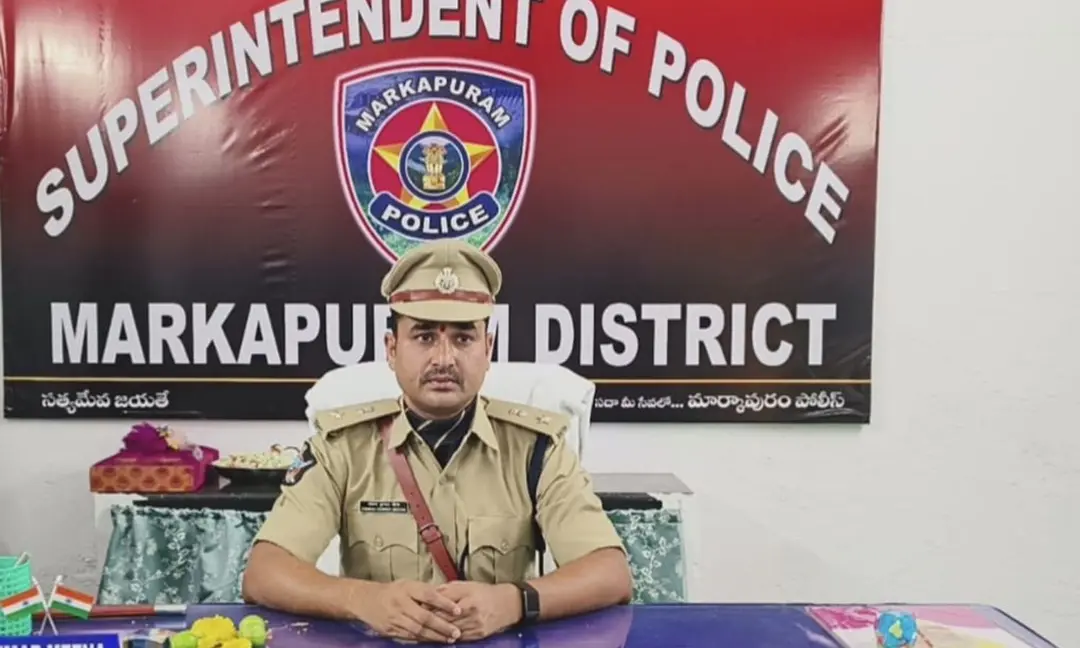
No permission for secretariat staff's 'Chalo Vijayawada': Markapur SP
Markapur District SP Pankaj Kumar Meena said no permissions have been granted for the 'Chalo Vijayawada' programme planned by secretariat employees in connection with the 'Swarna Gramam–Swarna Wardu' programme in Markapur district. He advised employees not to take part in events held without permission, warning that action would be taken as per rules if rallies or meetings were organised without clearance. He appealed for cooperation with police to protect law and order and compliance with legal norms to avoid public inconvenience.
Source
Markapur — crime & civic · read the original report ↗
Desk check · compared with the source
What the desk checked (4)
- No permissions have been granted for the 'Chalo Vijayawada' programme planned by secretariat employees. — Attributed directly to Markapur District SP Pankaj Kumar Meena in the source.
- The programme relates to the 'Swarna Gramam–Swarna Wardu' scheme in Markapur district. — Stated in source without further detail; no separate sourcing given.
- Action will be taken as per rules if rallies or meetings are held without permission. — Presented as a warning by the SP; attributed statement.
- SP appealed for cooperation with police and compliance with legal norms to avoid public inconvenience. — Attributed to the SP; no counter-view or employees' response included in source.
Analysts’ view opinion
The Markapur SP's pre-emptive announcement that the secretariat employees' ‘Chalo Vijayawada’ has no permissions is framed as a law-and-order notice, but politically it works to blunt the protest's momentum before it reaches the capital. Any government is in an awkward spot when its own staff turn agitators, because they are part of the administrative machinery itself. The permission refusal itself could now displace the employees' original demand and shift the debate onto the right to protest.
- Though it is a district-level police statement, the target being the capital makes this a state-level political story.
- The warning of action under the rules raises the personal cost of participating, so turnout now becomes the real test of the unions' strength.
- The opposition has an easy line available: that the grievance is being suppressed rather than settled.
- The government side has a genuine argument too — peace and order, avoiding public inconvenience, and following due permission procedure.
- That discontent is centred on a flagship scheme like ‘Swarna Gramam–Swarna Wardu’ is itself a messaging problem for the government.
What to watch — Watch whether the employee unions reapply for permission or proceed in defiance — that choice will decide if this ends in negotiation or confrontation.
The story does not establish what the employees are demanding, why permission was denied, or how the government and the unions have responded.
Deep dive
Research brief · 7 facts · 2 dates · exam-readyThe brief
Context
Secretariat employees in Andhra Pradesh's Markapur district planned a 'Chalo Vijayawada' protest programme in connection with the state's 'Swarna Gramam–Swarna Wardu' programme. On 26 September 2026, Markapur District Superintendent of Police Pankaj Kumar Meena publicly stated that no permissions had been granted for the march. He warned employees against joining unpermitted events and said action would follow under the rules if rallies or meetings were held without clearance. The source does not state the employees' specific demands or grievances.
Key facts
- Markapur District SP Pankaj Kumar Meena said on 26 September 2026 that no permissions have been granted for the secretariat employees' 'Chalo Vijayawada' programme.
- The proposed programme is linked to the 'Swarna Gramam–Swarna Wardu' programme in Markapur district.
- The SP advised employees not to participate in any programmes conducted without permission.
- He warned that action would be taken as per the rules if rallies or public meetings were organised without clearance.
- The SP appealed to employees to cooperate with police so that law and order is not disturbed.
- He asked that legal norms be followed so that the public is not inconvenienced.
- The employees' specific demands behind the 'Chalo Vijayawada' call are not stated in the source.
Timeline
- Date not stated in the sourceSecretariat employees plan a 'Chalo Vijayawada' programme connected to the 'Swarna Gramam–Swarna Wardu' programme in Markapur district.
- 26 September 2026Markapur District SP Pankaj Kumar Meena states no permissions have been granted and warns of action under the rules against unpermitted rallies or meetings.
Who has a stake
- Secretariat (village/ward secretariat) employees of Markapur district — Their planned 'Chalo Vijayawada' mobilisation lacks permission; participation could invite action as per rules.
- Markapur district police, led by SP Pankaj Kumar Meena — Responsible for maintaining law and order and enforcing permission requirements for rallies and meetings.
- Andhra Pradesh government — Implementation of the 'Swarna Gramam–Swarna Wardu' programme and handling of employee discontent around it.
- General public in Markapur district — Potential inconvenience from rallies; the SP cited public convenience as a reason for insisting on legal norms.
Why it matters
The case sits at the intersection of the right of government employees to protest and the state's power to regulate assemblies for law and order. When police deny permission in advance and threaten rule-based action, the space for organised grievance redressal by frontline staff narrows, raising questions about how such disputes get resolved.
UPSC angle
Prelims pointers
- Markapur is a district in Andhra Pradesh; its Superintendent of Police is Pankaj Kumar Meena (as of 26 September 2026).
- 'Swarna Gramam–Swarna Wardu' is the Andhra Pradesh programme referenced in the secretariat employees' agitation.
- 'Chalo Vijayawada' denotes a mass march to Vijayawada, a major administrative centre in Andhra Pradesh.
- Police permission is required for rallies and public meetings; violations invite action as per rules.
- The SP's stated grounds for insisting on permission: protecting law and order and avoiding public inconvenience.
Mains framing
The Markapur episode illustrates a recurring tension in Indian administration: government employees, who are also service-rule-bound personnel, seeking to press demands through mass mobilisation, against a district police administration asserting that assemblies without prior permission threaten law and order and public convenience. The immediate trigger here is the 'Swarna Gramam–Swarna Wardu' programme, over which secretariat employees planned a 'Chalo Vijayawada' march; the SP's response was preventive — declaring that no permission had been granted, advising employees to stay away, and warning of action as per rules. Such pre-emptive denial can be defended as a proportionate law-and-order measure, but it also shifts the dispute from negotiation to enforcement, leaving grievances unaddressed and inviting perceptions of suppression. A balanced way forward would emphasise institutional channels — structured dialogue between the department and employee associations, time-bound grievance redressal, and regulated permission for peaceful assembly at designated venues — so that both the employees' right to be heard and the public's right to undisturbed order are respected. The source does not detail the employees' demands, which underlines the need for transparent articulation of both sides.
Key terms
- Chalo Vijayawada
- A call for a mass march or gathering of protesters at Vijayawada in Andhra Pradesh to press demands.
- Swarna Gramam–Swarna Wardu
- The Andhra Pradesh programme in connection with which Markapur secretariat employees planned their protest.
- Secretariat employees
- Staff of village/ward secretariats — the local-level delivery arm of government services in Andhra Pradesh.
- Superintendent of Police (SP)
- District-level head of police, responsible for law and order; here, Pankaj Kumar Meena of Markapur district.
- Permission for rally/meeting
- Prior police clearance required to hold a procession or public meeting; the SP said none was granted here.
Practice questions
- Examine the limits on the right of government employees to protest in India, using the Markapur 'Chalo Vijayawada' case as a reference point.
- How should district police balance preventive denial of permission for rallies with citizens' freedom of assembly? Discuss.
- Discuss institutional mechanisms for resolving grievances of frontline government staff before they escalate into mass agitations.
Grounded only in the source report — figures and dates are the source's, not inferred.