
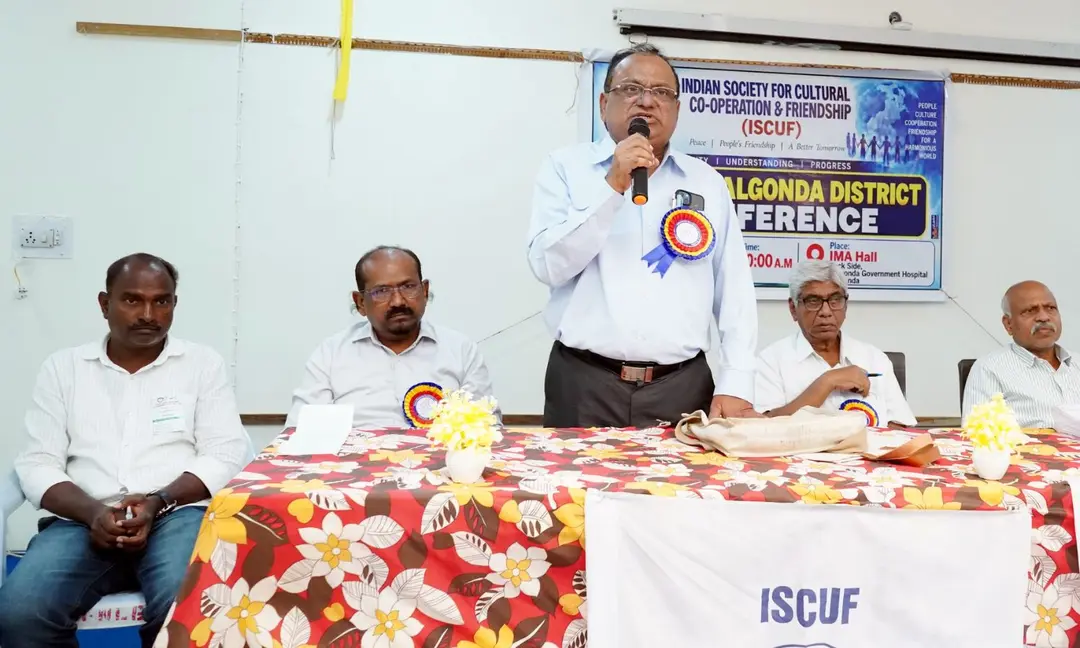
ISCUF working for national unity for 80 years: Kadaru Prabhakar Rao
ISCUF has worked continuously for 80 years to spread Indian culture and arts worldwide and to protect national unity and integrity, said the organisation's state president and High Court advocate Kadaru Prabhakar Rao. He was chief guest at the ISCUF district conference held Sunday at the IMA Hall in Nalgonda, chaired by Dr ACH Pulla Rao. He demanded adequate priority for developing countries in the IMF and World Bank, welcomed the questioning of imperialist dominance at the New Delhi BRICS summit and condemned what he called the illegal arrest of Venezuelan President Maduro by the US army.
Source
Nalgonda — వార్తలు · read the original report ↗
Desk check · some claims need care
What the desk checked (5)
- ISCUF has worked for 80 years to spread Indian culture and arts worldwide and protect national unity and integrity. — Attributed to ISCUF state president Kadaru Prabhakar Rao; the 80-year figure appears in the source with no independent documentation.
- The ISCUF district conference was held Sunday at the IMA Hall in Nalgonda, chaired by Dr ACH Pulla Rao, with Prabhakar Rao as chief guest. — Event details, venue and names appear in the source as reported; date line gives 13 September 2026.
- He demanded adequate priority for developing countries in the IMF and World Bank. — Attributed statement of demand by the speaker; no supporting data cited.
- The recent BRICS summit in New Delhi questioned the dominance of imperialist countries. — Characterisation attributed to the speaker; the source gives no independent confirmation of the summit or its proceedings.
- Venezuelan President Maduro was illegally arrested by the US army. — Presented as the speaker's condemnation; unsourced and unverified in the text — treat as a claim made at the meeting, not as established fact.
Analysts’ view opinion
The ISCUF district conference in Nalgonda looks like a cultural event on the surface, but its political register is unmistakable. By pairing the language of "national unity and integrity" with foreign-policy demands — greater weight for developing countries at the IMF and World Bank, approval of BRICS questioning big-power dominance, and condemnation of US action against Venezuela's president — Kadaru Prabhakar Rao turned a cultural platform into a foreign-policy one. District-level conferences of this kind are also organisational tools, and holding it in an IMA hall with a doctor presiding suggests an effort to draw professional, urban middle-class networks into that conversation.
- Foregrounding an 80-year record and national integration is a bid for patriotic legitimacy that insulates the organisation from the charge of being narrowly ideological.
- Calls for IMF and World Bank reform and support for BRICS sit close to India's mainstream diplomatic posture, so this is less anti-establishment than an appeal to a broad multipolarity consensus.
- The sharper condemnation of US action and the vocabulary of "imperialist dominance" mark a clear left/non-aligned ideological lineage.
- A state president who is also a High Court advocate serving as chief guest points to a strategy of expanding influence through professional and legal networks rather than street mobilisation.
- This is not an electoral pitch; such district conferences are typically slow-burn cadre-building and opinion-shaping exercises.
What to watch — Watch whether this district circuit builds towards a state-level convention and whether party politicians begin appearing on these platforms.
The story rests on one speaker's remarks and does not establish any party affiliation for the organisation, the size of the gathering, or the details of the international events he cited.
Deep dive
Research brief · 8 facts · 5 dates · exam-readyThe brief
Context
The Indian Cultural Co-operation and Friendship Society (ISCUF) held its district conference in Nalgonda, Telangana, on Sunday at the IMA Hall. The organisation's state president, High Court advocate Kadaru Prabhakar Rao, was chief guest and used the platform to describe ISCUF's 80-year record of promoting Indian culture and arts abroad and defending national unity and integrity. He also raised international issues: representation of developing countries in the IMF and World Bank, the recent BRICS summit in New Delhi, and the arrest of Venezuelan President Maduro by the US army. The report was published on 13 September 2026.
Key facts
- ISCUF (Indian Cultural Co-operation and Friendship Society) has worked continuously for 80 years, according to state president Kadaru Prabhakar Rao.
- Kadaru Prabhakar Rao is ISCUF's state president and a High Court advocate; he attended as chief guest.
- The ISCUF district conference was held on Sunday at the IMA Hall in Nalgonda.
- The conference was chaired by Dr ACH Pulla Rao.
- Rao demanded adequate priority for developing countries in the International Monetary Fund (IMF) and the World Bank.
- He welcomed the questioning of imperialist countries' dominance at the recently held BRICS summit in New Delhi.
- He strongly condemned what he called the illegal arrest of Venezuelan President Maduro by the US army.
- The report carries a publication date and time of 13 September 2026, 7:19 PM IST.
Timeline
- Over the past 80 yearsISCUF works to spread Indian culture and arts worldwide and to protect national unity and integrity, as stated by its state president.
- Recently (exact date not stated in the source)BRICS summit held in New Delhi, where the dominance of imperialist countries was questioned.
- Recently (exact date not stated in the source)Venezuelan President Maduro arrested by the US army, an act condemned at the conference as illegal.
- SundayISCUF district conference held at IMA Hall, Nalgonda, chaired by Dr ACH Pulla Rao with Kadaru Prabhakar Rao as chief guest.
- 13 September 2026Report of the conference published.
Who has a stake
- ISCUF (Indian Cultural Co-operation and Friendship Society) — Its claim of 80 years of work in cultural diplomacy and in defending national unity and integrity.
- Kadaru Prabhakar Rao, ISCUF state president and High Court advocate — Articulated the organisation's positions on IMF/World Bank reform, BRICS and Venezuela as chief guest.
- Dr ACH Pulla Rao — Chaired the ISCUF district conference in Nalgonda.
- Developing countries — Demand for adequate priority and voice within the IMF and the World Bank.
- BRICS grouping — Its New Delhi summit was cited as a forum where imperialist dominance was questioned.
- Venezuela and President Maduro — His arrest by the US army was condemned as illegal at the conference.
Why it matters
A district-level cultural organisation's conference shows how global questions — voting power in the IMF and World Bank, the rise of BRICS, and sovereignty disputes such as Venezuela's — travel into local Indian public discourse. It also illustrates the role of cultural friendship societies in projecting Indian culture abroad while claiming a stake in defending national unity and integrity.
UPSC angle
Prelims pointers
- ISCUF = Indian Cultural Co-operation and Friendship Society; said to be 80 years old; state president Kadaru Prabhakar Rao.
- ISCUF district conference: held Sunday at IMA Hall, Nalgonda, chaired by Dr ACH Pulla Rao.
- IMF and World Bank: demand raised for greater priority to developing countries in these institutions.
- BRICS summit was recently held in New Delhi, per the source.
- Venezuelan President Maduro's arrest by the US army was condemned at the meeting.
- Report published 13 September 2026.
Mains framing
The Nalgonda ISCUF conference links a local cultural platform to global governance debates. The demand that developing countries get adequate priority in the IMF and the World Bank reflects a long-standing grievance that Bretton Woods institutions under-represent the Global South, while the welcoming of the questioning of imperialist dominance at the New Delhi BRICS summit signals support for plurilateral groupings as counterweights. The condemnation of the arrest of Venezuelan President Maduro by the US army frames the concern as one of sovereignty and non-intervention. At the same time, ISCUF's self-description — eighty years of spreading Indian culture and arts worldwide alongside protecting national unity and integrity — positions cultural diplomacy as both an external and internal project. The way forward suggested by such positions is institutional reform giving developing countries greater voice, strengthened multilateral forums, and continued people-to-people cultural exchange; the source does not state any specific policy mechanism or commitment beyond these demands.
Key terms
- ISCUF
- Indian Cultural Co-operation and Friendship Society; organisation that says it has worked 80 years on Indian culture, arts and national unity.
- IMF (International Monetary Fund)
- Global financial institution in which the speaker demanded adequate priority for developing countries.
- World Bank
- International development lending institution, also named in the demand for greater priority for developing countries.
- BRICS
- Grouping whose recent New Delhi summit, per the source, saw the dominance of imperialist countries questioned.
- IMA Hall, Nalgonda
- Venue of the ISCUF district conference held on Sunday.
Practice questions
- Examine the demand for greater representation of developing countries in the IMF and the World Bank. What arguments support such reform?
- How do plurilateral groupings such as BRICS shape debates on dominance in the global order? Discuss with reference to the recent New Delhi summit.
- Discuss the role of cultural friendship societies in promoting Indian culture abroad and in domestic discourse on national unity and integrity.
Grounded only in the source report — figures and dates are the source's, not inferred.