
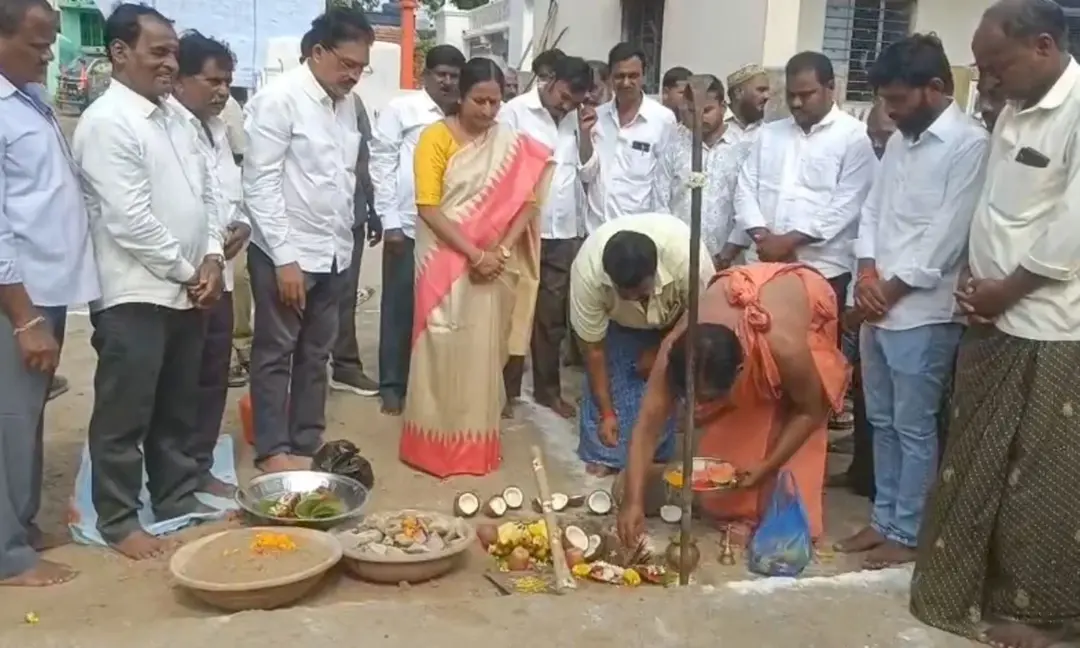
Palle Panduga works launched in Alur, anganwadi centre inspected
TDP in-charge Vaikuntam Jyothi launched development works in Alur of Kurnool district as part of Palle Panduga 3.0, performing bhoomi puja for a CC road in Kota Street. She thanked Chief Minister Chandrababu Naidu and Deputy Chief Minister Pawan Kalyan for sanctioning Rs 21 crore of works to Alur constituency. She later visited Anganwadi Centre No. 4, inspected nutritious food given to children and told staff to ensure quality nutrition for children and pregnant women.
Source
Kurnool — వార్తలు · read the original report ↗
Desk check · compared with the source
What the desk checked (5)
- Rs 21 crore of development works were sanctioned to Alur constituency under Palle Panduga 3.0 — Figure appears in source, attributed to statements by TDP in-charge Vaikuntam Jyothi; no official order cited.
- Bhoomi puja was performed for a CC road in Kota Street, Alur — Stated as fact in source with no separate attribution.
- Vaikuntam Jyothi inspected nutritious food supplied at Anganwadi Centre No. 4 in Kota Street — Reported directly by the source; consistent with the rest of the account.
- Thanks conveyed to CM Chandrababu Naidu and Deputy CM Pawan Kalyan for the sanction — Attributed to Vaikuntam Jyothi's remarks at the event.
- Coalition government is prioritising rural infrastructure, farmer welfare, sanitation and horticulture — Political claim attributed to Vaikuntam Jyothi, not independently sourced.
Analysts’ view opinion
On the surface this is a routine groundbreaking in Aluru, but politically it reads as constituency-level base-building. That a party in-charge — not an elected legislator — performed the bhoomi puja and then inspected an anganwadi centre is the classic model of concentrating both development credit and welfare oversight around one local figure. Thanking both Chief Minister Chandrababu Naidu and Deputy CM Pawan Kalyan for the Rs 21 crore sanction is a deliberate signal of coalition cohesion taken to the grassroots.
- Government drives like 'Palle Pandaga 3.0' function as platforms where administration and party outreach happen simultaneously at the village level.
- Having a party in-charge rather than an elected representative launch the works gives that leader a chance to consolidate local political standing.
- Crediting the Rs 21 crore to both the CM and the Deputy CM is a calibrated show of TDP–Jana Sena alliance unity.
- Pairing road works with an anganwadi nutrition inspection broadens the appeal from infrastructure to women and child welfare voters.
- With credit flowing entirely to the ruling side, the opposition could counter on alleged bias in fund allocation or on quality of execution.
What to watch — Watch how quickly and transparently the sanctioned Rs 21 crore of works actually materialise on the ground, and who ends up owning that credit.
The story does not establish how funds were allocated, what actual progress has been made, or how rivals have responded — it documents a single event.
Deep dive
Research brief · 8 facts · 2 dates · exam-readyThe brief
Context
Palle Panduga 3.0 is a rural development drive under which the coalition (Kutami) government in Andhra Pradesh sanctions and launches village-level infrastructure works. In Alur of Kurnool district, TDP in-charge Vaikuntam Jyothi launched such works, performing bhoomi puja for a CC (cement concrete) road in Kota Street. She said the government is prioritising rural infrastructure, farmer welfare, sanitation and horticulture development. The same visit included an inspection of Anganwadi Centre No. 4 in Kota Street, where supplementary nutrition for children is served.
Key facts
- Development works in Alur, Kurnool district were launched as part of Palle Panduga 3.0 by TDP in-charge Vaikuntam Jyothi.
- Bhoomi puja was performed for construction of a CC (cement concrete) road in Kota Street, Alur.
- Rs 21 crore worth of development works have been sanctioned to Alur constituency under Palle Panduga 3.0.
- Vaikuntam Jyothi thanked Chief Minister Chandrababu Naidu and Deputy Chief Minister Pawan Kalyan for the sanction.
- She said the coalition government is giving priority to rural infrastructure, farmer welfare, sanitation and horticulture development.
- She visited Anganwadi Centre No. 4 in Kota Street and examined the nutritious food being supplied to children.
- Staff were asked whether children receive quality nutritious food as prescribed by the government.
- She directed staff to focus on children's health and nutrition and ensure every pregnant woman gets proper nutritious food.
Timeline
- Day of the event (date not stated in the source)Bhoomi puja performed and CC road works launched in Kota Street, Alur, under Palle Panduga 3.0.
- Later the same dayAnganwadi Centre No. 4 in Kota Street inspected; nutritious food supply reviewed and instructions given to staff.
Who has a stake
- Residents of Alur constituency, Kurnool district — Beneficiaries of Rs 21 crore of sanctioned works, including the new CC road in Kota Street.
- Vaikuntam Jyothi, TDP in-charge, Alur — Launched the works and is answerable locally for their execution and quality.
- Andhra Pradesh coalition government (CM Chandrababu Naidu, Deputy CM Pawan Kalyan) — Credited with sanctioning the works; delivery of Palle Panduga 3.0 reflects on its rural development claims.
- Anganwadi Centre No. 4 staff — Directed to ensure government-prescribed quality nutrition for children and pregnant women.
- Children and pregnant women in Alur — Depend on the anganwadi centre for supplementary nutrition and health support.
Why it matters
Village-level works like CC roads and functioning anganwadi centres are the point where state schemes are actually felt by households, and a Rs 21 crore sanction for a single constituency is a significant local commitment. The dual focus on hard infrastructure and nutrition delivery shows how rural development drives are increasingly paired with human development monitoring. For citizens, the test is whether sanctioned works and prescribed nutrition norms are delivered on the ground.
UPSC angle
Prelims pointers
- Palle Panduga 3.0 — rural development programme under which works were launched in Alur, Kurnool district, Andhra Pradesh.
- Rs 21 crore of development works sanctioned to Alur constituency under Palle Panduga 3.0.
- Alur is a constituency in Kurnool district, Andhra Pradesh.
- Andhra Pradesh Chief Minister named in the source: Chandrababu Naidu; Deputy Chief Minister: Pawan Kalyan.
- Anganwadi centres deliver supplementary nutrition to children and pregnant women.
- Stated priorities of the coalition government: rural infrastructure, farmer welfare, sanitation, horticulture development.
Mains framing
Local development programmes such as Palle Panduga 3.0 illustrate the delivery-end of rural governance in India: state funds are sanctioned constituency-wise (here Rs 21 crore for Alur in Kurnool district), and works such as CC roads are launched with political leadership present, while parallel attention is paid to social infrastructure like anganwadi centres. The causes of such a dual approach lie in the recognition that rural well-being depends both on physical connectivity and sanitation and on nutrition outcomes for children and pregnant women, which the source records as being inspected against government-prescribed norms. The implications are twofold: visible infrastructure creates accountability that citizens can verify, but nutrition delivery depends on continuous supervision of frontline workers rather than one-time visits. A grounded way forward, as suggested by the source itself, is regular inspection of anganwadi centres for quality and coverage, transparent tracking of sanctioned works against completion, and integrating infrastructure spending with the stated priorities of farmer welfare, sanitation and horticulture development so that the money translates into measurable local outcomes.
Key terms
- Palle Panduga 3.0
- Andhra Pradesh rural development programme under which village works, including Alur's CC road, were sanctioned and launched.
- Bhoomi puja
- Ground-breaking ritual performed before beginning a construction work, here for the Kota Street CC road.
- CC road
- Cement concrete road; a durable village road being constructed in Kota Street, Alur.
- Anganwadi centre
- Village-level centre providing supplementary nutrition and child care services; Centre No. 4 in Kota Street was inspected.
- Kutami (coalition) government
- The ruling alliance government in Andhra Pradesh credited in the source with prioritising rural infrastructure and welfare.
- TDP in-charge
- Party functionary responsible for a constituency; Vaikuntam Jyothi holds this role for Alur.
Practice questions
- Discuss how constituency-level programmes such as Palle Panduga 3.0 shape rural infrastructure delivery in Andhra Pradesh, using the Alur example.
- Anganwadi centres are the frontline of nutrition delivery for children and pregnant women. Examine the challenges in ensuring quality and coverage at this level.
- Evaluate the argument that visible infrastructure works receive greater political attention than nutrition and health outcomes in rural development programmes.
Grounded only in the source report — figures and dates are the source's, not inferred.