
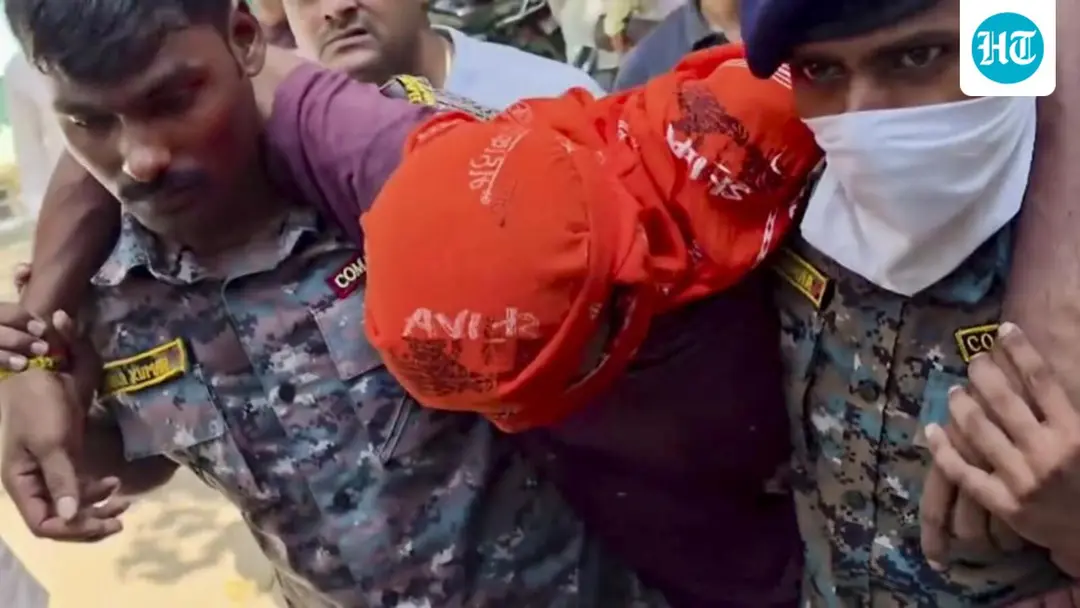
Masked accused in Jamui video arrested after being shot in leg
Nandan Yadav, the masked man seen grabbing a 16-year-old schoolgirl in a viral video from Bihar's Jamui, was arrested on Tuesday after being shot in the leg, police said. His associate Hari Ram Yadav was also arrested. Munger range DIG Rakesh Kumar said the SIT conducted the operation near Kundan Braj on the Jamui-Lakhisarai road. Three more persons were arrested for circulating the clips. The incident occurred on September 19.
Source
Hindustan Times — India · read the original report ↗
Desk check · some claims need care
What the desk checked (5)
- Nandan Yadav, the masked man in the Jamui viral video, was arrested on Tuesday after being shot in the leg during a raid. — Attributed to police in the source; circumstances not independently detailed.
- Police opened fire when the suspect attacked the team and tried to flee. — Police claim; source notes police declined to share details of the circumstances.
- The SIT arrested the two near Kundan Braj area on the Jamui-Lakhisarai road, about 5km from the crime spot. — Attributed to Munger range DIG Rakesh Kumar.
- Seven people were identified and three earlier arrested, all of whom police said were minors. — Attributed to Jamui SP Vishwajeet Dayal and Jamui police.
- Three persons — Ramashish Chaudhary, Kundan Kumar and Mohammad Faiyaaj — were arrested for circulating the video clips. — Attributed to police; names appear in source.
Analysts’ view opinion
The police action looks swift, but legally two separate questions now run in parallel: the prosecution of the accused, and whether the shooting itself withstands legal scrutiny. Because the survivor is a 16-year-old, child-protection provisions and identity-confidentiality rules impose additional duties on the investigation. Police themselves say three of those arrested earlier are minors, which would ordinarily route their cases through the juvenile justice system. The separate arrests over circulating the clips are a reminder that sharing such footage can itself be an independent offence, even as the footage serves as evidence.
- Where an arrest involves police firing, established Supreme Court-laid procedure — independent inquiry, magisterial examination, registration of a case — becomes the key next procedural step.
- Police say the suspect attacked them and tried to flee, but the story records that they declined to share the circumstances, a gap that leaves the legal justification untested for now.
- An injured accused retains constitutional protections — medical attention, access to counsel, production before a magistrate within the prescribed time — and the gravity of the allegation does not dilute them.
- The survivor's minority triggers heightened obligations: shielding her identity and recording her statement in the manner the law prescribes for child victims.
- The clips have a dual character: evidence that enabled identification, and material whose circulation is being treated as a distinct offence.
What to watch — Watch whether any independent or magisterial examination of the shooting is announced, whether the remaining identified suspects are traced, and whether the minors' cases are placed before the juvenile justice machinery.
The story does not set out the specific charges, the full circumstances of the shooting, or the status of any chargesheet or judicial review — and an arrest is not proof of guilt.
Deep dive
Research brief · 8 facts · 5 dates · exam-readyThe brief
Context
On the evening of September 19, a group of men in Bihar's Jamui district stopped two Class 10 students returning from a local tourist spot, made vulgar comments, slapped the boy and sexually assaulted the 16-year-old girl. Video clips of the assault circulated on social media and triggered nationwide outrage as well as a political row. Bihar police constituted a special investigation team (SIT) to trace the accused; on Tuesday, the masked main accused Nandan Yadav was arrested after being shot in the leg during a raid, along with his associate Hari Ram Yadav.
Key facts
- Nandan Yadav, the masked man seen grabbing the 16-year-old schoolgirl in the viral video, was arrested on Tuesday after being shot in the leg during a raid.
- His associate, identified by police as Hari Ram Yadav, was also arrested.
- The incident took place on the evening of September 19, when two Class 10 students were stopped while returning from a local tourist spot.
- Nandan Yadav had covered his face with a gamcha (light cotton towel) during the attack, as per police.
- Munger range DIG Rakesh Kumar said the SIT made the arrests near Kundan Braj on the Jamui-Lakhisarai road, about 5 km from the crime spot.
- The SIT is led by sub-divisional police officer Deepti Monali.
- Jamui SP Vishwajeet Dayal said seven people were identified using video clips from social media; three were arrested and police said on Tuesday these three were minors.
- Three more persons - Ramashish Chaudhary, Kundan Kumar and Mohammad Faiyaaj - were arrested for circulating the video clips.
Timeline
- September 19 (evening)A group stops two Class 10 students in Jamui, makes vulgar comments, slaps the boy and sexually assaults the girl; clips are recorded.
- After the videos surfacedNationwide outrage; Bihar police constitute an SIT led by SDPO Deepti Monali to trace the suspects.
- MondayJamui SP Vishwajeet Dayal says seven people identified from video clips and three arrested.
- TuesdayNandan Yadav shot in the leg and arrested along with Hari Ram Yadav near Kundan Braj; police say the three earlier arrested are minors.
- Tuesday (same phase)SIT arrests Ramashish Chaudhary, Kundan Kumar and Mohammad Faiyaaj for circulating the video clips.
Who has a stake
- The 16-year-old survivor and the boy assaulted with her — Justice, safety and protection of identity after videos of the assault spread on social media.
- Bihar Police / Jamui police — Credibility of investigation and the circumstances of the encounter in which the main accused was shot.
- SIT led by SDPO Deepti Monali — Tracking down all seven identified suspects and those who recorded and shared the clips.
- Munger range DIG Rakesh Kumar and Jamui SP Vishwajeet Dayal — Supervisory accountability for the operation and public disclosure of details.
- The accused, including three minors — Criminal liability; the three minors face proceedings as juveniles, per police.
- Social media users and WhatsApp group members who shared clips — Legal exposure - three have already been arrested for circulating the videos.
Why it matters
The case shows how a video circulating on social media can both expose a crime and re-victimise the survivor, forcing police into a high-visibility, time-bound response. It also raises questions about encounter-style arrests, since police declined to immediately share details of the circumstances in which the main accused was shot. Separately, the arrest of three people for circulating the clips signals that sharing such footage is itself treated as an offence.
UPSC angle
Prelims pointers
- Jamui and Lakhisarai are districts in Bihar; Jamui falls under the Munger police range.
- An SIT (special investigation team) is a dedicated police team formed for a specific case; here it is led by an SDPO.
- Police hierarchy in the story: DIG (range) > SP (district) > SDPO (sub-division).
- Circulating video clips of a sexual assault is itself a punishable act - three persons were arrested on that charge.
- Accused identified as minors are dealt with under juvenile justice provisions, not as adult accused.
- Incident date: September 19; main accused arrested on a Tuesday after being shot in the leg.
Mains framing
The Jamui case illustrates three intersecting failures and responses in India's criminal justice system. First, the crime itself - the roadside sexual assault of a 16-year-old and the assault of her classmate in daylight public space - points to the persistent insecurity of girls in public places, and the involvement of minors among the identified accused suggests a wider social normalisation of such harassment. Second, the role of the mobile video is double-edged: it became the primary evidentiary basis for identifying seven suspects, but its circulation on social media and WhatsApp groups also amounted to a secondary violation of the survivor's dignity, which is why police arrested three persons for sharing it and deployed technical teams to trace the origin. Third, the state's response was driven by the intensity of public and political pressure, culminating in an encounter in which the main accused was shot in the leg while police declined to share details - raising the familiar tension between swift visible action and due process. The way forward, on the facts available, lies in evidence-led prosecution that withstands trial, strict enforcement against the online circulation of such material, survivor-centred support and identity protection, and transparent internal review of the use of force during arrest, so that public confidence rests on convictions rather than on spectacle.
Key terms
- SIT (Special Investigation Team)
- A dedicated police team constituted for a specific sensitive case; here led by SDPO Deepti Monali.
- DIG (Deputy Inspector General)
- Senior police officer heading a range; Rakesh Kumar holds the post for the Munger range covering Jamui.
- SDPO (Sub-divisional police officer)
- Officer in charge of policing in a sub-division of a district; heads the Jamui SIT in this case.
- Gamcha
- A light cotton towel, used by the main accused to cover his face during the September 19 attack.
- Encounter
- Police term for an armed exchange during an operation; here police say they fired when the suspect attacked and tried to flee.
Practice questions
- The Jamui case shows that viral videos can serve both as evidence and as a further violation of a survivor's dignity. Discuss the legal and ethical challenges this poses for police investigations in India.
- Critically examine the use of 'encounters' and injury-causing police firing during arrests in high-profile crimes, with reference to due process safeguards.
- What institutional measures can improve the safety of schoolgirls in public spaces, and how should cases involving minor accused be handled?
Grounded only in the source report — figures and dates are the source's, not inferred.