
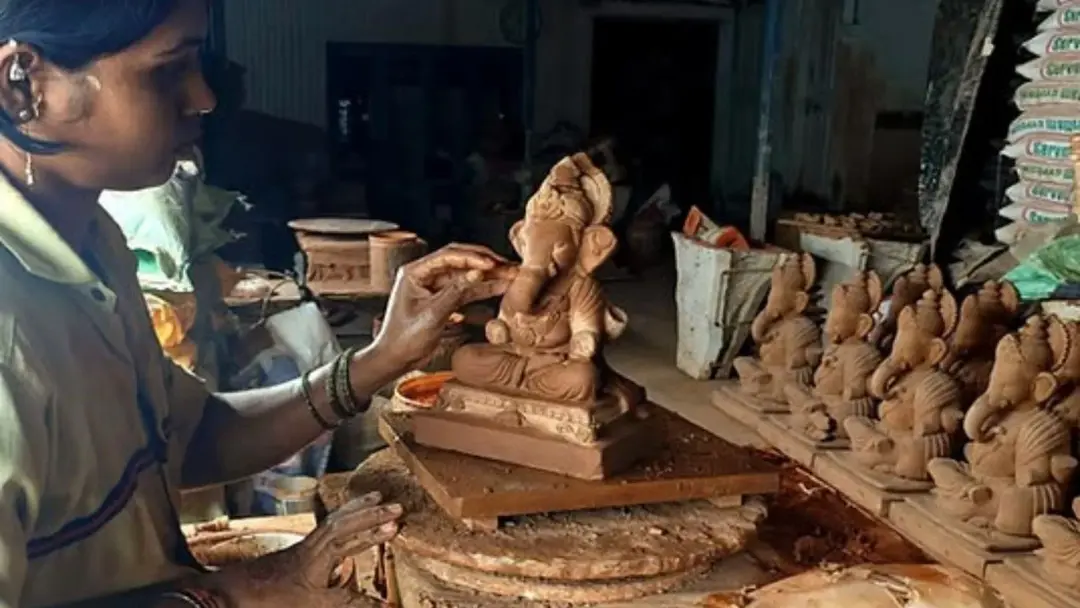
Pune initiative makes farm-soil Ganesha idols that grow Tulsi plants
Pune-based Vruskh Gajanan, founded by Dr Akshay Kauthale, makes Ganesha idols from farm soil sourced from the district's Bor region. The idols dissolve in 30 to 45 minutes in a tub of water at home, after which the soil and water can be moved to a planter and grown with separately supplied Krishna Tulsi seeds. Started in 2018, the Uruli Kanchan unit makes 75,000 to one lakh idols a year with about 200 women workers, and says over 1.5 lakh Tulsi saplings have been planted.
Source
Indian Express — Cities · read the original report ↗
Desk check · compared with the source
What the desk checked (5)
- Idols made from farm soil from Pune district's Bor region dissolve in 30-45 minutes in a tub of water — Figure appears in source, attributed to the initiative Vruskh Gajanan; no independent testing cited.
- Initiative produces 75,000 to 1 lakh idols annually at Uruli Kanchan with about 200 women workers — Production and workforce figures appear in source, sourced to the founder.
- More than 1.5 lakh authentic Tulsi saplings planted in past few years — Figure stated in source without independent verification or documentation.
- Krishna Tulsi seeds sourced via association with Padma Shri recipient Rahibai Soma Popere's seed-conservation work — Attributed to the initiative; Popere's own confirmation is not included in the source.
- Idols delivered to Rashtrapati Bhavan, Union Minister Nitin Gadkari and Governors, and exported to the US, Canada, Australia, Spain and UAE — Direct quote from founder Kauthale; no confirmation from recipients in source.
Analysts’ view opinion
On the surface this is an environment story, but politically it is that rare thing: a no-conflict issue where faith and green goals point the same way. Regulating Ganesh immersion to curb water pollution has always been politically delicate; here the lever is substitution rather than prohibition, and that is the initiative's real political strength. The founder's claim that the idols have reached Rashtrapati Bhavan, Union Minister Nitin Gadkari and Governors shows the symbolic validation such products can attract.
- The "alternative, not ban" model lets authorities pursue environmental goals at far lower political cost than restrictions on ritual.
- Employment for roughly 200 women and use of local farm soil fit neatly into local-economy and self-employment narratives.
- The founder's account of deliveries to Rashtrapati Bhavan, a Union Minister and Governors is potentially valuable endorsement optics, but the story establishes no policy backing.
- The link to Padma Shri awardee Rahibai Soma Popere's seed-conservation work taps into the growing public appeal of indigenous seed preservation.
- At 75,000 to one lakh idols a year, this is still a small slice of a vast festival market, so scale is the question for any policy-level impact.
What to watch — Watch whether municipal bodies and state pollution control agencies promote home-immersion models like this through incentives or awareness drives in coming festival seasons.
The story establishes no party position, government policy or official endorsement, and the production and sapling figures are as stated by the founder rather than independently verified.
Deep dive
Research brief · 8 facts · 3 dates · exam-readyThe brief
Context
Ganesh Chaturthi in Maharashtra ends with the immersion (visarjan) of idols, a ritual that has long raised concerns about water pollution from idols made of non-biodegradable material. A Pune-based initiative, Vruskh Gajanan, founded by Dr Akshay Kauthale, makes Ganesha idols from farm soil sourced from the Bor region of Pune district that dissolve in a tub of water at home within 30 to 45 minutes. The dissolved soil and water can then be shifted to a planter and sown with Krishna Tulsi seeds supplied along with the idol, turning the idol into a plant. The story was published around the immersion ceremony, which the source says took place on Friday.
Key facts
- Vruskh Gajanan, founded by Dr Akshay Kauthale, makes Ganesha idols from farm soil sourced from the Bor region of Pune district.
- The idols are designed to dissolve within 30 to 45 minutes when immersed in a tub of water at home.
- The initiative was started in 2018 as an alternative to conventional idols that contribute to water pollution.
- The Uruli Kanchan facility, about 20 km from Hadapsar, produces nearly 75,000 to one lakh idols annually with a workforce of about 200 women.
- Krishna Tulsi seeds distributed with the idols are sourced through an association with the seed-conservation work of Padma Shri recipient Rahibai Soma Popere.
- The initiative says it has helped plant more than 1.5 lakh authentic Tulsi saplings over the past few years.
- The enterprise has developed around 20 to 25 copyrighted idol designs and sells through dealers, outlets and online orders.
- Idols have been delivered to Rashtrapati Bhavan, Union Minister Nitin Gadkari and Governors, and shipped to the US, Canada, Australia, Spain and the UAE.
Timeline
- 2018Vruskh Gajanan started producing farm-soil Ganesha idols as an alternative to conventional polluting idols; since then, says Kauthale, not a single idol has remained unsold.
- Past few yearsMore than 1.5 lakh authentic Tulsi saplings planted through the initiative, with idols also shipped overseas.
- Friday (as reported)Ganesh idol immersion ceremony, the occasion for which the eco-friendly idols are offered as a sustainable alternative.
Who has a stake
- Dr Akshay Kauthale, founder, Vruskh Gajanan — Leads the initiative and frames it as a 'green movement' where devotion does not come at the cost of the environment.
- Dr V Kauthale, agricultural scientist and founder's father — Involved in the research and development process behind the farm-soil idols.
- Kedar Kumbhar — Oversees the factory at Uruli Kanchan where the idols are made.
- About 200 women workers — Employment in handcrafting 75,000 to one lakh idols a year at the Uruli Kanchan unit.
- Rahibai Soma Popere, Padma Shri recipient — Her seed-conservation work is the source of the Krishna Tulsi seeds distributed with the idols.
- Devotees in India and abroad — Can immerse idols at home in a tub and grow a Tulsi plant, avoiding immersion in public water bodies.
- Water bodies and urban local bodies — Reduced pollution load from idol immersion during Ganesh festival.
Why it matters
Idol immersion at the end of Ganesh Chaturthi is a major seasonal source of water pollution, and home-immersion idols that dissolve in 30 to 45 minutes shift the ritual away from rivers and lakes. By pairing the idol with Krishna Tulsi seeds sourced from a Padma Shri awardee's conservation work, the model links festival practice to seed conservation and greening. It also shows a rural enterprise model: about 200 women employed and 75,000 to one lakh idols made a year at Uruli Kanchan.
UPSC angle
Prelims pointers
- Vruskh Gajanan: Pune-based initiative making farm-soil Ganesha idols; founded by Dr Akshay Kauthale, started 2018.
- Farm soil for the idols is sourced from the Bor region of Pune district; unit is at Uruli Kanchan, about 20 km from Hadapsar.
- Idols dissolve in 30 to 45 minutes in a tub of water at home; soil and water then shifted to a planter.
- Krishna Tulsi, an indigenous species found in dense forests, is distributed as seeds with the idols.
- Rahibai Soma Popere is a Padma Shri recipient known for seed-conservation work; her work is the seed source.
- Output: 75,000 to one lakh idols a year, about 200 women workers, 20 to 25 copyrighted designs, over 1.5 lakh Tulsi saplings planted.
Mains framing
Religious festivals in India generate concentrated, seasonal environmental stress, with Ganesh idol immersion widely associated with water pollution in rivers, lakes and tanks. The Pune initiative described here offers a technology-light, behaviour-focused answer: idols handcrafted from farm soil of the Bor region that dissolve in a tub at home within 30 to 45 minutes, with the resulting soil and water reused in a planter along with Krishna Tulsi seeds, so that the immersion ends in a sapling rather than in a water body. Two secondary gains follow from the source: conservation of an indigenous, non-hybrid Tulsi variety through seeds linked to Padma Shri recipient Rahibai Soma Popere's seed-conservation work, with more than 1.5 lakh saplings planted; and rural livelihoods, with about 200 women employed making 75,000 to one lakh idols a year at Uruli Kanchan. The limits are also visible: scale is small relative to festival demand, and adoption depends on devotees accepting home immersion and on distribution through dealers, outlets and online orders. The way forward suggested by the story's own logic is demonstration and demand creation, including high-visibility deliveries to Rashtrapati Bhavan, a Union Minister and Governors, and exports to countries such as the US, Canada, Australia, Spain and the UAE, so that eco-friendly immersion becomes the default rather than the exception.
Key terms
- Vruskh Gajanan
- Pune-based initiative, started 2018, producing Ganesha idols from farm soil that dissolve at home and can be grown into plants.
- Krishna Tulsi
- An indigenous Tulsi species found in dense forests, distinct from commonly available hybrid varieties, whose seeds accompany the idols.
- Idol immersion (visarjan)
- Ritual immersion of Ganesha idols at the end of the festival, traditionally in water bodies, often causing water pollution.
- Bor region
- Area in Pune district from where the farm soil used to handcraft the idols is sourced.
- Uruli Kanchan
- Location of the initiative's manufacturing facility, about 20 km from Hadapsar in Pune.
- Rahibai Soma Popere
- Padma Shri recipient known for seed-conservation work; the Krishna Tulsi seeds are sourced through association with her work.
Practice questions
- Idol immersion is a recurring source of water pollution in Indian cities. Examine how community-level innovations such as farm-soil idols that dissolve at home can reduce this pollution, and what limits their scale-up.
- Discuss how conservation of indigenous seed varieties can be linked to cultural and religious practices, using the example of Krishna Tulsi seeds distributed with eco-friendly Ganesha idols in Pune.
- Rural micro-enterprises can combine environmental goals with women's employment. Analyse this with reference to the Uruli Kanchan unit that makes 75,000 to one lakh idols a year with about 200 women workers.
Grounded only in the source report — figures and dates are the source's, not inferred.