
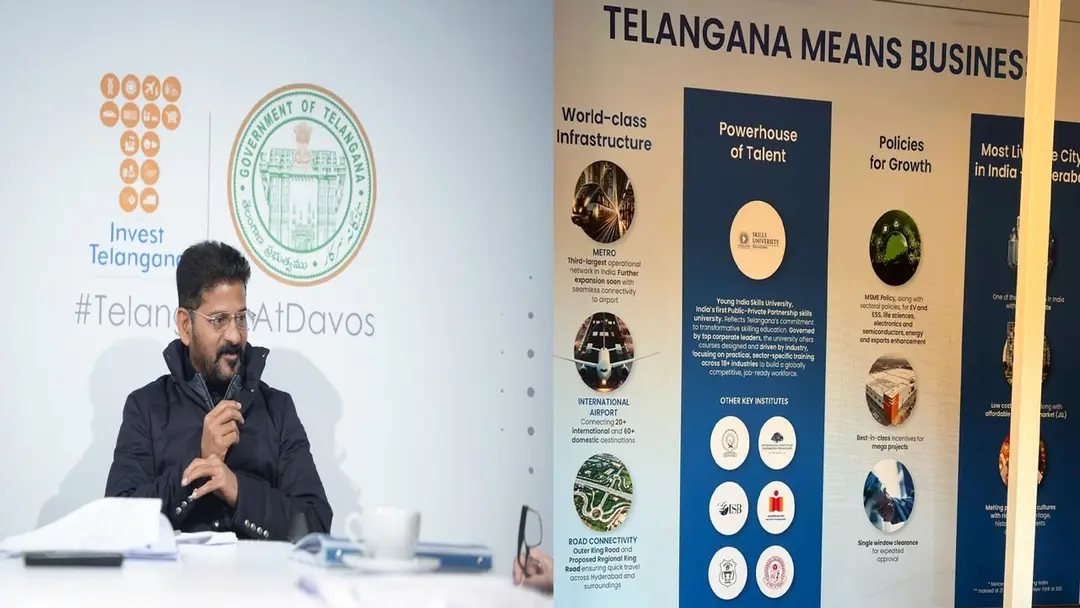
Telangana pavilion draws attention at Davos World Economic Forum
The Telangana pavilion, set up under the theme "Telangana Means Business", was a key attraction at the World Economic Forum annual meeting. This time, separate pavilions were allotted to all states within the India Gallery. Displays highlighted the country's third-largest metro network, the Outer Ring Road, a proposed Regional Ring Road, the Young India Skill University and single-window clearances. Under Telangana Rising 2050, a 14,000-acre Future City with a 6,000-acre eco zone is planned as India's first net-zero city.
Source
Business · read the original report ↗
Desk check · some claims need care
What the desk checked (5)
- Telangana pavilion set up at the World Economic Forum annual meeting under the theme 'Telangana Means Business' — Figure and theme appear in source; no official or spokesperson named.
- All Indian states were allotted separate pavilions within the India Gallery this time — Stated in source without attribution to organisers.
- Hyderabad has the country's third-largest metro network, an Outer Ring Road and a planned Regional Ring Road — Listed as pavilion display content; no independent source cited.
- Young India Skill University set up under PPP trains youth for about 18 sectors — Appears in source as government claim; unverified externally.
- Future City to span 14,000 acres with a 6,000-acre eco zone and be India's first net-zero city, aligned with Telangana Rising 2050 — Forward-looking government vision figures quoted from pavilion display; not independently confirmed.
Analysts’ view opinion
A pavilion at Davos is a marketing spend, not an investment inflow — but in India's increasingly competitive state-level race for capital, visibility has real economic value. Telangana's pitch is coherent: it leads with what firms actually price in when siting a plant or a global capability centre — metro and ring-road connectivity, airport access, a skills pipeline, single-window clearances and a low cost of living relative to Mumbai or Bengaluru. The costlier part of the story is what comes after the pitch: a 14,000-acre Future City with a 6,000-acre eco zone and net-zero ambitions implies very large, front-loaded public outlays on land, water, power and transport, recovered only slowly through land value and tax base. The story reports the offer, not the order book.
- The immediate gain is reputational and deal-pipeline access; the story does not state any investment commitment, MoU or job number arising from the pavilion.
- That every Indian state now gets its own pavilion in the India gallery signals intensifying inter-state competition — which tends to be good for investors and costly for states, as incentives and concessions become the differentiator.
- The infrastructure pitch — third-largest metro network, ORR, proposed Regional Ring Road, airport metro link — targets logistics costs and employee commute time, the two variables that most directly shape site selection.
- Skills is the sharper edge of the offer: a PPP skills university plus established institutions speaks to firms in electronics, semiconductors, life sciences and EVs, where talent scarcity, not land, is usually the binding constraint.
- Future City is the high-risk, high-reward line item: greenfield cities need anchor tenants early or they carry heavy interest and maintenance costs for years, and net-zero design typically raises upfront capex even if it lowers operating costs later.
What to watch — Watch whether the Davos visibility converts into announced projects with disclosed capital and employment numbers, and how much of Future City's land, water and power cost the state carries versus private developers.
The story describes what was displayed and claimed at the pavilion — it establishes no funding plan, timeline, cost estimate or independent verification of the liveability, cost-of-living and net-zero claims.
Deep dive
Research brief · 8 facts · 3 dates · exam-readyThe brief
Context
At the World Economic Forum annual meeting in Davos, Telangana set up a pavilion under the theme "Telangana Means Business" inside the India Gallery. Unlike earlier editions, this time separate pavilions were allotted to all Indian states within the India Gallery. The Telangana pavilion showcased infrastructure, skilling institutions, investor-friendly policies and Hyderabad's liveability, along with the state's long-term vision under Telangana Rising 2050, including a planned Future City. The source does not state the dates of the meeting or the officials who represented the state.
Key facts
- The Telangana pavilion at the WEF annual meeting was set up under the theme "Telangana Means Business" and drew industrialists and experts from India and abroad.
- For the first time as described in the source, separate pavilions were allotted to all states within the India Gallery.
- Displays highlighted India's third-largest metro network in Telangana and metro extension up to the airport.
- Infrastructure showcased included the Outer Ring Road around Hyderabad and a newly proposed Regional Ring Road.
- The state set up the Young India Skill University through public-private partnership, described as the first of its kind in the country, training youth in world-class skills for about 18 sectors.
- ISB, IIIT and NALSAR were listed among prominent educational institutions in the state.
- Policies showcased included the MSME policy, incentives for electric vehicles, life sciences, electronics, semiconductors and energy, plus single-window clearances.
- Under Telangana Rising 2050, Future City is planned over 14,000 acres with a 6,000-acre forest conservation eco zone, to be developed as India's first net-zero city.
Timeline
- Not stated in the source (current WEF annual meeting)Telangana pavilion under the theme "Telangana Means Business" becomes a key attraction; separate pavilions allotted to all states in the India Gallery.
- Proposed / under planRegional Ring Road around Hyderabad newly taken up, in addition to the existing Outer Ring Road.
- Target year 2050Telangana Rising 2050 vision, under which Future City is to be developed on 14,000 acres as India's first net-zero city.
Who has a stake
- Government of Telangana — Uses the Davos platform to project infrastructure, skills and policy incentives to attract investment.
- World Economic Forum / India Gallery — Hosts the annual meeting and, this time, separate state pavilions, shaping how Indian states pitch to global investors.
- Domestic and foreign industrialists and experts — Potential investors evaluating Telangana's infrastructure, single-window clearances and sector incentives.
- Young India Skill University and students — PPP skill university training youth in world-class skills across about 18 sectors, linking education to industry demand.
- Hyderabad and its residents — Promoted as India's most liveable city with high living standards, safety and low cost of living; Greater City development goals displayed.
- Future City area and environment — 14,000-acre project including a 6,000-acre forest conservation eco zone, planned as India's first net-zero city.
Why it matters
Davos has become a venue where Indian states compete directly for global capital, and the allotment of separate state pavilions inside the India Gallery formalises that competition. Telangana's pitch — metro and ring-road connectivity, a skills university, sector incentives and single-window clearances — signals how sub-national governments now market themselves on infrastructure and ease of doing business. The Future City plan also ties investment promotion to net-zero and eco-zone commitments, linking growth pitches to climate goals.
UPSC angle
Prelims pointers
- World Economic Forum annual meeting: Telangana pavilion theme was "Telangana Means Business"; separate pavilions for all states in the India Gallery.
- Telangana claims India's third-largest metro network, with metro extension up to the airport.
- Young India Skill University: set up in PPP mode, described as the country's first such university, covering about 18 sectors.
- Institutions cited in the Telangana pavilion: ISB, IIIT and NALSAR.
- Telangana Rising 2050: Future City on 14,000 acres, 6,000 acres as forest conservation eco zone, India's first net-zero city.
- Future City concept: "Work, Live, Learn, Play" with zones for innovation, electronics, medical tourism and eco-tourism.
Mains framing
The Telangana pavilion at Davos illustrates the rise of sub-national economic diplomacy: with separate pavilions for every state inside the India Gallery, states now compete on infrastructure depth, skilled manpower and regulatory ease rather than on incentives alone. Telangana's pitch rests on three legs — connectivity (third-largest metro network, metro to the airport, Outer Ring Road and a proposed Regional Ring Road), human capital (the PPP-based Young India Skill University covering about 18 sectors, alongside ISB, IIIT and NALSAR), and policy (MSME policy, incentives for EVs, life sciences, electronics, semiconductors and energy, and single-window clearances). Layered on this is a spatial vision: Hyderabad marketed as India's most liveable, safe and low-cost city, and a 14,000-acre Future City under Telangana Rising 2050 with a 6,000-acre eco zone, positioned as India's first net-zero city on a "Work, Live, Learn, Play" model. The implications are that investment promotion is increasingly bundled with sustainability and liveability claims; the way forward lies in converting pavilion promises into delivered projects — completing ring-road and metro works, aligning skill university output with industry demand, and ensuring the eco zone and net-zero targets are enforceable rather than promotional, since the source records intent and plans, not outcomes.
Key terms
- World Economic Forum annual meeting
- Global gathering of business and policy leaders where countries and, increasingly, Indian states set up pavilions to attract investment.
- India Gallery
- The India section at the WEF meeting where, this time, every Indian state was allotted a separate pavilion.
- Young India Skill University
- Telangana's public-private partnership skill university, described as the first in the country, training youth for about 18 industry sectors.
- Single-window clearance
- A simplified system where industries obtain required government approvals through one integrated channel.
- Regional Ring Road
- A newly proposed outer road corridor around Hyderabad, in addition to the existing Outer Ring Road.
- Telangana Rising 2050 / Future City
- State vision under which a 14,000-acre Future City with a 6,000-acre eco zone is planned as India's first net-zero city.
Practice questions
- Indian states are increasingly marketing themselves directly to global investors. Examine this trend of sub-national economic diplomacy with reference to Telangana's pavilion at the World Economic Forum.
- Discuss how infrastructure connectivity and skill development institutions shape a state's investment attractiveness, using the examples showcased by Telangana at Davos.
- What challenges arise in developing a large greenfield 'net-zero city' such as Telangana's proposed 14,000-acre Future City, and how can ecological safeguards be made credible?
Grounded only in the source report — figures and dates are the source's, not inferred.