
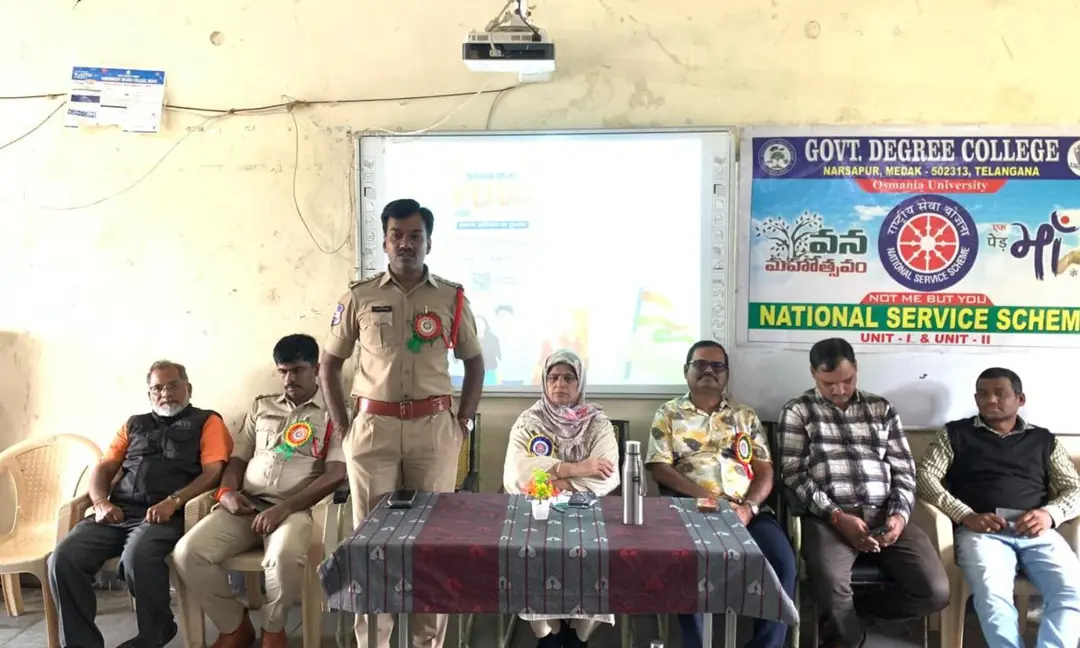
NSS Foundation Day marked at Narsapur college with drug awareness drive
Narsapur Government Degree College marked NSS Foundation Day with a "Nasha Mukt Yuva – Viksit Bharat" programme. Circle Inspector Ranga Krishna told students to stay away from drugs and focus on studies, skill development, sports and social service, and to limit mobile phone use. The event was held under the guidance of Principal Dr K. Hussain and presided over by Vice Principal Dr Sameera Najmeen. Faculty and NSS volunteers later pledged to stay away from drugs.
Source
Medak — వార్తలు · read the original report ↗
Desk check · compared with the source
What the desk checked (5)
- Narsapur Circle Inspector Ranga Krishna urged students to stay away from drugs and focus on studies, skills, sports and social service. — Directly attributed to the named police officer in the source.
- The 'Nasha Mukt Yuva – Viksit Bharat' programme was held at Narsapur Government Degree College to mark NSS Foundation Day. — Stated as fact in the source; event details appear consistent.
- The programme was held under the guidance of Principal Prof. Dr K. Hussain and was presided over by Vice Principal Dr Sameera Najmeen. — Names and roles appear in the source; no independent confirmation possible.
- Faculty and NSS volunteers took a pledge to stay away from drugs and work for drug eradication. — Reported in the source without a separate attribution; consistent with the event description.
- IQAC coordinator Dr Adeppa said youth are the future strength of the nation. — Attributed quote-in-substance from a named speaker.
Analysts’ view opinion
This is awareness-drive policy in its most familiar Indian form: a campus event, a police officer as messenger, a pledge at the end. Using the NSS foundation day and the "Nasha Mukt Yuva – Viksit Bharat" framing is sensible institutional design — NSS already has volunteers, faculty coordinators and a service mandate, so the delivery channel costs almost nothing. The weakness is equally familiar: pledges and speeches are inputs, not outcomes, and nothing in the story indicates any follow-up mechanism, counselling referral or measurement of whether behaviour actually changes.
- The scheme design piggybacks on existing structures — NSS volunteers, the programme officer, IQAC and the local police circle — which is low-cost but also means reach is limited to students already inside an organised campus network.
- Putting a circle inspector at the podium blends enforcement and prevention messaging; it lends authority, but drug dependence is also a health issue, and no health or counselling component is mentioned in the account.
- The broadening of the message to include screen and mobile-phone discipline reflects a wider trend in youth-focused advisories, though it risks diluting a campaign nominally aimed at substance abuse.
- Compared with earlier anti-drug awareness efforts in colleges, the pattern is continuity rather than innovation: sensitisation plus a collective pledge, with accountability resting on moral suasion.
- Who it serves matters — government degree college students are exactly the cohort such outreach should target, but the story gives no indication of parallel supply-side action in the area.
What to watch — Watch whether this is followed by anything durable — a campus anti-drug committee, counselling access, repeat sessions or any reporting on results — since that is what separates a one-day event from a functioning prevention programme.
The story establishes that an awareness event and pledge took place; it does not establish the scale of any local drug problem, any budget or targets, or any evidence that such events change student behaviour.
Deep dive
Research brief · 8 facts · 3 dates · exam-readyThe brief
Context
Narsapur Government Degree College held an awareness programme titled "Nasha Mukt Yuva – Viksit Bharat" (Drug-Free Youth – Developed India) to mark National Service Scheme (NSS) Foundation Day. NSS is a student volunteering programme in colleges that promotes social service, discipline and community work. At the event, Narsapur Circle Inspector Ranga Krishna urged students to stay away from narcotics and to channel their energy into studies, skills, sports and social service. Faculty and NSS volunteers took a pledge against drug use at the close of the programme.
Key facts
- The programme was titled "Nasha Mukt Yuva – Viksit Bharat" and was held at Narsapur Government Degree College on NSS Foundation Day.
- Narsapur Circle Inspector Ranga Krishna told students not to darken their bright future by becoming addicted to intoxicants.
- The CI said some youth today are drawn towards narcotics unknowingly, and that drug use damages the future and causes many health problems.
- The CI also advised students to control mobile phone use and use phones only as needed, so that concentration on studies is not affected.
- The event was held under the guidance of Principal Prof. Dr K. Hussain and presided over by Vice Principal Dr Sameera Najmeen.
- Vice Principal Dr Sameera Najmeen said NSS volunteers should move forward with a spirit of service in line with Mahatma Gandhi's ideals.
- IQAC Coordinator Dr Adeppa said youth are the future strength of the nation and should use their talent for education, skills, sports, social service and nation-building.
- After the programme, faculty and NSS volunteers pledged to stay away from drugs, commit to drug eradication and help build a healthy society.
Timeline
- NSS Foundation Day (date not stated in the source)"Nasha Mukt Yuva – Viksit Bharat" awareness programme organised at Narsapur Government Degree College.
- During the programmeCI Ranga Krishna, Vice Principal Dr Sameera Najmeen and IQAC Coordinator Dr Adeppa address students on drugs, discipline and service.
- After the programmeFaculty and NSS volunteers take a pledge to stay away from drugs and work for a drug-free, healthy society.
Who has a stake
- Students and NSS volunteers of Narsapur Government Degree College — Primary audience; urged to avoid narcotics, limit phone use and focus on studies, skills, sports and social service.
- Narsapur police (CI Ranga Krishna, SI Ranjith Kumar) — Lead the awareness messaging on drug abuse prevention among youth as part of community policing outreach.
- College administration (Principal Dr K. Hussain, Vice Principal Dr Sameera Najmeen) — Guided and presided over the programme; responsible for campus-level anti-drug awareness and NSS activity.
- NSS unit and Programme Officer Dr B. Suresh Kumar — Organising the Foundation Day event and sustaining volunteer-led social responsibility and discipline.
- IQAC of the college (Coordinator Dr Adeppa) — Links such co-curricular awareness drives to institutional quality and student development.
Why it matters
Campus-level drug awareness drives bring police and college faculty together to address substance abuse at the point where it often begins — among young students. By tying the anti-drug pledge to the "Nasha Mukt Yuva – Viksit Bharat" theme, the event frames youth health and discipline as inputs into national development. The added advice on limiting mobile phone use reflects a wider concern about distraction and student concentration.
UPSC angle
Prelims pointers
- NSS (National Service Scheme) is a student volunteering scheme; its Foundation Day was marked at Narsapur Government Degree College.
- Programme theme: "Nasha Mukt Yuva – Viksit Bharat" (Drug-Free Youth – Developed India).
- IQAC (Internal Quality Assurance Cell) functions in colleges; Dr Adeppa is its coordinator at this college.
- NSS volunteers were urged to follow Mahatma Gandhi's ideals of service.
- Narsapur Circle Inspector Ranga Krishna advised students to avoid drugs and limit mobile phone use.
- NSS Programme Officer at the college: Dr B. Suresh Kumar; Principal: Prof. Dr K. Hussain.
Mains framing
Substance abuse among college-going youth is both a public health and a law-and-order concern, and the Narsapur event illustrates the preventive, awareness-led approach now common on campuses. The Circle Inspector's point that some students are drawn to narcotics "unknowingly" underlines that peer pressure and lack of information, rather than deliberate choice, often drive first use; the remedy proposed was substitution — redirecting energy into studies, skill development, sports, social service and nation-building — alongside disciplined living and restrained mobile phone use. Institutional platforms such as NSS and the IQAC give such messaging continuity beyond a single event, converting one-day pledges into volunteer-led community engagement rooted, as the Vice Principal noted, in Gandhian service ideals. The way forward suggested by the story is collaborative: police outreach for credible deterrence and information, college leadership for guidance, and student volunteers as peer educators committed to drug eradication and a healthy society. The source does not detail any enforcement, counselling or rehabilitation mechanism, which remains the untested gap in such campaigns.
Key terms
- NSS (National Service Scheme)
- A scheme under which college students volunteer for community service; its Foundation Day was the occasion for this programme.
- Nasha Mukt Yuva – Viksit Bharat
- The theme of the awareness programme, linking drug-free youth to the goal of a developed India.
- IQAC
- Internal Quality Assurance Cell of a college, which oversees quality and student-development activities; Dr Adeppa is the coordinator here.
- Circle Inspector (CI)
- A police officer in charge of a circle of police stations; CI Ranga Krishna delivered the anti-drug message.
- NSS Programme Officer
- The faculty member who coordinates a college's NSS unit and its volunteer activities; here, Dr B. Suresh Kumar.
Practice questions
- Discuss the role of institutions like the National Service Scheme in building social responsibility and discipline among Indian youth.
- Awareness campaigns alone cannot curb substance abuse among students. Examine, with reference to the roles of police, colleges and peer volunteers.
- How does youth health and discipline connect to the goal of a 'Viksit Bharat'? Analyse with examples of campus-level interventions.
Grounded only in the source report — figures and dates are the source's, not inferred.