
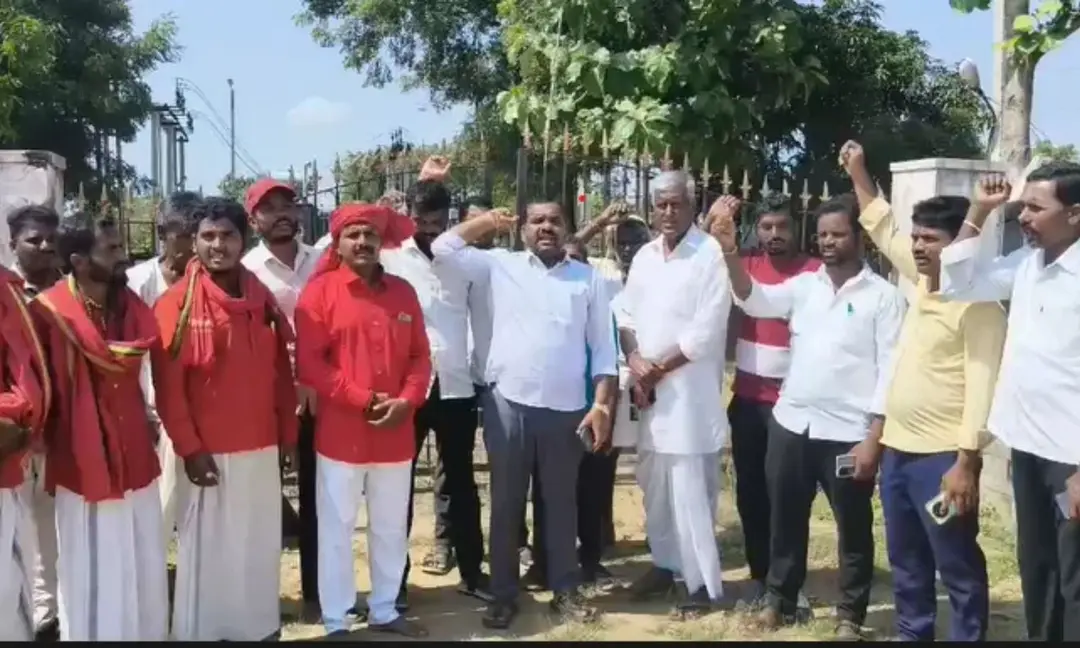
Farmers stage dharnas over power cuts in Medak, Sangareddy
Farmers in Medak and Sangareddy districts have staged dharnas at electricity substations over power cuts. They said borewell-irrigated paddy crops are drying up amid intense heat, that they wait hours for supply, and that voltage problems persist even when power is available. Protests were reported in Siripuram, Nasteepur, Vaddepally and Nagaram in Hatnoora mandal, and in Narsapur, Moosapet, Shivampet, Kowdipally and Chilipiched areas of Medak. Farmers warned of larger agitations without uninterrupted supply.
Source
Sangareddy — స్థానికం · read the original report ↗
Desk check · some claims need care
What the desk checked (4)
- Power cuts and voltage problems are drying up borewell-irrigated paddy crops in Medak and Sangareddy districts — Attributed in the source to farmers' statements; no official or discom confirmation given
- Farmers staged dharnas at substations in several places — Appears in source as reported protest activity; no organiser, date or crowd figure given
- Affected areas include Siripuram, Nasteepur, Vaddepally and Nagaram in Hatnoora mandal of Sangareddy district, and villages in Narsapur, Moosapet, Shivampet, Kowdipally and Chilipiched mandals of Medak district — Place names appear in source; mandal/village classification is as worded in the source
- Farmers warned of larger agitations if the government and power officials do not resolve the issue — Attributed to farmers; no named spokesperson
Analysts’ view opinion
This is less a power story than a cash-flow story: if irrigation stops at the final, water-critical stage of a paddy crop, the money already sunk into seed, fertiliser, pesticide and labour is at risk of becoming a total loss rather than a smaller harvest. For borewell-dependent farming, electricity is effectively a production input, so uncertainty in supply translates directly into uncertainty in farm income. That is why the protests have gathered at substations rather than at market yards.
- Missing a late-stage watering does not just trim yield — it can turn an entire season's already-spent investment into unrecovered cost.
- Voltage fluctuation is a second, less visible cost layer, since it can damage motors and pumpsets and force repair or replacement spending on the farmer.
- Crop damage would not stop at the farmgate: labour workdays, grain movement, milling and local trade all sit downstream of the same harvest.
- A failed or reduced harvest weakens loan repayment capacity and can push growers deeper into borrowing for the next season's inputs.
- Peak-summer demand rising simultaneously in household and agricultural use is a well-known stress point for distribution systems — the story gives no load data, but the dispute points to exactly that allocation squeeze.
What to watch — Watch whether officials publicly commit to specified daily supply hours on agricultural feeders in the coming days, or whether the agitation shifts from a supply demand to a crop-loss assessment and compensation demand.
The story does not establish how much acreage is affected, the value of any loss, the reason for the cuts, or the response of the power utility — this reading rests on the farmers' stated grievances.
Deep dive
Research brief · 8 facts · 4 dates · exam-readyThe brief
Context
Farmers in Telangana's Medak and Sangareddy districts, who irrigate paddy using borewells, are protesting at electricity substations over prolonged power cuts. With intense heat raising crop water needs at the critical harvest-approaching stage, farmers say inadequate and low-voltage supply is leaving fields unwatered and standing paddy drying up. Having already spent heavily on seeds, fertilisers, pesticides and labour, they fear losing their entire investment and have warned of bigger agitations if supply is not restored.
Key facts
- Farmers in Medak and Sangareddy districts staged dharnas and protests at electricity substations over power cuts, as reported in the source.
- Borewell-dependent paddy crops are drying up because supply is insufficient at the crucial stage when the crop is nearing harvest.
- Farmers say they wait for hours for power, and even when supply comes there are voltage problems.
- Protests in Sangareddy district were reported at Siripuram, Nasteepur, Vaddepally and Nagaram in Hatnoora mandal.
- In Medak district, farmers protested in Moosapet, Shivampet, Kowdipally and Chilipiched areas, including Narsapur mandal.
- Farmers say heavy expenditure already incurred on seeds, fertilisers, pesticides and labour wages risks being wiped out if the crop is damaged.
- Demands: uninterrupted power supply when crops need it, immediate reduction of power cuts, and swift action to prevent crops drying up.
- Farmers warned of larger-scale agitations if the government and electricity officials do not resolve the issue.
Timeline
- Current season (intense summer heat; crop nearing harvest)Rising temperatures increase irrigation needs in fields while power supply to borewells remains inadequate.
- Same periodBorewell-irrigated paddy begins drying up; farmers report hours-long waits for power and voltage problems.
- Reported nowFarmers gather at substations in Hatnoora (Sangareddy) and Narsapur, Shivampet, Kowdipally, Chilipiched areas (Medak) to stage dharnas.
- Next, if unresolvedFarmers warn they will launch larger agitations unless the government and power officials respond.
Who has a stake
- Borewell-dependent paddy farmers of Medak and Sangareddy — Standing crop and the entire investment in seeds, fertilisers, pesticides and labour at risk from drying fields.
- Electricity officials / substation staff — Face direct protests at substations and demands for uninterrupted supply and voltage stability.
- State government — Under pressure to restore agricultural power supply or face escalating farmer agitations.
- Farm labourers — Wages and work linked to the crop; crop failure would hit employment (labour costs already incurred, per source).
- Villages named in the protests (Siripuram, Nasteepur, Vaddepally, Nagaram, Moosapet, Shivampet, Kowdipally, Chilipiched) — Local irrigation and village economies dependent on borewell power.
Why it matters
Paddy grown on borewells depends entirely on electricity, so a few hours of lost or low-voltage supply during a heatwave can translate directly into crop loss and sunk input costs. The protests show how power reliability, not just water availability, has become a core agricultural risk in Telangana's groundwater-irrigated belts, with political consequences if unresolved.
UPSC angle
Prelims pointers
- Medak and Sangareddy are districts in Telangana; Hatnoora and Narsapur are mandals named in the protests.
- Borewell irrigation depends on electricity supply; power cuts and low voltage directly halt pumping.
- Paddy is a highly water-intensive crop, needing assured irrigation at critical growth stages.
- Farmers' demands: uninterrupted supply during crop need, immediate cut in load-shedding, action to save crops.
- Protest form used: dharnas at electricity substations by farmers of affected villages.
Mains framing
The Medak-Sangareddy dharnas illustrate the tight coupling of energy and agriculture in groundwater-irrigated India: where paddy is grown on borewells, assured and stable-voltage electricity is effectively an irrigation input, and any shortfall during a heat spell converts into immediate crop loss. The proximate causes cited in the source are intense summer heat raising crop water demand, insufficient hours of supply to borewells, and voltage fluctuation even during supply hours. The implications are threefold: farmers risk losing sunk costs on seeds, fertilisers, pesticides and labour; distress escalates into agitation against power utilities and the state; and the episode underlines the vulnerability of water-intensive cropping in a bore-dependent landscape. The way forward, as demanded by farmers themselves, is restoration of uninterrupted supply at the crop's critical stage, reduction of cuts, and attention to voltage quality at the feeder level, along with responsive grievance redressal by electricity officials so that substation protests are not the only channel available. Longer-term questions about crop choice, groundwater dependence and distribution infrastructure are implied but not addressed in the source.
Key terms
- Dharna
- A sit-in protest; here staged by farmers at electricity substations to press their demand for power.
- Borewell irrigation
- Drawing groundwater through an electric pump; wholly dependent on reliable power supply.
- Substation
- Local electricity distribution installation where supply to feeders is managed; the site of the farmers' protests.
- Voltage problem
- Low or fluctuating voltage that prevents pumpsets from running properly even when power is nominally available.
- Mandal
- Administrative sub-district unit in Telangana; Hatnoora and Narsapur are the mandals named in the story.
Practice questions
- Why does electricity reliability function as an irrigation input in borewell-dependent agriculture? Discuss with reference to the farmer protests in Medak and Sangareddy.
- Examine how heatwave conditions amplify the impact of power cuts on water-intensive crops such as paddy.
- Farmers' agitation at substations reflects gaps in grievance redressal by power utilities. Suggest measures to address agricultural supply and voltage quality concerns.
Grounded only in the source report — figures and dates are the source's, not inferred.