
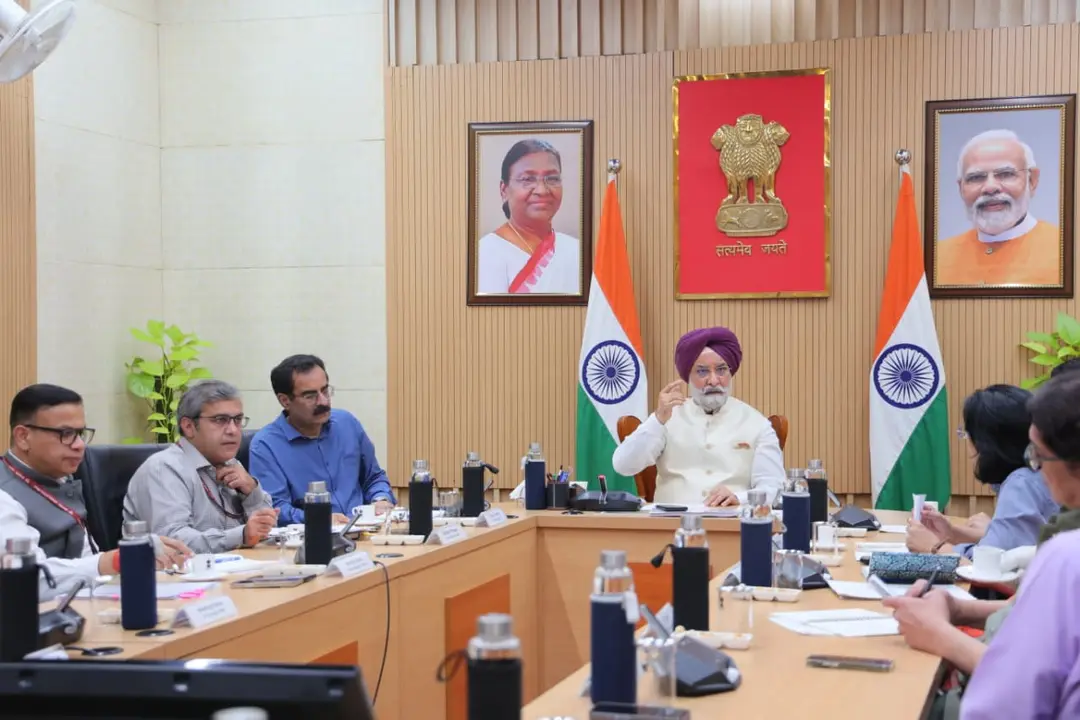
Delhi LG asks NSUT to develop tech solutions for civic issues
Delhi Lieutenant Governor T.S. Sandhu on Tuesday directed technical universities to develop solutions for civic issues such as sanitation, traffic management, road conditions and flood management. Chairing the 6th Court Meeting of Netaji Subhas University of Technology (NSUT) at Lok Niwas, he called for turning research papers into actionable solutions. He asked the university to assist agencies including MCD, NDMC, Delhi Police, the Health Department, PWD and the Transport Department, and to focus on AI-enabled healthcare in government hospitals.
Source
Technology · read the original report ↗
Desk check · compared with the source
What the desk checked (5)
- Delhi LG T.S. Sandhu directed technical universities to develop solutions for civic issues such as sanitation, traffic management, road conditions and flood management. — Attributed in source to the LG at an official meeting; no independent confirmation available.
- Sandhu chaired the 6th Court Meeting of Netaji Subhas University of Technology at Lok Niwas on Tuesday. — Specific detail stated in source; exact calendar date not given, only 'Tuesday'.
- Quote: 'AI education must stay future-ready through global collaboration... especially AI-enabled healthcare in government hospitals.' — Direct quote attributed to the LG in the source text.
- NSUT was asked to assist agencies including MCD, NDMC, Delhi Police, Health Department, PWD and Transport Department. — Agency list appears verbatim in source; attributed to the LG's directions.
- University directed to adopt urban centres and colonies with RWAs and continue work in adopted villages. — Stated in source as LG's directive; no supporting figures or timelines given.
Analysts’ view opinion
This is not a new scheme but a directive aimed at wiring university research capacity into the city's governance needs. The underlying logic is sound: Delhi's sanitation, traffic, road and flooding problems have persisted less for want of technical know-how than for want of coordination between institutions. Positioning NSUT as a technology partner to MCD, NDMC, the police, PWD and Transport is an attractive idea, but implementation detail will decide whether it amounts to anything.
- The diagnosis is right — the call to move from research papers to actionable solutions names a long-standing gap in Indian higher education.
- Directives issued at a Court Meeting risk remaining advisory unless attached to budgets, timelines and accountability mechanisms; the story mentions no funding.
- Serving multiple agencies at once (MCD, NDMC, police, health, PWD, transport) requires clarity on data sharing, procurement rules and intellectual property that is not spelled out.
- The push for AI-enabled healthcare in government hospitals is significant but sensitive, and hard to scale without a framework for patient data protection, validation and clinical oversight.
- Village adoption, tie-ups with RWAs and NCC-NSS involvement continue familiar models of student community engagement, though the insistence on feedback and record-keeping hints at a slightly more measurable approach.
What to watch — Watch whether these instructions translate into formal agreements between NSUT and civic agencies, named pilot projects and allocated funds, or remain on paper until the next Court Meeting.
The story establishes no specific project, budget, timeline or response from the civic agencies involved — it reports a directive, not a programme.
Deep dive
Research brief · 8 facts · 1 dates · exam-readyThe brief
Context
Delhi Lieutenant Governor T.S. Sandhu chaired the 6th Court Meeting of Netaji Subhas University of Technology (NSUT) at Lok Niwas, where he asked the university and other technical universities to convert academic research into working solutions for the city's civic problems. The "Court" is the apex body of a state university that reviews its overall functioning, and the LG serves as the constitutional head associated with Delhi's universities. The directions cover sanitation, traffic management, road conditions and rain-flooding, along with AI-enabled healthcare in government hospitals, skilling, international partnerships and community outreach.
Key facts
- Delhi LG T.S. Sandhu on Tuesday directed technical universities to develop solutions for civic issues such as sanitation, traffic management, road conditions and flood management.
- The direction came while he chaired the 6th Court Meeting of Netaji Subhas University of Technology (NSUT) at Lok Niwas.
- He said the way forward for a 'Viksit Dilli' lies in moving from research to solutions and from innovation to impact.
- NSUT was asked to facilitate government agencies including MCD, NDMC, Delhi Police, the Health Department, PWD and the Transport Department with tailored technological solutions.
- The LG said AI education must stay future-ready through global collaboration, with focus on transformative applications, especially AI-enabled healthcare in government hospitals.
- He called for skill courses that generate employability, focused on artificial intelligence, cyber security and digital tools.
- The University was directed to continue activities in adopted villages, and to adopt urban centres and colonies in collaboration with respective RWAs.
- NCC and NSS students should be encouraged to address civic issues, with suitable awards instituted to recognise outstanding performance.
Timeline
- Tuesday (date not stated in the source)LG T.S. Sandhu chairs the 6th Court Meeting of NSUT at Lok Niwas and issues directions on civic-tech solutions, AI healthcare, skilling and community engagement.
Who has a stake
- Delhi Lieutenant Governor T.S. Sandhu — Chaired the NSUT Court Meeting; pushing universities to deliver research-to-solution outcomes for a 'Viksit Dilli'.
- Netaji Subhas University of Technology (NSUT) — Directed to provide technological solutions to civic problems, upgrade rankings, run skill courses and expand community engagement.
- MCD, NDMC, Delhi Police, Health Department, PWD, Transport Department — To receive technological solutions tailored to their specific operational needs.
- Government hospitals in Delhi — Named as the focus area for transformative AI-enabled healthcare applications.
- Students of NSUT, including NCC and NSS volunteers — Employability-linked skilling in AI, cyber security and digital tools; participation in civic problem-solving with awards.
- Adopted villages, urban colonies and RWAs — Targets of university outreach on employability, financial awareness and sports, with feedback and records maintained.
Why it matters
Indian technical universities are often criticised for research that ends in publications rather than public use; the LG's directive attempts to tie a state technical university directly to municipal service delivery. If implemented, agencies like MCD, PWD and Delhi Police could get locally designed tools for sanitation, traffic and flooding, while students gain applied training in AI and cyber security.
UPSC angle
Prelims pointers
- Netaji Subhas University of Technology (NSUT) is a Delhi technical university; its 6th Court Meeting was chaired by the Lieutenant Governor.
- Delhi Lieutenant Governor: T.S. Sandhu; meeting venue Lok Niwas.
- Civic issues listed for tech solutions: sanitation, traffic management, road conditions, rain-flooding management.
- Agencies named for support: MCD, NDMC, Delhi Police, Health Department, PWD, Transport Department.
- Focus areas for skill courses: artificial intelligence, cyber security and digital tools.
- NCC and NSS students to be involved in civic issues, with awards for outstanding performance.
Mains framing
The directive to NSUT reflects a wider governance problem: a gap between academic research output and the delivery of urban public services. Delhi's recurring civic stresses — poor sanitation, congested traffic, damaged roads and monsoon flooding — are technically tractable but institutionally fragmented across MCD, NDMC, PWD, Delhi Police and the Transport Department, each with distinct data and operational needs. By asking a technical university to study global best practices, coordinate with expert agencies and build tailored tools, the LG is proposing a university-as-civic-laboratory model, extended to AI-enabled healthcare in government hospitals. The same framing links skilling in AI, cyber security and digital tools to employability, and international academic-industry partnerships to improved national and global rankings. The way forward, as articulated in the source, lies in sustained coordination between the university and line agencies, community engagement through adopted villages and RWA-linked urban colonies, documented feedback and records of outreach, and incentives such as awards for NCC and NSS students who work on civic problems — in short, moving from research to solutions and from innovation to impact.
Key terms
- Court Meeting (university)
- A university's top review body; NSUT's 6th Court Meeting was chaired by the Delhi Lieutenant Governor at Lok Niwas.
- NSUT
- Netaji Subhas University of Technology, the Delhi technical university directed to build civic-tech solutions.
- Viksit Dilli
- The 'developed Delhi' goal invoked by the LG, to be pursued by moving from research to solutions and innovation to impact.
- AI-enabled healthcare
- Use of artificial intelligence applications in government hospitals, flagged as a priority transformative application.
- MCD / NDMC / PWD
- Municipal Corporation of Delhi, New Delhi Municipal Council and Public Works Department — civic agencies to be given tailored tech solutions.
- NCC and NSS
- National Cadet Corps and National Service Scheme student wings, to be involved in addressing civic issues with awards for performance.
Practice questions
- Universities are expected to move 'from research to solutions and innovation to impact'. Examine how technical universities can be institutionally linked to urban local bodies for civic problem-solving, using the NSUT directive as an example.
- Discuss the scope and limits of AI-enabled healthcare in government hospitals in India. What safeguards would such deployment require?
- How can student volunteer networks such as NCC and NSS be used for urban civic engagement? Evaluate with reference to adopted villages and RWA-linked colony adoption.
Grounded only in the source report — figures and dates are the source's, not inferred.