
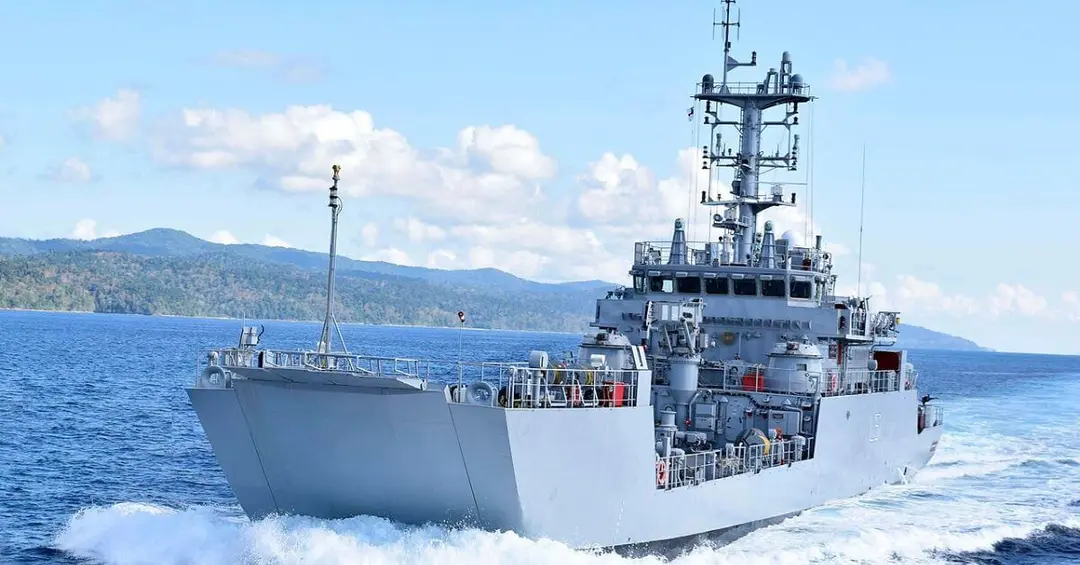
Navy issues RFI for six LCU Mk V amphibious vessels
The Indian Navy has issued a Request for Information to Indian shipyards for six Landing Craft Utility (LCU) Mk V vessels, to be built under 'Make in India' and procured in the Buy (Indian-IDDM) category. Each vessel is to be about 85 metres long with a displacement of around 1,500 tonnes, and must carry at least four main battle tanks, four BMP vehicles and 190 troops. The Navy wants 4,500 nautical miles endurance, at least 15 knots speed and a 30-year service life.
Source
Indian Navy · read the original report ↗
Desk check · compared with the source
What the desk checked (5)
- Indian Navy has issued an RFI for six Landing Craft Utility Mk V vessels from Indian shipyards. — Attributed to the Navy's RFI in the source; the RFI document is not linked, source cites indiandefensenews and thedefensenews.
- Each vessel is to be about 85 metres long, around 1,500 tonnes displacement with 15% variation allowed. — Figures appear in the source and are internally consistent, repeated twice.
- Each vessel must carry at least four MBTs, four BMP infantry fighting vehicles and 190 fully equipped troops. — Figure appears in the source and is stated twice without contradiction.
- Required endurance about 4,500 nautical miles, top speed at least 15 knots, service life 30 years, diesel propulsion. — All figures present in source, attributed to the Navy's requirement.
- The Navy operates eight LCU Mk IV vessels designed and built by GRSE, about 62.8 m long, 830-1,001 tonnes. — Stated in source; troop capacity of 160-216 is attributed only to unnamed 'sources'.
Analysts’ view opinion
On the surface this is a technical procurement step, but politically it is another data point in the government's 'Make in India' defence narrative. By routing six LCU Mk V vessels through the Buy (Indian-IDDM) category and seeking responses only from Indian shipyards, the story reinforces the self-reliance agenda. The stated endurance of about 4,500 nautical miles and the island-logistics role also signal a broader strategic priority around far-flung territories — though an RFI is only the first rung of the procurement ladder, not an order.
- Limiting responses to Indian shipyards sets up a politically interesting contest between public-sector yards and private players, with states hosting shipbuilding capacity standing to gain.
- Given that GRSE designed and built the existing eight LCU Mk IV vessels, whether this stays a public-sector story or opens to wider competition is worth political attention.
- Asking bidders to detail indigenous content and domestic industrial participation feeds directly into a jobs and local supply-chain message.
- Island logistics, EEZ patrols and HADR missions give the platform dual utility — hard capability plus the diplomatic goodwill that disaster-relief deployments generate.
- Because defence procurement historically takes years from RFI to contract, any slippage offers the opposition a familiar line of criticism.
What to watch — Watch how many and which shipyards respond, and how quickly an RFP follows — that timeline will indicate how much political priority this programme carries.
The story establishes no cost, no timeline, no selected shipyard and no final government approval; this is only the information-gathering stage.
Deep dive
Research brief · 8 facts · 2 dates · exam-readyThe brief
Context
The Indian Navy has floated a Request for Information (RFI) to Indian shipyards for six new Landing Craft Utility (LCU) Mk V vessels — flat-bottomed ships that ferry troops, tanks and heavy equipment from ship to shore. The Navy already operates eight smaller LCU Mk IV ships designed and built by Garden Reach Shipbuilders and Engineers (GRSE), used largely around the Andaman and Nicobar Islands. The Mk V is intended to be bigger and far longer-ranged, and will be procured under the Buy (Indian-IDDM) category of Defence Procurement Procedure 2.0, under the 'Make in India' initiative. Beyond amphibious assault, the vessels are meant for island logistics, search and rescue, EEZ patrols and disaster relief.
Key facts
- The Indian Navy has issued an RFI for six LCU Mk V vessels from Indian shipyards.
- Each Mk V is to be about 85 metres long with a displacement of around 1,500 tonnes; the RFI permits 15% variation in displacement.
- Minimum carrying capacity specified: four Main Battle Tanks, four BMP infantry fighting vehicles and 190 fully equipped troops.
- Required endurance of about 4,500 nautical miles and a top speed of at least 15 knots, with a planned service life of 30 years.
- Diesel propulsion; must operate in Sea State 3 and remain survivable up to Sea State 7.
- Procurement is planned under the Buy (Indian-IDDM) category following Defence Procurement Procedure 2.0, under 'Make in India'.
- The Navy currently operates eight LCU Mk IV vessels, designed and built by GRSE.
- Mk IV ships are about 62.8 metres long, 830-1,001 tonnes displacement, 15 knots maximum speed and about 1,500 nautical miles endurance at 12 knots, carrying 160-216 personnel.
Timeline
- Earlier (existing fleet)Garden Reach Shipbuilders and Engineers designs and builds eight LCU Mk IV vessels, deployed for amphibious, transport, SAR and disaster-relief tasks including around the Andaman and Nicobar Islands.
- NowIndian Navy issues an RFI to Indian shipyards and vendors for six LCU Mk V vessels under Buy (Indian-IDDM), seeking details of indigenous content and domestic industrial participation.
Who has a stake
- Indian Navy — Seeks larger, longer-endurance landing craft for amphibious operations, island logistics, SAR, EEZ patrols and HADR missions.
- Indian shipyards and vendors — Potential builders; must respond to the RFI with details of indigenous content and level of domestic industrial participation.
- Garden Reach Shipbuilders and Engineers (GRSE) — Designer and builder of the existing eight LCU Mk IV vessels, giving it experience relevant to the new class.
- Ministry of Defence / procurement system — Acquisition to follow Defence Procurement Procedure 2.0 in the Buy (Indian-IDDM) category, testing indigenous design and manufacturing capacity.
- India's island territories, including Andaman and Nicobar Islands — Longer-range LCUs would improve movement of personnel, supplies, vehicles and engineering equipment and disaster response.
Why it matters
Landing craft are the workhorses of amphibious capability and island logistics, and the Mk V's 4,500 nautical mile endurance — three times the Mk IV's roughly 1,500 nautical miles — would let them operate much farther from base. Routing the buy through Buy (Indian-IDDM) ties a frontline capability need to indigenous design and manufacturing, with the RFI itself asking bidders to quantify indigenous content. The same ships also serve non-combat roles such as HADR, search and rescue and EEZ patrols.
UPSC angle
Prelims pointers
- LCU Mk V: RFI for six vessels; ~85 m length, ~1,500 tonnes displacement (15% variation allowed), 30-year service life.
- Capacity norm: at least 4 Main Battle Tanks, 4 BMP infantry fighting vehicles and 190 fully equipped troops.
- Performance: ~4,500 nautical miles endurance, minimum 15 knots speed, diesel propulsion, Sea State 3 operation and Sea State 7 survivability.
- Buy (Indian-IDDM) = Indigenously Designed, Developed and Manufactured category; procurement under Defence Procurement Procedure 2.0.
- Existing fleet: eight LCU Mk IV vessels designed and built by GRSE, ~62.8 m long, ~830-1,001 tonnes, ~1,500 nm endurance at 12 knots.
- Stated roles: amphibious operations, troop/equipment transport, island logistics, SAR, EEZ patrols and HADR.
Mains framing
The LCU Mk V RFI reflects two converging drivers: an operational need for greater reach in amphibious and island-support missions, and a policy push to build such platforms indigenously. Functionally, the Mk IV class — eight GRSE-built ships of about 62.8 metres and roughly 1,500 nautical miles endurance at 12 knots — is limited in how far it can operate from base, which matters for logistics to India's island territories; the Mk V's specifications (about 85 metres, ~1,500 tonnes, ~4,500 nautical miles, at least 15 knots, four MBTs, four BMPs and 190 troops, 30-year life, Sea State 7 survivability) are calibrated to extend that reach and payload. Procedurally, choosing Buy (Indian-IDDM) under Defence Procurement Procedure 2.0 and asking respondents to declare indigenous content and domestic industrial participation places the design burden on Indian yards rather than on foreign licensors, deepening the shipbuilding supplier base. The dual-use character of the platform — amphibious assault on one side, HADR, search and rescue, medical evacuation and EEZ patrol on the other — makes it a cost-effective acquisition. The way forward lies in converting the RFI into a competitive, time-bound tender, ensuring capacity across yards beyond GRSE, and verifying that indigenous content claims translate into real design and systems capability.
Key terms
- Request for Information (RFI)
- A pre-tender step in which the armed forces seek details from potential vendors on capability, indigenous content and industrial participation before framing a procurement.
- Landing Craft Utility (LCU)
- Vessel designed to move troops, vehicles and heavy equipment from ships to shore, along coasts or back to warships; also used for HADR and medical evacuation.
- Buy (Indian-IDDM)
- Procurement category prioritising equipment that is indigenously designed, developed and manufactured by Indian vendors.
- Defence Procurement Procedure 2.0
- The procedural framework under which this acquisition is planned to be processed, as stated in the RFI.
- Sea State 3 / Sea State 7
- Scale of sea roughness; the Mk V must be able to operate in Sea State 3 and remain survivable up to Sea State 7.
- GRSE
- Garden Reach Shipbuilders and Engineers, the yard that designed and built the Navy's eight existing LCU Mk IV vessels.
Practice questions
- How do the specifications of the LCU Mk V differ from the existing Mk IV class, and what operational advantages do these differences offer the Indian Navy?
- Discuss the significance of the Buy (Indian-IDDM) category in India's defence procurement, using the LCU Mk V RFI as an illustration.
- Amphibious vessels such as LCUs serve both combat and humanitarian purposes. Examine their relevance to India's island territories and disaster-response capability.
Grounded only in the source report — figures and dates are the source's, not inferred.