
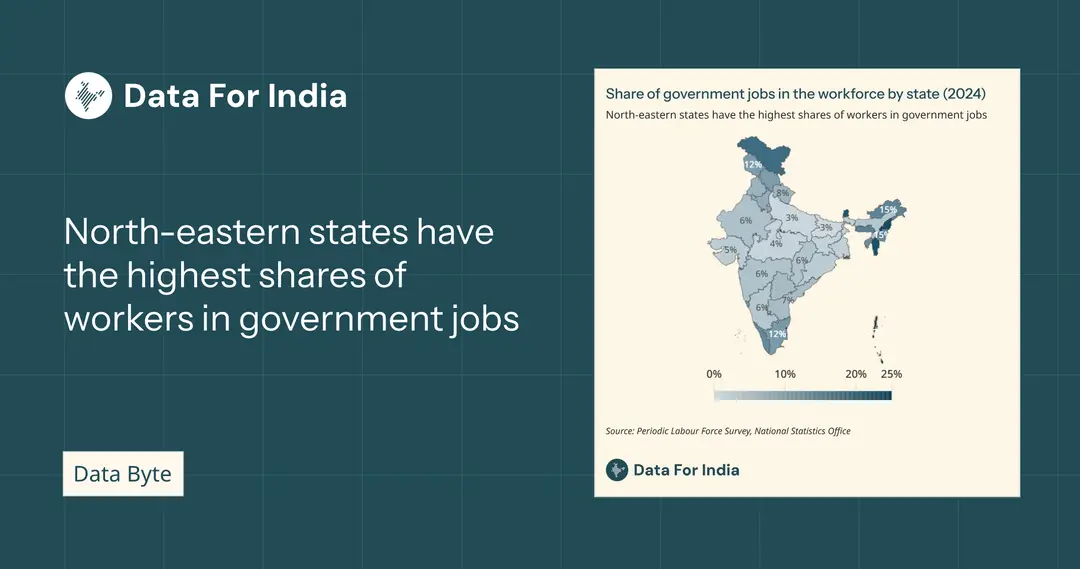
North-eastern states lead in share of government jobs: survey
Only 6% of India's workers are in the public sector and another 6% in private companies, according to the 2023-24 Periodic Labour Force Survey conducted by the National Statistics Office. One in four jobs in Mizoram, Nagaland and Sikkim is in the public sector. In Kerala and Tamil Nadu the share is between 10% and 15%. In Bihar, Madhya Pradesh and Uttar Pradesh only 3% hold government jobs, while over 90% work in household enterprises.
Source
Jobs · read the original report ↗
Desk check · compared with the source
What the desk checked (4)
- Just 6% of India's workers are in the public sector and another 6% in private companies. — Figure appears in source, attributed to the 2023-24 Periodic Labour Force Survey by the National Statistics Office.
- One in four jobs in Mizoram, Nagaland and Sikkim are in the public sector. — Stated in source as a survey finding; no state-wise table shown, but consistent with the article's PLFS attribution.
- Between 10% and 15% of the workforce is in the public sector in Kerala and Tamil Nadu. — Range appears in source; presented as PLFS-based.
- Only 3% of workers in Bihar, Madhya Pradesh and Uttar Pradesh hold government jobs, with over 90% in household enterprises. — Figures appear in source; internally consistent with the national pattern described.
Analysts’ view opinion
The survey quietly explains why government jobs dominate Indian political rhetoric far beyond their actual share of employment: only 6% of workers are in the public sector, yet that sliver is the most secure and aspirational tier of work. Politically, the states where sarkari jobs are scarcest — Bihar, Madhya Pradesh, Uttar Pradesh — are precisely where recruitment drives, exam calendars and job-quota promises carry the heaviest electoral charge, because over 90% of workers there are in household enterprises with no formal security. In the north-east and in Kerala and Tamil Nadu, where the public sector is a far bigger employer, state governments are themselves major patrons, which changes the politics from demand for jobs to management of an existing constituency.
- With just 6% of workers in the public sector nationally, government employment functions less as a mass livelihood and more as a political symbol of security and mobility.
- In Mizoram, Nagaland and Sikkim, where one in four jobs is public sector, the state is the dominant employer — giving incumbents unusual leverage but also exposing them to anger over salaries, vacancies and fiscal strain.
- Kerala and Tamil Nadu's 10-15% share sits alongside the story's note that these are richer, better-educated states, which helps explain why public employment and welfare delivery are central to their party competition.
- The 3% share in Bihar, MP and UP underlines a political paradox: the loudest demand for government jobs comes from where the state supplies the fewest, keeping recruitment pledges an evergreen campaign currency.
- Opposition parties can read the data as evidence of a thin formal-jobs base, while governments can argue the real fix lies in private and formal-sector expansion rather than expanding public payrolls.
What to watch — Watch whether parties in the low-share Hindi-belt states convert these structural gaps into fresh recruitment announcements and exam-calendar commitments, and whether north-eastern and southern states face pressure over the fiscal cost of large public payrolls.
The story is a labour-statistics finding, not a political analysis: it establishes no causal link between public-sector shares and voting behaviour, contains no party positions or official reactions, and does not address vacancies, pay or government finances.
Deep dive
Research brief · 8 facts · 1 dates · exam-readyThe brief
Context
Government jobs remain among the most sought-after forms of employment in India because they offer greater security and benefits than private sector work. But data from the 2023-24 round of the Periodic Labour Force Survey (PLFS), conducted by the National Statistics Office, shows that only a small minority of Indian workers actually hold such jobs. Just 6% of workers are in the public sector and another 6% in private companies, with the majority working in household enterprises. The survey also reveals sharp regional variation, with north-eastern states having the largest share of public sector workers and the poorest central and northern states the smallest.
Key facts
- Only 6% of India's workers are employed in the public sector, according to PLFS 2023-24.
- Another 6% of India's workers are employed in private companies.
- The majority of India's workers are employed in household enterprises.
- One in four jobs in Mizoram, Nagaland and Sikkim is in the public sector — the highest shares in India.
- In Kerala and Tamil Nadu, between 10% and 15% of the workforce is in the public sector.
- In Bihar, Madhya Pradesh and Uttar Pradesh, only 3% of workers hold government jobs.
- More than 90% of the workforce in Bihar, Madhya Pradesh and Uttar Pradesh works in household enterprises.
- The data comes from the Periodic Labour Force Survey, a nationally representative annual labour survey run by the National Statistics Office.
Timeline
- 2023-24Round of the Periodic Labour Force Survey conducted by the National Statistics Office, the source of this employment data.
Who has a stake
- National Statistics Office (NSO) — Conducts the annual Periodic Labour Force Survey that generates nationally representative estimates of India's employment structure.
- North-eastern states (Mizoram, Nagaland, Sikkim) — Depend heavily on government jobs — one in four jobs is in the public sector — as the private sector there remains small.
- Southern states (Kerala, Tamil Nadu) — Richer and better educated, with 10-15% of the workforce in public sector jobs.
- Bihar, Madhya Pradesh and Uttar Pradesh — Only 3% of workers in government jobs and over 90% in household enterprises, reflecting low formal employment.
- Job-seeking workers across India — Public sector jobs offer security and benefits but can absorb only a minority of Indian adults.
Why it matters
The survey shows that the job type most prized by Indian workers \u2014 secure, benefit-bearing government employment \u2014 is available to only about one in sixteen workers, while an equally small share works in private companies. The rest depend on household enterprises, which are typically informal. The wide state-level spread also shows that the public sector plays very different roles in regional economies: a dominant employer where private industry is thin, and a marginal one in India's poorest and least educated regions.
UPSC angle
Prelims pointers
- Periodic Labour Force Survey (PLFS) is conducted annually by the National Statistics Office (NSO).
- PLFS 2023-24: 6% of workers in public sector, 6% in private companies; majority in household enterprises.
- Highest public sector job shares: Mizoram, Nagaland, Sikkim — one in four jobs.
- Kerala and Tamil Nadu: public sector accounts for 10-15% of the workforce.
- Lowest public sector job shares: Bihar, Madhya Pradesh, Uttar Pradesh — 3% each.
- Over 90% of workers in Bihar, MP and UP are in household enterprises.
Mains framing
India's employment structure, as captured by PLFS 2023-24, is dominated not by the formal public or private sector but by household enterprises: only 6% of workers are in the public sector and 6% in private companies. The public sector is prized for security and benefits, yet can absorb only a minority of adults, which explains the intense competition for government jobs. The regional pattern is revealing: in north-eastern states such as Mizoram, Nagaland and Sikkim, where the private sector remains small, the state is the single largest formal employer with one in four jobs; in richer, better-educated southern states like Kerala and Tamil Nadu the share is 10-15%; while in Bihar, Madhya Pradesh and Uttar Pradesh \u2014 India's poorest regions with the lowest education levels \u2014 only 3% of workers hold government jobs and over 90% are in household enterprises. This suggests that public sector employment tracks both state capacity and educational attainment, and that household enterprise dominance in poorer states signals a weak formal job base. The way forward implied by the data is expansion of formal private employment and education levels, since public sector hiring cannot by itself absorb India's workforce; the source does not prescribe specific policy measures.
Key terms
- Periodic Labour Force Survey (PLFS)
- India's annual nationally representative labour survey, which generates employment and workforce estimates.
- National Statistics Office (NSO)
- The government body that conducts the Periodic Labour Force Survey.
- Public sector
- Various departments and arms of the government, including companies run directly by the government.
- Household enterprise
- Employment within a household-run economic unit; the category that employs the majority of India's workers.
- Formal sector
- The organised part of the economy covering public sector and registered private company employment, a small share of India's workforce.
Practice questions
- PLFS 2023-24 shows only 6% of Indian workers are in the public sector and 6% in private companies. Examine what this says about the size of India's formal sector and the dominance of household enterprises.
- Why do north-eastern states have the highest share of workers in government jobs while Bihar, Madhya Pradesh and Uttar Pradesh have the lowest? Discuss with reference to private sector development and education levels.
- Government jobs are the most sought-after in India but can employ only a minority of adults. Critically analyse the implications of this mismatch for India's labour market.
Grounded only in the source report — figures and dates are the source's, not inferred.