
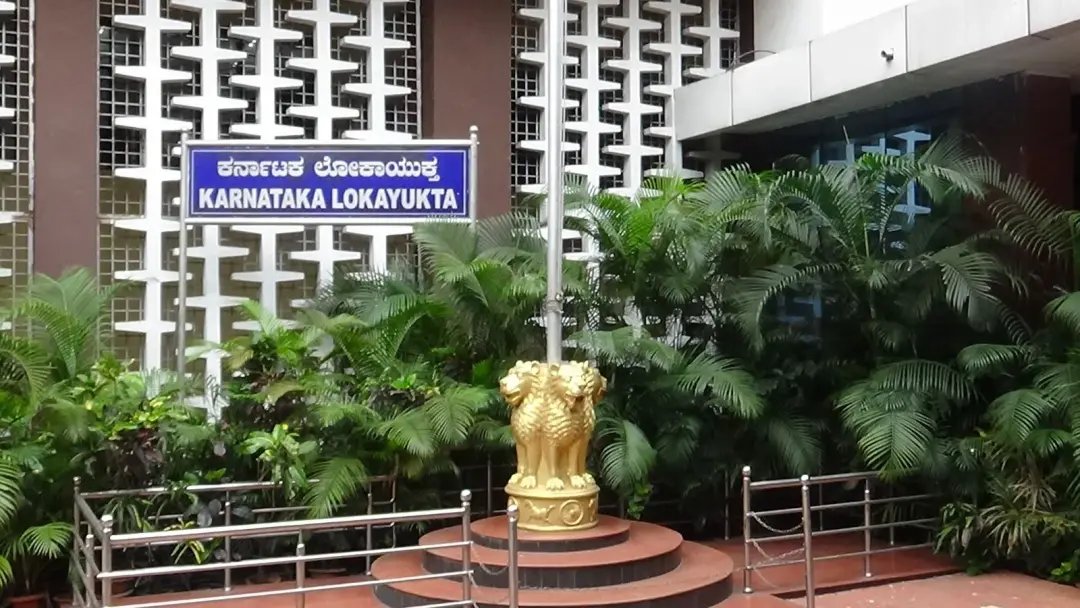
Karnataka Lokayukta raids 33 locations, identifies Rs 29 crore assets
Karnataka Lokayukta Police on Tuesday conducted simultaneous searches at over 33 locations linked to six government officers and two retired officers in disproportionate assets cases, identifying assets worth over Rs 29 crore, officials said. These included immovable properties worth Rs 17.98 crore and movable assets worth Rs 11.63 crore. Searches covered Bengaluru, Chikkaballapur, Kalaburagi, Mandya, Kodagu, Dharwad and Bidar. District Registrar Sridevi had the highest assets at about Rs 6.81 crore. Lokayukta said seized documents were being examined.
Source
Indian Express — Cities · read the original report ↗
Desk check · compared with the source
What the desk checked (5)
- Lokayukta Police searched over 33 locations linked to six serving and two retired government officers on Tuesday. — Attributed to officials and Karnataka Lokayukta Police in the source.
- Assets worth over Rs 29 crore identified, comprising Rs 17.98 crore immovable and Rs 11.63 crore movable. — Figures appear in source, attributed to officials; components are internally consistent with the stated total.
- District Registrar Sridevi had the highest asset value at about Rs 6.81 crore. — Attributed to officials; itemised break-up given in source.
- Retired assistant engineer H M Ranganath's total assets valued at about Rs 5.70 crore, including Rs 3.96 crore movable. — Figure appears in source, attributed to officials.
- Seized documents are being examined to establish income, expenditure and sources of assets. — Attributed to Lokayukta; investigation is ongoing and no charges are stated.
Analysts’ view opinion
This is the opening stage of an investigation, not a finding of guilt. Under anti-corruption law, searches in disproportionate assets (DA) cases are evidence-gathering steps, and the headline figure of "assets identified" is a preliminary valuation — not a determination that the money was illicit. As the Lokayukta itself indicates, the work of establishing income, expenditure and the sources of the assets is still ongoing, and that exercise will decide where these cases go.
- In a DA prosecution the burden is to quantify the gap between assets and known lawful income; it is that disproportion, not the gross asset value, that is legally decisive.
- Simultaneous searches across 33-plus locations in a single day is a familiar investigative tactic to prevent evidence being moved, and its integrity will rest on proper search authorisation and correctly drawn seizure inventories.
- Examining premises linked to relatives is routine, but attributing such property to an officer requires proof that it was held on his or her behalf.
- The officers are entitled to explain lawful sources — inheritance, loans, family or business income can materially alter the disproportion calculation.
- Departmental action such as suspension or inquiry can run parallel to the criminal process, and the two operate on different standards of proof.
What to watch — Watch whether, after the seized documents are examined, the Lokayukta files charge sheets, against how many of the eight, and whether sanction for prosecution is granted by the competent authority.
The story establishes no wrongdoing by anyone named; it does not say whether the assets are in fact disproportionate, whether any arrests or charges have followed, or what the officers' own explanations are.
Deep dive
Research brief · 8 facts · 3 dates · exam-readyThe brief
Context
The Karnataka Lokayukta is the state's anti-corruption ombudsman with its own police wing empowered to investigate public servants, including for disproportionate assets (DA) — wealth that cannot be explained by known lawful income. On Tuesday, the Lokayukta Police mounted simultaneous searches at over 33 locations linked to six serving government officers and two retired officers across several districts. The raids covered residences, offices and premises of relatives, and identified assets worth over Rs 29 crore in aggregate. Seized documents are now being examined to match income, expenditure and the sources of the assets.
Key facts
- Karnataka Lokayukta Police searched over 33 locations on Tuesday linked to six serving and two retired government officers in disproportionate assets cases.
- Total assets identified exceeded Rs 29 crore: immovable properties worth Rs 17.98 crore and movable assets worth Rs 11.63 crore.
- Searches spanned Bengaluru, Bengaluru South, Chikkaballapur, Kalaburagi, Mandya, Kodagu, Dharwad and Bidar.
- Sridevi, District Registrar, Basavanagudi, Bengaluru, had the highest asset value at around Rs 6.81 crore, including agricultural land worth Rs 2.5 crore and a garment factory worth Rs 2.3 crore.
- Retired assistant engineer H M Ranganath (Greater Bengaluru Authority, Shivajinagar) had movable assets of about Rs 3.96 crore and total assets of about Rs 5.70 crore.
- In Mandya, assets linked to Hostel Superintendent Shivaraju M included immovable property worth Rs 2.16 crore and movable assets worth Rs 1.66 crore — five sites, five houses, a commercial complex, a farmhouse and six acres of farmland.
- Assets of about Rs 2.20 crore were identified for Rajeshwari Babalad (AEE, GESCOM) in Kalaburagi and about Rs 2.80 crore for Kiran Baindur (AEE, HESCOM, Dharwad).
- Items identified during the raids included properties, vehicles, gold and silver ornaments, cash and fixed deposits.
Timeline
- Tuesday (date not stated in the source)Karnataka Lokayukta Police conduct simultaneous searches at over 33 locations linked to eight serving and retired officers.
- Same day / after the searchesOfficials put the identified assets at over Rs 29 crore — Rs 17.98 crore immovable and Rs 11.63 crore movable.
- OngoingLokayukta examining seized documents and materials to establish the officials' income, expenditure and sources of assets.
Who has a stake
- Karnataka Lokayukta Police — Must convert search findings into provable disproportionate assets cases by establishing income versus expenditure.
- The eight officers named, including Sridevi and H M Ranganath — Face DA investigation and possible action; their properties, cash and ornaments are under scrutiny.
- Relatives of the officers — Their premises were searched as assets are often held in family members' names.
- State departments and utilities — Backward Classes Welfare Dept, GBA, GESCOM, HESCOM, Karnataka FDA, municipal and registration offices — Institutional credibility and internal vigilance over frontline, public-facing posts.
- Citizens of Karnataka — Quality and integrity of services in welfare hostels, power utilities, drug regulation, municipal and land registration work.
Why it matters
The case shows corruption risk is concentrated not only at the top but in mid-level, public-facing posts — hostel superintendents, assistant engineers in power utilities, municipal commissioners and sub-registrars — where discretionary decisions meet ordinary citizens. That a retired officer's assets are also under scrutiny signals that superannuation does not end accountability. The scale, over Rs 29 crore from eight officers, underlines the gap between declared income and accumulated wealth in state administration.
UPSC angle
Prelims pointers
- Karnataka Lokayukta is the state anti-corruption ombudsman with a police wing that investigates public servants.
- Disproportionate assets (DA) case: assets beyond a public servant's known and lawful sources of income.
- Raids identified Rs 29 crore-plus: Rs 17.98 crore immovable and Rs 11.63 crore movable.
- Districts covered: Bengaluru, Bengaluru South, Chikkaballapur, Kalaburagi, Mandya, Kodagu, Dharwad, Bidar.
- GESCOM = Gulbarga Electricity Supply Company Ltd; HESCOM = Hubli Electricity Supply Company Ltd; GBA = Greater Bengaluru Authority.
- Highest individual value: Rs 6.81 crore, District Registrar Sridevi, Basavanagudi, Bengaluru.
Mains framing
The Karnataka Lokayukta's simultaneous raids at over 33 locations, yielding identification of assets worth more than Rs 29 crore linked to eight serving and retired officers, illustrate how disproportionate asset accumulation clusters around posts with high discretion and low visibility — welfare hostel administration, electricity distribution engineering, municipal administration, drug regulation and property registration. The pattern of assets — multiple sites and houses, agricultural land, a commercial complex, a farmhouse, a garment factory, gold, cash and fixed deposits, often on premises linked to relatives — points to layering of wealth through family and business fronts, which is precisely why coordinated, multi-district searches matter evidentially. The source notes the investigative task ahead: reconciling income, expenditure and sources of assets from seized documents, the core test in any DA prosecution. The way forward suggested by the facts is stronger front-end deterrence — rigorous scrutiny of annual property returns, data-matching between registration records and declared income, and timely conclusion of cases including against retired officials, so that enforcement is not limited to episodic search operations whose findings take years to translate into outcomes.
Key terms
- Lokayukta
- State-level anti-corruption ombudsman; in Karnataka it has a police wing that registers and investigates cases against public servants.
- Disproportionate assets (DA) case
- A case where a public servant's assets exceed what can be explained by known lawful sources of income.
- Immovable vs movable assets
- Immovable: land, houses, sites, factories; movable: cash, gold and silver, vehicles, fixed deposits and similar articles.
- GESCOM / HESCOM
- Gulbarga and Hubli Electricity Supply Company Limited — Karnataka's regional power distribution utilities.
- Greater Bengaluru Authority (GBA)
- Bengaluru civic authority; the retired assistant engineer under scrutiny served in its Shivajinagar office.
- District Registrar
- Officer overseeing registration of property documents in a district — a post with significant revenue-related discretion.
Practice questions
- Disproportionate assets cases repeatedly implicate mid-level officials in utilities, welfare and land registration. What structural features of these posts create corruption risk, and how can they be reduced?
- Evaluate the effectiveness of state Lokayuktas as anti-corruption institutions, using the Karnataka searches as an illustration of their powers and limitations.
- Search-and-seizure operations produce headline asset figures but few timely convictions. Discuss the evidentiary and procedural challenges in prosecuting disproportionate assets cases in India.
Grounded only in the source report — figures and dates are the source's, not inferred.