
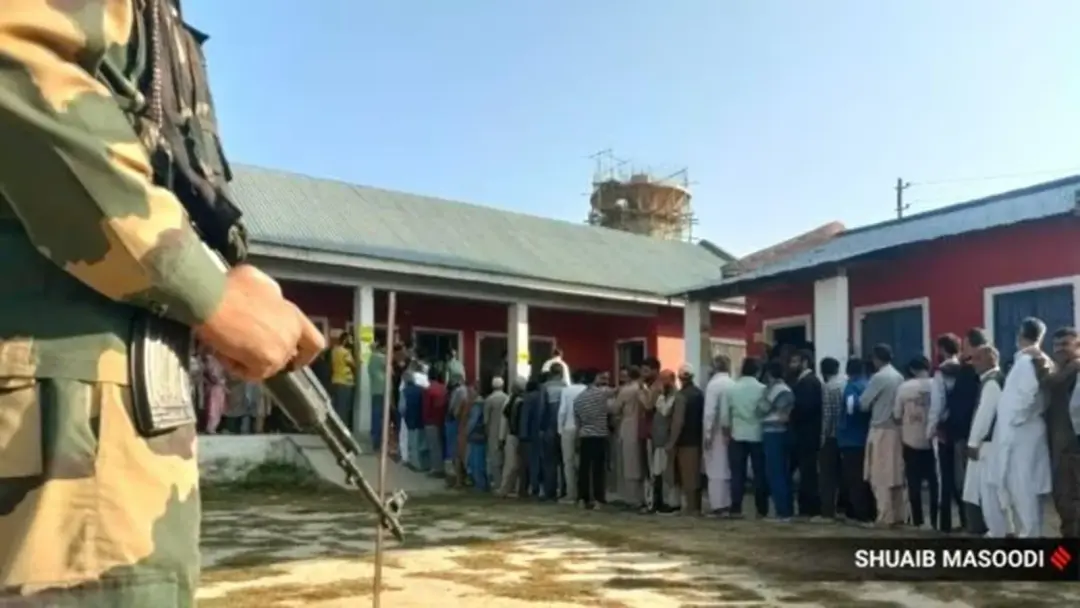
J&K panchayat polls stalled as OBC reservation decision pends
Two years after local bodies in Jammu & Kashmir completed their tenure, there is no sign of panchayat elections, with the government yet to decide on OBC reservation in rural bodies, officials said. A three-member OBC Commission headed by former high court judge Janak Raj Kotwal submitted its report in February last year. Minister Javid Ahmed Dar said the report will go to the Cabinet, followed by delimitation and reservation. Chief Minister Omar Abdullah said polls will be held at an appropriate time.
Source
Indian Express — India · read the original report ↗
Desk check · compared with the source
What the desk checked (5)
- J&K panchayat elections are stalled because the government has not decided on OBC reservation in grassroots bodies — Attributed to officials and an unnamed State Election Commission official quoted in the source.
- A three-member OBC Commission led by former high court judge Janak Raj Kotwal submitted its report in February last year — Attributed to officials; minister Javid Ahmed Dar confirms receipt of the report.
- Terms of panchayats and BDCs ended on January 9, 2024; municipalities in October-November 2023; District Development Councils on February 24, 2026 — Dates appear in the source; the DDC date is in the future relative to the other dates and should be verified by the desk.
- SEC told the Chief Secretary in August that a decision was needed by September to hold polls before winter — Attributed to a senior official, unnamed.
- Municipal polls cannot be held until assembly electoral rolls are revised after the SIR — Attributed to an unnamed official; SIR is not expanded in the source.
Analysts’ view opinion
OBC reservation looks like a technical and legal hurdle, but it is hard to read the stalled panchayat polls in Jammu & Kashmir as purely administrative. Two years without elected local bodies means grassroots power sits with the bureaucracy rather than with elected representatives — a message no party finds politically comfortable. That the OBC Commission report has been with the government since February last year and is still not before the Cabinet gives the opposition an obvious line of attack about a reluctance to decide.
- Sequencing the OBC decision before delimitation and reservation keeps the election calendar firmly in the government's hands, even though the State Election Commission says it is ready and only needs the dates.
- Chief Minister Omar Abdullah's phrase "an appropriate time" is notable — the story points out it echoes the language BJP leaders have used on restoring statehood, which invites political needling.
- Whatever the OBC quota decision turns out to be, it will reshape local equations across regions and social groups, which is one reason no side may be in a hurry to own it.
- Urban local bodies face an even longer wait, since municipal polls depend on assembly rolls that will only be revised after the SIR.
- With no elected panchayats, the pipeline for local leadership stays frozen — a relative loss for cadre-based parties and a relative gain for whoever works through the administrative machinery.
What to watch — Watch whether the Kotwal Commission report reaches the Cabinet and whether the government conveys poll dates to the SEC before winter closes the window — another missed season will sharpen the charge that the delay is deliberate.
The story does not establish any political motive behind the delay, nor what the Commission actually recommended or when the Cabinet will take it up.
Deep dive
Research brief · 8 facts · 8 dates · exam-readyThe brief
Context
Jammu & Kashmir currently has no elected local bodies: the terms of panchayats, Block Development Councils, municipalities and District Development Councils have all lapsed. Until 2019, panchayat polls in the region were held under the J&K Panchayati Raj Act, which did not require an OBC quota; after J&K became a Union Territory, OBC reservation rules apply. A three-member OBC Commission headed by former high court judge Janak Raj Kotwal submitted its report to the government in February last year, but no decision has been taken, stalling rural local body elections.
Key facts
- Two years have passed since the erstwhile local bodies in J&K completed their tenure, with no sign of panchayat elections.
- The term of the erstwhile Panchayats and Block Development Councils (BDCs) in J&K ended on January 9, 2024.
- Municipalities in J&K completed their term in October-November 2023.
- The term of District Development Councils ended on February 24, 2026.
- A three-member OBC Commission led by former high court judge Janak Raj Kotwal submitted its report to the government in February last year.
- Under the Panchayati Raj Act, OBC reservation has to be in proportion to the population in every panchayat, an SEC official said.
- At a meeting with Chief Secretary Atal Dulloo in August, the SEC said the government must convey its decision by September for polls this year.
- The SEC says it needs at least one-and-a-half to two months to hold elections, and could hold them in November after a summary revision of panchayat rolls.
Timeline
- Until 2019Panchayat elections in J&K were conducted under the J&K Panchayati Raj Act, which did not require an OBC quota.
- Seven years agoJ&K's conversion into a Union Territory, after which OBC reservation rules apply to the region.
- October-November 2023Municipalities in J&K completed their term.
- January 9, 2024Term of the erstwhile Panchayats and Block Development Councils concluded.
- February last yearThree-member OBC Commission headed by Janak Raj Kotwal submitted its report to the government.
- February 24, 2026Term of District Development Councils drew to a close.
- AugustSEC told Chief Secretary Atal Dulloo that the government must convey its poll decision by September for elections this year.
- Last monthCM Omar Abdullah said local body elections will be held at 'an appropriate time'.
Who has a stake
- J&K government / Cabinet — Must decide on the OBC Commission report, then carry out delimitation and reservation of panchayat constituencies before polls.
- State Election Commission (SEC), J&K — Says all requisite exercises are complete; has asked the government for one-two months' advance notice of poll dates.
- OBCs in J&K — Await proportional reservation in panchayats, which is the pending precondition for rural local body elections.
- Chief Minister Omar Abdullah — Says polls will be held at 'an appropriate time'; has also questioned holding polls if J&K is run from Raj Bhawan.
- Javid Ahmed Dar, Minister for Rural Development and Panchayati Raj — Confirms receipt of the OBC report and the sequence: Cabinet, then delimitation and reservation, then elections.
- Rural voters and panchayat aspirants — Left without elected grassroots representation as all three tiers of Panchayati Raj institutions are non-existent.
- Urban voters — Municipal polls cannot be held even after an OBC decision, as assembly constituency electoral rolls are un-updated pending the SIR.
Why it matters
All three tiers of Panchayati Raj institutions in J&K are currently non-existent, leaving grassroots governance without elected representatives while decisions rest with the administration. The delay ties a constitutional-style requirement of OBC reservation to political timing, with both the Chief Minister and the Panchayati Raj Minister using the phrase "appropriate time". Urban polls face a separate hurdle, as municipal elections depend on assembly electoral rolls that will be revised only after the SIR.
UPSC angle
Prelims pointers
- Terms lapsed: Panchayats and BDCs on January 9, 2024; municipalities in October-November 2023; DDCs on February 24, 2026.
- Three-member OBC Commission for J&K headed by former high court judge Janak Raj Kotwal; report submitted February last year.
- J&K Panchayati Raj Act: poll dates are finalised by the government in consultation with the State Election Commission.
- Under the Panchayati Raj Act, OBC reservation must be in proportion to population in every panchayat.
- Panchayats maintain separate electoral rolls; municipal polls use assembly constituency rolls, to be revised only after the SIR.
- Javid Ahmed Dar is J&K Minister for Rural Development and Panchayati Raj; Atal Dulloo is Chief Secretary.
Mains framing
The stalling of panchayat elections in Jammu & Kashmir illustrates how procedural preconditions can become instruments of political delay in grassroots democracy. The immediate cause is legal-administrative: after J&K's conversion into a Union Territory, OBC reservation rules apply, and the Panchayati Raj Act requires such reservation to be proportional to population in every panchayat, so delimitation and reservation of constituencies must precede polls. Yet the OBC Commission headed by Janak Raj Kotwal submitted its report in February last year and the Cabinet has still not acted, even as the SEC repeatedly says all requisite exercises are complete and that it needs only one-and-a-half to two months' notice. The implication is a governance vacuum: all three tiers of Panchayati Raj institutions are non-existent, devolved functions and funds lack elected custodians, and the phrase "appropriate time" used by the Chief Minister and the Panchayati Raj Minister echoes the language used on statehood restoration. A way forward grounded in the source would be timely Cabinet consideration of the OBC report, followed by delimitation, reservation and a summary revision of the separate panchayat electoral rolls, with clear advance communication of dates to the SEC; urban polls additionally require updated assembly electoral rolls after the SIR.
Key terms
- OBC Commission (J&K)
- Three-member body led by former high court judge Janak Raj Kotwal that reported on OBC reservation in J&K local bodies in February last year.
- State Election Commission (SEC)
- Poll body that conducts local body elections in J&K; poll dates are set by the government in consultation with it.
- J&K Panchayati Raj Act
- Law governing panchayat elections in the region; until 2019 it did not require an OBC quota.
- Block Development Councils (BDCs)
- Middle tier of J&K's Panchayati Raj structure; their term ended on January 9, 2024.
- District Development Councils (DDCs)
- Top tier of J&K's rural local bodies; their term concluded on February 24, 2026.
- SIR
- Electoral roll exercise after which J&K's assembly constituency rolls will be revised; municipal polls depend on these rolls.
Practice questions
- Why has the pending decision on OBC reservation held up panchayat elections in Jammu & Kashmir, and what steps must follow the Cabinet's consideration of the OBC Commission report?
- Examine the consequences of a prolonged vacuum in all three tiers of Panchayati Raj institutions for grassroots governance in a Union Territory.
- Distinguish between the procedural requirements for holding rural and urban local body elections in J&K, as brought out by the current impasse.
Grounded only in the source report — figures and dates are the source's, not inferred.