
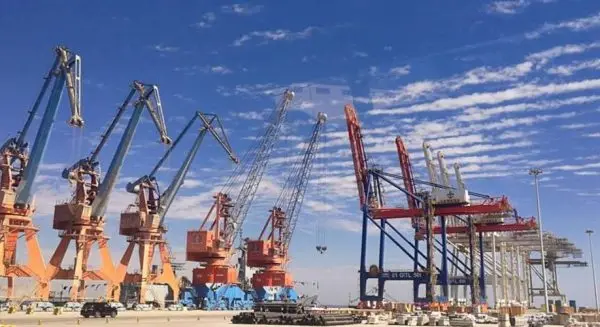
US interest in Pakistan's Gwadar Port grows, analysis says
An analysis says Gwadar Port, located just outside the Strait of Hormuz, is drawing increased US attention for its strategic value. Since the US war on Iran began in February, diverted transshipments have reached Gwadar, including a 53,277-ton steel billet consignment in May on a Chinese vessel originally bound for Oman's Sohar Port. A US Naval War College report flagged Gwadar as a possible site for expanded Chinese naval operations. Pakistan offered Washington its Pasni port in September 2025.
Source
The Diplomat (Asia) · read the original report ↗
Desk check · some claims need care
What the desk checked (5)
- Gwadar handled a 53,277-ton steel billet shipment in May aboard a Chinese vessel diverted from Oman's Sohar Port — Figure appears in source; no shipping authority or company cited
- Gwadar has received several diverted transshipments since the start of the US war on Iran in February — Stated in source without attribution; war reference is central and unsourced
- The US Geological Survey identified Gwadar in 1954 as suitable for a seaport; Gwadar was an Omani enclave until 1958 — Historical claims stated in source, attributed to USGS survey only
- A US Naval War College report identified Gwadar as a candidate for expanded Chinese naval operations — Attributed to a named institution's report; report title and date not given
- Pakistan offered Washington its Pasni port, 100 km from Gwadar, in September 2025 — Appears in source; no official confirmation cited, and source says US response is not public
Analysts’ view opinion
Gwadar's story has stopped being a commercial one and become a geopolitical one. Its position just outside the Strait of Hormuz, combined with the uncertainty created by the U.S. war on Iran, has suddenly placed a port that struggled for a decade to attract business squarely on the radar of major powers. The real strategic signal is not the tonnage of steel billets it handled, but why those ships were diverted there at all.
- A Chinese vessel originally bound for Sohar in Oman being rerouted to Gwadar shows the wartime value of alternative routing, not necessarily a durable commercial win.
- American strategic interest is not new — from the creation of the U.S. Navy Middle East Force in 1949 to the 2019 arrangement for access to Duqm and Salalah in Oman, Washington has sustained a naval presence in these waters.
- The U.S. Naval War College report flagging Gwadar as a candidate for expanded Chinese naval operations makes clear that Washington's concern is military potential, not cargo volumes.
- Pakistan's September 2025 offer of Pasni port to Washington is a familiar hedging play between Beijing and Washington; notably, the U.S. response has not been made public.
- Even without economic returns, China is unlikely to loosen its grip on Gwadar because the port and CPEC ease its 'Malacca Dilemma' — which is why diplomatic warmth, such as the Xi-Trump meeting, does not end the competition.
What to watch — Watch for any public U.S. decision on the Pasni offer, and whether diverted shipping keeps flowing to Gwadar once uncertainty around Hormuz eases.
The story does not establish that U.S. interest will translate into policy or presence, that the Pasni offer was accepted, or that any Chinese naval facility at Gwadar exists — these remain assessments and possibilities.
Deep dive
Research brief · 8 facts · 8 dates · exam-readyThe brief
Context
Gwadar, a deep-sea port on Pakistan's Balochistan coast built with Chinese funding as the flagship of the China-Pakistan Economic Corridor (CPEC), has for a decade struggled to attract commercial traffic. Since the start of what the source calls the U.S. war on Iran in February, shipping uncertainty around the Strait of Hormuz has diverted cargo to Gwadar, lifting its activity. An analysis argues that Gwadar's real value lies in its location just outside the Strait of Hormuz, which is drawing renewed United States attention alongside long-standing Chinese interest.
Key facts
- In May, Gwadar Port handled a 53,277-ton steel billet shipment on a Chinese vessel originally bound for Sohar Port in Oman, diverted to Gwadar.
- Since the start of the U.S. war on Iran in February, Gwadar has received several diverted transshipments.
- The U.S. Geological Survey of Balochistan identified Gwadar in 1954 as a suitable location for a seaport.
- Gwadar was an Omani enclave until 1958 and was later transferred to Pakistan.
- The U.S. Navy Middle East Force (MEF) was created in 1949, marking the first regular U.S. naval presence in West Asia; the U.S. has been in these waters since the 1940s.
- In 2019, the U.S. and Oman signed a deal allowing the U.S. Navy to use the ports of Duqm and Salalah.
- A U.S. Naval War College report identified Gwadar as a potential candidate for expanded Chinese naval (PLAN) operations, citing Pakistan's close ties with China.
- In September 2025, Pakistan offered Washington its Pasni port, located just 100 km from Gwadar; no public decision has been announced.
Timeline
- 1954U.S. Geological Survey of Balochistan identifies Gwadar as a suitable site for a seaport.
- 1949U.S. Navy Middle East Force established, beginning regular U.S. naval presence in West Asia.
- 1958Gwadar, until then an Omani enclave, is later transferred to Pakistan.
- 2019U.S.-Oman deal gives the U.S. Navy access to Duqm and Salalah ports.
- February (this year)U.S. war on Iran begins; maritime disruptions divert transshipments to Gwadar.
- MayGwadar handles a 53,277-ton steel billet consignment diverted from Sohar, Oman.
- September 2025Pakistan offers Pasni port to Washington, 100 km from Gwadar.
- Not dated in the sourceChinese President Xi Jinping visits the U.S. and meets President Donald Trump, signalling possible cooperation.
Who has a stake
- Pakistan — Seeks economic revival of Gwadar while balancing ties with China and the U.S.; has offered Pasni port to Washington.
- China — Has funded Gwadar and CPEC; has not yet gained economically but values the port for easing its 'Malacca Dilemma'.
- United States — Wants to protect Gulf energy and shipping routes and counter Chinese control of strategic port infrastructure.
- Oman — Lost the diverted Sohar cargo to Gwadar; hosts U.S. Navy access at Duqm and Salalah.
- Iran — The war involving Iran is the trigger for regional maritime disruption and Gwadar's rising traffic.
- U.S. Naval War College — Its report flagging Gwadar as a possible PLAN site shapes U.S. strategic thinking.
Why it matters
Gwadar sits at the mouth of the world's most critical energy chokepoint, so its alignment affects global shipping, energy security and the balance of naval power in the Arabian Sea. For India's neighbourhood, a port that is both Chinese-funded and now courted by Washington makes Pakistan's coastline a theatre of great-power competition. The unresolved question of whether the U.S. accepts Pasni will signal how far that contest goes.
UPSC angle
Prelims pointers
- Gwadar Port: Balochistan, Pakistan, on the Arabian Sea just outside the Strait of Hormuz; flagship of CPEC.
- Gwadar was an Omani enclave until 1958 before transfer to Pakistan; identified as a port site by a U.S. Geological Survey in 1954.
- U.S. Navy Middle East Force created in 1949; 2019 U.S.-Oman deal covers Duqm and Salalah ports.
- Pasni port, 100 km from Gwadar, was offered to the U.S. by Pakistan in September 2025.
- PLAN = People's Liberation Army Navy; 'Malacca Dilemma' refers to China's dependence on the Strait of Malacca.
- May shipment at Gwadar: 53,277 tons of steel billets diverted from Sohar Port, Oman.
Mains framing
Gwadar illustrates how geography can outweigh commerce in determining a port's strategic worth. Built with Chinese money under CPEC, it failed for a decade to attract cargo, and its recent uptick — including a 53,277-ton diverted consignment in May — stems less from its own competitiveness than from wartime disruption around the Strait of Hormuz since February. Washington's interest is not new: the U.S. Geological Survey flagged Gwadar in 1954, and American naval presence in these waters dates to the 1940s through the Middle East Force and later arrangements such as the 2019 Oman deal for Duqm and Salalah. What has changed is the fear, articulated in a U.S. Naval War College report, that Chinese-linked ports like Gwadar could host expanded PLAN operations, and a reported U.S. push to bring 23 China-controlled strategic ports under Western influence. Pakistan's September 2025 offer of Pasni is a classic hedging move, seeking benefits from both patrons without rupturing either relationship. The way forward hinges on whether Washington converts interest into presence, and whether stabilising Sino-U.S. diplomacy — signalled by the Xi-Trump meeting — restrains competition; meanwhile China will not relinquish Gwadar because it eases the Malacca Dilemma.
Key terms
- CPEC (China-Pakistan Economic Corridor)
- Chinese-funded programme of construction, development and connectivity projects in Pakistan, with Gwadar Port as a centrepiece.
- Strait of Hormuz
- Narrow maritime chokepoint critical to global energy supplies and shipping; Gwadar lies just outside it.
- Malacca Dilemma
- China's strategic vulnerability from relying on the Strait of Malacca for trade and energy; Gwadar and CPEC are meant to ease it.
- PLAN (People's Liberation Army Navy)
- China's navy, which a U.S. Naval War College report says could expand operations at Gwadar.
- U.S. Navy Middle East Force (MEF)
- Formation created in 1949 that gave the United States its first regular naval presence in West Asia.
- Pasni port
- Pakistani port 100 km from Gwadar, offered to the United States in September 2025.
Practice questions
- Why does Gwadar's strategic value exceed its economic performance? Discuss with reference to its location near the Strait of Hormuz and great-power competition.
- Examine how Pakistan's offer of Pasni port to the United States in September 2025 reflects a hedging strategy between Washington and Beijing.
- Explain the 'Malacca Dilemma' and assess how far CPEC and Gwadar Port address China's maritime vulnerabilities.
Grounded only in the source report — figures and dates are the source's, not inferred.