
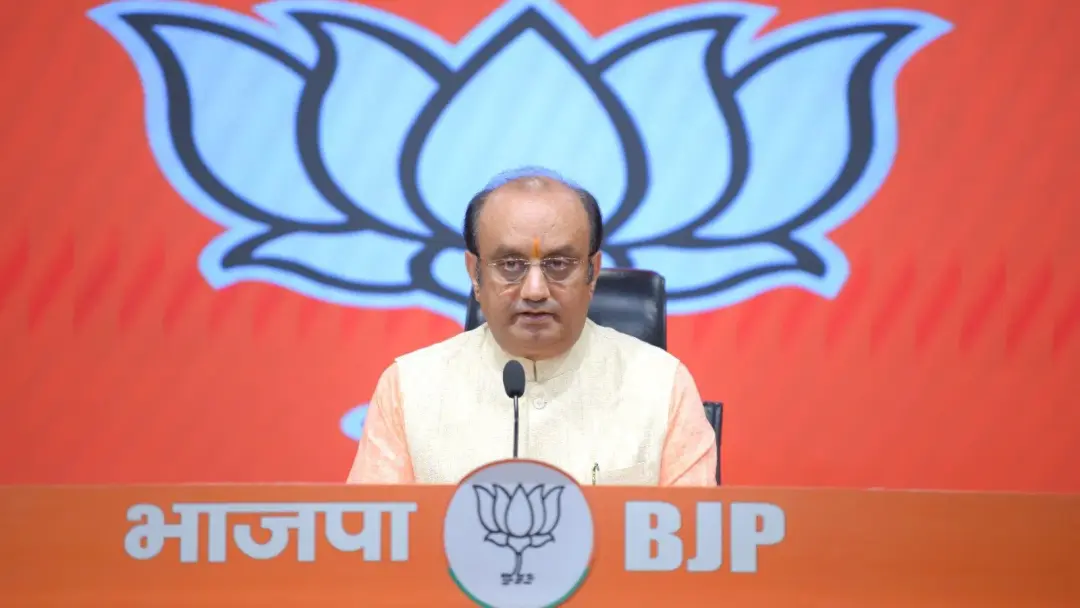
BJP defends EC's SIR process, hits back at Rahul Gandhi
BJP spokesperson Sudhanshu Trivedi on Thursday responded to Leader of Opposition Rahul Gandhi's remarks against the Chief Election Commissioner, saying the Election Commission's Special Intensive Revision process is legally sound and its decisions are taken by majority. He questioned an Indian Express report that two Election Commissioners objected on record 14 times in 10 months to steps under CEC Gyanesh Kumar, saying it carried no quote from them. Trivedi said Congress was responsible for its own electoral losses.
Source
Indian Express — India · read the original report ↗
Desk check · some claims need care
What the desk checked (5)
- BJP spokesperson Sudhanshu Trivedi said the ECI's Special Intensive Revision process is legally sound and its decisions are taken by majority consensus. — Directly attributed to Trivedi at a press conference; opinion/defence, not independently verified.
- An Indian Express report said two Election Commissioners objected on record 14 times in 10 months to steps taken under CEC Gyanesh Kumar. — Figure appears in source, attributed to the Indian Express report; contested by Trivedi.
- The Indian Express sent a questionnaire to the ECI on September 21 and emails to the two ECs, followed by phone calls, with no response received. — Stated in source as the publication's own account; no independent confirmation available.
- Trivedi said Section 21(3) of the Representation of the People Act 1950 authorises the Commission to conduct an SIR, and that the Supreme Court upheld the ECI's SIR powers. — Attributed to Trivedi; legal citation not independently checked here.
- Trivedi's electoral claims, including that Congress last repeated a state government in Madhya Pradesh in 1998 and has not returned to power in Tamil Nadu since 1967 or Bengal since 1977. — Attributed to Trivedi as political argument; figures unverified in source.
Analysts’ view opinion
This is no longer an argument about administrative procedure — it is a fight over the credibility of the referee, and both sides have decided that fight suits them. Rahul Gandhi is using a newspaper investigation to build a single, repeatable narrative that BJP victories rest on a compromised Election Commission; Trivedi's counter is deliberately two-pronged, attacking the report's sourcing on one hand and Congress's own electoral record on the other. The BJP's strongest legal card is the claim that the SIR rests on statute, that the Supreme Court has upheld ECI powers, and that a three-member body cannot act without a majority — a defence that, if it holds, blunts the 'one man' framing at its core.
- By pivoting from the Election Commission to the Gandhi family's win-loss record, the BJP is trying to convert an institutional question into a referendum on Congress's competence — a familiar and usually effective deflection.
- Rahul Gandhi's incentive is to make institutional distrust the Opposition's shared platform, since it is one of the few issues that can unite allies who compete with each other on the ground.
- Trivedi's procedural point — that a three-member commission decides by majority, so two dissenting Commissioners could not be overruled — is the crux of the dispute, and the story does not record any ECI or Commissioner response to test it.
- Invoking the Leader of the Opposition's presence in the EC selection process is a shrewd move to share ownership of the institution and make Opposition attacks look self-defeating.
- The communal framing of the Wayanad remark risks becoming a story of its own and could complicate the BJP's effort to keep this debate on procedural ground.
What to watch — Watch whether the Election Commission or the two Commissioners themselves say anything on the record, and whether the Opposition escalates this into a coordinated parliamentary and legal campaign rather than individual press conferences.
The story establishes what each side is claiming, not who is right: it does not record any response from the ECI or the two Commissioners, and it does not establish that any electoral outcome was affected.
Deep dive
Research brief · 8 facts · 4 dates · exam-readyThe brief
Context
The Indian Express reported on Wednesday that two of the three members of the Election Commission of India objected on record 14 times in 10 months to steps taken under Chief Election Commissioner Gyanesh Kumar, including being kept out of the loop and decisions on adding and deleting voters. Leader of Opposition Rahul Gandhi attacked the CEC at a press conference citing the report. On Thursday, BJP spokesperson Sudhanshu Trivedi hit back, defending the Special Intensive Revision (SIR) of electoral rolls as legally sound and saying the Commission decides by majority. The exchange is part of a wider political fight over the SIR exercise and the credibility of the poll body.
Key facts
- The Indian Express report, published Wednesday, said two Election Commissioners in the three-member ECI objected on record 14 times in 10 months to steps taken under CEC Gyanesh Kumar.
- Objections ranged from being kept in the dark to decisions on adding new voters and deleting names.
- Trivedi said the report carried no quote from the Election Commissioners, "even off-record".
- On September 21, two days before publication, The Indian Express sent a questionnaire to the ECI and emails to the two ECs; follow-up calls were made Monday and Tuesday, with no response.
- Trivedi cited Section 21(3) of the Representation of the People Act, 1950 as authorising the ECI to conduct an SIR at its convenience.
- Trivedi said no changes had been made to Form 6 for new voters, contrary to Congress claims.
- He said India's first electoral roll was made in 1952 when the voting age was 21, and that mother/father references were not required till 1974.
- Trivedi said the Supreme Court had upheld all ECI powers regarding the SIR process, and that with three Commissioners a decision needs a majority.
Timeline
- September 21The Indian Express sends a questionnaire to the ECI and emails to the two Election Commissioners on the flagged issues.
- Monday and Tuesday (after Sept 21)Express follows up the emails with phone calls; no response received to any query.
- WednesdayThe Indian Express publishes its report on 14 on-record objections by two ECs in 10 months.
- ThursdayRahul Gandhi attacks the CEC at a press conference; BJP's Sudhanshu Trivedi responds, defending the ECI and the SIR.
Who has a stake
- Election Commission of India (three-member body) — Its internal decision-making, transparency and institutional credibility during the SIR exercise are under scrutiny.
- CEC Gyanesh Kumar — Steps taken under him are the subject of the reported objections and of Rahul Gandhi's attack.
- The two Election Commissioners — Reported to have recorded 14 objections in 10 months; did not respond to the Express's emails and calls.
- BJP / Sudhanshu Trivedi — Defending the poll body's legality and process, and rebutting Congress claims of electoral manipulation.
- Congress / Rahul Gandhi — Using the report to question the CEC and the SIR; accused by BJP of blaming the EC for its own electoral losses.
- Voters undergoing SIR — Additions and deletions of names decide who remains on the electoral roll; Express cited valid Goa voters left out.
Why it matters
The Election Commission is a constitutional body whose credibility rests on being seen as neutral and collegial; reported internal dissent over an ongoing revision of electoral rolls goes to the heart of who gets to vote. The dispute also tests how far a multi-member Commission's majority decision-making can settle questions of transparency. With the SIR touching additions and deletions of names across states, the political contest over the poll body's functioning affects public trust in elections themselves.
UPSC angle
Prelims pointers
- Special Intensive Revision (SIR) of electoral rolls is conducted by the Election Commission of India.
- Trivedi cited Section 21(3) of the Representation of the People Act, 1950 as the legal basis for conducting an SIR.
- The ECI is a three-member body — the Chief Election Commissioner and two Election Commissioners; the incumbent CEC is Gyanesh Kumar.
- Form 6 is the application form for enrolment of new voters.
- India's first electoral roll was prepared in 1952, when the voting age was 21.
- Trivedi noted the Leader of the Opposition is part of the selection process for Election Commissioners.
Mains framing
The controversy over the Special Intensive Revision illustrates how disputes about electoral administration quickly become disputes about institutional trust. The trigger is a report that two of the three Election Commissioners objected on record 14 times in 10 months to steps taken under the CEC — on being kept in the dark and on additions and deletions of voters — while the ECI and the two ECs did not respond to a questionnaire, emails and follow-up calls. The BJP's defence rests on legality and procedure: Section 21(3) of the RP Act, 1950 permits the Commission to order a revision, the Supreme Court has upheld ECI powers over the SIR, no change was made to Form 6, and in a three-member body decisions require a majority, so dissent cannot by itself invalidate them. The Congress's counter is that the exercise has been used to manipulate rolls, a claim the BJP answers by blaming anti-incumbency against the Congress and its dependence on allies. The unresolved issue is transparency: legality of process does not answer whether internal objections were addressed or whether valid voters, as reported in Goa, were excluded. The way forward suggested by the facts is fuller public disclosure of how the Commission recorded and resolved internal differences, and a responsive grievance mechanism for wrongly excluded voters.
Key terms
- Special Intensive Revision (SIR)
- An intensive revision of electoral rolls by the ECI involving verification, addition of new voters and deletion of names.
- Section 21(3), Representation of the People Act, 1950
- Provision cited by BJP as authorising the Election Commission to order a revision of electoral rolls at its convenience.
- Form 6
- The application form used for enrolment of a new voter in the electoral roll; BJP says no changes were made to it.
- Chief Election Commissioner (CEC)
- Head of the three-member Election Commission of India; the current incumbent named in the story is Gyanesh Kumar.
- Leader of the Opposition (LoP)
- Head of the largest opposition party in the House; Rahul Gandhi holds the post and is part of the EC selection process.
Practice questions
- Does majority decision-making in a three-member Election Commission adequately safeguard institutional credibility when Commissioners record repeated objections? Discuss.
- Examine the legal basis and the transparency concerns surrounding the Special Intensive Revision of electoral rolls.
- "Electoral reform is as much about public trust as about legal authority." Critically evaluate in the light of the recent debate over the Election Commission's functioning.
Grounded only in the source report — figures and dates are the source's, not inferred.