
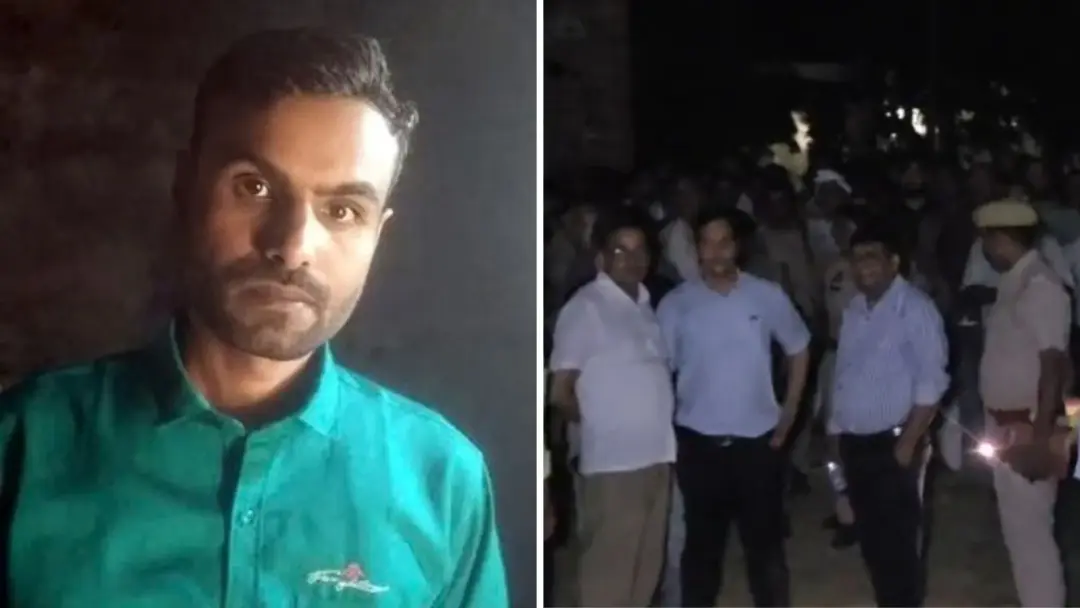
Seven-hour standoff in Azamgarh village; man, son die
Police said Arvind Singh, 45, allegedly shot dead his wife Babita, 35, and priests Mahendra Pathak, 42, and Akhilesh Mishra, 55, during a puja at his home in Shambhupur village, Azamgarh, around 5.45 pm Tuesday. He then locked himself in a room with his three children and refused to surrender for nearly seven hours. Officers stormed in and returned fire. Singh and his nine-year-old son died in hospital; two daughters were rescued safely.
Source
Indian Express — Cities · read the original report ↗
Desk check · some claims need care
What the desk checked (5)
- Arvind Singh, 45, shot his wife Babita, 35, and priests Mahendra Pathak, 42, and Akhilesh Mishra, 55, during a puja at his home around 5.45 pm Tuesday. — Attributed to police and relatives in source; described as alleged, ages and names appear in source.
- Singh held his three children in a bedroom for nearly seven hours and refused appeals to surrender. — Attributed to police, including SSP Anil Kumar's on-record quote.
- Singh fired at police, who fired back; Singh and his nine-year-old son later died in hospital. — Police account; figure of five rounds fired attributed to an unnamed police officer.
- Singh's behaviour changed after his brother Sunil Singh's murder in 2017 and he was being treated in Varanasi. — Attributed to village pradhan Santosh Nishad; medical claim unverified.
- The licensed revolver used was transferred to Arvind after his brother's death. — Attributed to police; no document cited in source.
Analysts’ view opinion
This incident opens two legal tracks at once: with the accused dead, the murder prosecution effectively ends, while the police firing itself becomes the subject of separate scrutiny. In Indian practice, a death caused by police gunfire — especially one involving a child — must be tested against the standard of necessary and proportionate force, and that question is not settled by the police account alone. What the story carries so far is the police version; the legal conclusion will rest on forensic, post-mortem and magisterial-level examination.
- Because the accused has died, the case over the killings of his wife and two priests cannot proceed to trial — only an investigation report can close it, with no judicial finding of guilt.
- Deaths in police firing attract a distinct layer of legal review; force used in self-defence or to protect others must still be shown to have been necessary and no more than required.
- The nine-year-old's death is the central legal question, and only ballistics and post-mortem evidence can establish whether the wound came from the father's weapon — the story reflects the police reading, not a finding.
- Police say the licensed revolver had been transferred from the brother's name, and also note a 2020 assault case and treatment in Varanasi — together raising regulatory questions about how mental-health and criminal history are weighed in arms licensing and renewal.
- The seven hours of negotiation, the offer to send food in for the children, and the use of relatives to persuade him all bear on the minimum-force principle and are likely to be central to any review.
What to watch — Watch whether a magisterial or independent inquiry is formally initiated, what the post-mortem and ballistics reports say about the cause of the boy's death, and what arrangements or orders follow for the care of the two surviving children.
The account rests largely on police statements and villagers' impressions; the exact sequence of firing, the cause of the boy's fatal wound, and what inquiry process has begun are not independently established here.
Deep dive
Research brief · 8 facts · 6 dates · exam-readyThe brief
Context
In Shambhupur village of Uttar Pradesh's Azamgarh district, a family had organised a five-day puja for the wellbeing of 45-year-old farmer Arvind Singh, whom relatives believed was "possessed by an evil spirit". On the fourth day, Tuesday, police say Singh turned on the priests conducting the ritual and on his wife, shooting three people dead with his licensed revolver. He then barricaded himself in a bedroom with his three children, triggering a nearly seven-hour standoff that ended after midnight when police stormed the room; Singh and his nine-year-old son died of gunshot wounds.
Key facts
- Police say Arvind Singh, 45, a farmer, shot dead his wife Babita, 35, and priests Mahendra Pathak, 42, and Akhilesh Mishra, 55, around 5.45 pm on Tuesday.
- The family had organised a five-day puja for Singh's wellbeing, believing he was "possessed by an evil spirit"; three priests were called and each paid Rs 1,000. Tuesday was the fourth day.
- Singh locked himself with his three children in a room measuring roughly 10x12 feet and held out for nearly seven hours, threatening to shoot the children if anyone entered.
- At 12.45 am on Wednesday, a single gunshot was heard; SSP Anil Kumar, SOG in-charge Sanjay Singh and constable Pradeep Pandey broke down the door.
- Police say Singh fired at the officers, who returned fire; Singh and his nine-year-old son were taken to hospital, where both died.
- Daughters aged 10 and six months were rescued safely; police suspect the infant slipped from Singh's arms during the chaos.
- A police officer said Singh had fired five rounds at the police team at close-range contact.
- The revolver used was originally licensed to Singh's brother Sunil alias Pappu and was transferred to Arvind after Sunil's murder in 2017.
Timeline
- 2017Singh's brother Sunil alias Pappu is murdered; Singh's relatives are arrested in the case. Village pradhan says Singh's behaviour changed after this.
- 2020An assault case is registered against Arvind Singh, according to police.
- Five days before the incidentFamily organises a five-day puja for Singh's wellbeing, engaging three priests at Rs 1,000 each.
- Tuesday, around 5.45 pm (fourth day of puja)Singh allegedly abuses the priests, assaults his wife Babita, then fires at her and two priests; all three die in hospital. The third priest flees.
- Tuesday evening onwardsSingh locks himself in a bedroom with his three children; police cordon off the house, bring in relatives and senior officers to persuade him, and offer to send in biscuits and milk.
- 12.45 am WednesdayA gunshot is heard; police storm the room, exchange fire with Singh. Singh and his son die in hospital; two daughters are rescued.
Who has a stake
- Arvind Singh's family — Wife Babita, 35, and a nine-year-old son killed; two daughters aged 10 and six months orphaned; mother, sisters, niece and uncle were used as negotiators.
- Priests Mahendra Pathak and Akhilesh Mishra (and a third priest) — Two were shot dead while conducting the paid ritual; the third fled the scene.
- Azamgarh police / SSP Anil Kumar, SOG in-charge Sanjay Singh, constable Pradeep Pandey — Led the seven-hour negotiation and the final entry; accountable for the decision to storm the room and for the fatal exchange of fire.
- ADG Varanasi zone Naveen Arora and senior officers — Attempted to persuade Singh to surrender; oversight of the hostage-type operation.
- Shambhupur village (population around 6,000, about 35 km from district headquarters) — Community stunned by the killings; pradhan Santosh Nishad spoke of Singh's changed behaviour and treatment in Varanasi.
- Licensing authorities — The weapon was a licensed revolver transferred to Singh after his brother's 2017 murder, despite a 2020 assault case and reported aggression.
Why it matters
The case sits at the intersection of untreated mental distress, faith-based "exorcism" rituals substituting for medical care, and easy access to a licensed firearm by a man with a prior assault case and a history of aggression. It also raises hard questions about police handling of hostage situations involving children, where a seven-hour negotiation ended with the death of the nine-year-old hostage and the armed man.
UPSC angle
Prelims pointers
- Incident location: Shambhupur village, Azamgarh district, Uttar Pradesh; village population around 6,000, about 35 km from district headquarters.
- Officers named: Azamgarh SSP Anil Kumar; SOG in-charge Sanjay Singh; constable Pradeep Pandey; ADG Varanasi zone Naveen Arora.
- SOG stands for Special Operations Group, a specialised police unit deployed in the operation.
- Weapon: licensed revolver originally in brother Sunil's name, transferred to Arvind after Sunil's 2017 murder.
- Standoff duration: nearly seven hours, ending with police entry at 12.45 am Wednesday; accused allegedly fired five rounds at police.
- Deaths: wife Babita (35), priests Mahendra Pathak (42) and Akhilesh Mishra (55), Arvind Singh (45) and his nine-year-old son.
Mains framing
The Azamgarh killings illustrate how three fault lines can converge into a mass-casualty crime. First, a man whose behaviour reportedly changed after his brother's 2017 murder and who was said to be under treatment in Varanasi was treated through a five-day puja premised on spirit possession rather than sustained mental health care, a pattern common where clinical services are distant and stigma is high. Second, he retained a licensed revolver, inherited from his slain brother, despite an assault case registered in 2020 and reported aggression, pointing to weak periodic review of arms licences against criminal and medical history. Third, the police response reveals the limits of improvised crisis negotiation: relatives were brought to the gate, food was offered for the children, senior officers appealed for surrender, yet for nearly seven hours there was no resolution, and the assault came only after a shot was heard, by which time the nine-year-old had been wounded. A grounded way forward would involve strengthening district-level mental health outreach and counselling for families of violent-crime victims, rigorous re-verification of arms licences where criminal cases or mental illness are reported, and trained, protocol-driven hostage negotiation and tactical capacity at the district level, alongside a transparent inquiry into the exchange of fire that left a child hostage dead.
Key terms
- SSP (Senior Superintendent of Police)
- The senior-most police officer of a district; in Azamgarh, Anil Kumar, who personally entered the room.
- SOG (Special Operations Group)
- A specialised state police unit for operations such as raids and armed standoffs; its in-charge Sanjay Singh took part in the entry.
- ADG, Varanasi zone
- Additional Director General of Police heading the Varanasi police zone, here Naveen Arora, who also tried to persuade Singh to surrender.
- Licensed revolver
- A firearm legally held under an arms licence; this one was transferred to Arvind Singh after his brother Sunil's death in 2017.
- Village pradhan
- Elected head of the gram panchayat; Santosh Nishad described Singh's behavioural change and treatment in Varanasi.
- Five-day puja for wellbeing
- A religious ceremony the family organised believing Singh was possessed by an evil spirit; three priests were paid Rs 1,000 each.
Practice questions
- Examine how gaps in rural mental health care and reliance on faith-based remedies can escalate into violent crime, using recent incidents as illustration.
- Should arms licences be subject to mandatory re-verification when the holder faces a criminal case or reported mental illness? Discuss with reference to the Azamgarh case.
- Discuss the institutional capacity Indian district police need for hostage and barricade situations involving children, and the accountability questions raised when such operations end in fatalities.
Grounded only in the source report — figures and dates are the source's, not inferred.