
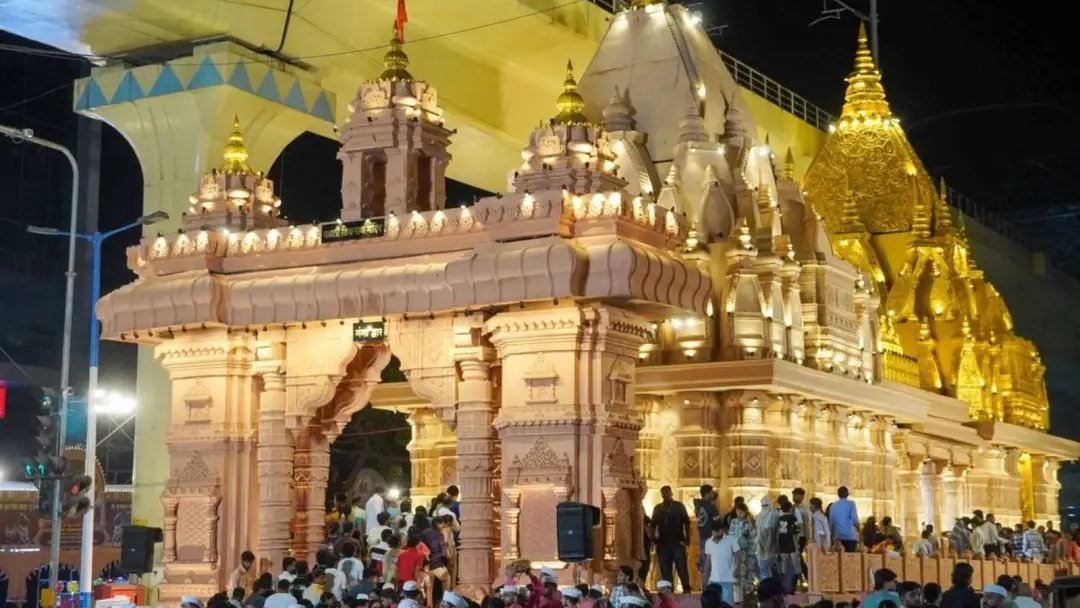
Pune Ganesh immersion: 17 roads to close in phases
Pune traffic police said 17 major roads will be closed in phases during the Ganesh idol immersion processions on September 25 and 26. Heavy vehicles of all categories are barred from entering the city for 48 hours, from 12.01 am on September 25 to midnight on September 26. The main procession will move along Laxmi, Tilak, Kumthekar and Kelkar roads, converging at Alaka Talkies Chowk. An alternative ring-road route, diversion points and parking at 26 locations have been arranged, with the AI platform Trafficure used to predict congestion.
Source
Indian Express — Cities · read the original report ↗
Desk check · compared with the source
What the desk checked (5)
- A 48-hour ban on heavy vehicles applies across Pune city from 12.01 am on September 25 to midnight on September 26. — Attributed to Pune traffic police; stated twice in the source consistently.
- 17 major roads will be closed in phases during the immersion processions on September 25 and 26. — Figure appears in source with a road-by-road listing and phased timings.
- Traffic police are using the AI-based platform Trafficure to predict congestion and redeploy personnel. — Attributed to the traffic control branch in the source; no independent detail on accuracy given.
- The main procession begins with Pooja at Shri Kasba Ganpati at 9 am on September 25, with routes converging at Alaka Talkies Chowk. — Stated in source; note source spells the junction both Alaka and Alka Talkies Chowk.
- Parking has been arranged at 26 locations for visitors. — Figure appears in source, attributed to police; individual sites not listed.
Analysts’ view opinion
In Pune, the Ganesh immersion is not just a festival — it is an annual public audit of the city's governance capacity. The phased closure of 17 major roads, a 48-hour heavy-vehicle ban, 26 parking sites and an AI-based traffic platform together form a message from the enforcement machinery to both citizens and the state: we are prepared. If it runs smoothly, the credit flows to the administration and the elected leadership above it; if there is chaos or a blocked emergency vehicle anywhere, it becomes a political charge within hours.
- Ganesh mandals are among the most organised local power blocs in Pune, so coordinating procession corridors with them is a politically sensitive exercise, not merely a traffic one.
- The perennial local flashpoint is the balance between devotees' convenience and the disruption faced by traders and daily commuters on closed central-city roads.
- Publicising the AI platform Trafficure feeds a 'tech-enabled modern governance' narrative, though the story offers no data on how well it has performed.
- The story notes mandals reacting to a noise-free Ganeshotsav call, indicating friction between organisers and authorities over festival rules already exists.
- This is framed purely as a police-administrative announcement, with no political figure attached — which allows leaders to claim success and distance themselves from failure alike.
What to watch — Watch the post-September 26 reaction from mandals, trader bodies and local representatives — their tone will decide whether these arrangements read as a political plus or a liability.
The story is confined to traffic arrangements and establishes nothing about political involvement, party reactions, or the actual effectiveness of the AI system.
Deep dive
Research brief · 8 facts · 7 dates · exam-readyThe brief
Context
Ganeshotsav in Pune culminates in massive idol immersion (visarjan) processions through the old city, where hundreds of mandals move along traditional routes watched by huge crowds. For 2025, Pune traffic police announced a phased shutdown of 17 major roads on September 25 and 26, a 48-hour city-wide ban on heavy vehicles, an alternative ring-road route and parking at 26 designated locations. The main procession runs along Laxmi, Tilak, Kumthekar and Kelkar roads, all converging at Alaka Talkies Chowk, beginning with the Pooja at the first Manacha Ganpati, Shri Kasba Ganpati. For the first time highlighted here, the traffic control branch is using the AI-based platform Trafficure to predict congestion and redeploy personnel in real time.
Key facts
- 17 major roads in central Pune will be closed in phases during the Ganesh immersion processions on September 25 and 26.
- Heavy vehicles of all categories are banned from entering Pune city for 48 hours, from 12.01 am on September 25 to midnight on September 26.
- First closure: Laxmi Road between Sant Kabir Chowk and Alka Talkies Chowk from 5 am on September 25.
- Shivaji Road (Kakasaheb Gadgil statue to Jedhe Chowk), Tilak Road (Jedhe Chowk to Tilak Chowk), Bagade Road and Guru Nanak Road close from 9 am.
- Bajirao, Kumthekar, Ganesh, Kelkar and Shastri roads close from 10 am; Jangli Maharaj Road and Fergusson College Road from 11 am; Bhandarkar, Pune-Satara, Solapur and Prabhat roads from noon.
- Main procession begins with the Pooja at the first Manacha Ganpati, Shri Kasba Ganpati, at 9 am on September 25.
- The main immersion procession covers four roads - Laxmi, Tilak, Kumthekar and Kelkar - all converging at Alaka Talkies Chowk.
- Parking has been arranged at 26 locations for citizens travelling to Pune for the processions.
Timeline
- 12.01 am, September 25City-wide ban on heavy vehicles of all categories comes into force.
- 5 am, September 25Laxmi Road between Sant Kabir Chowk and Alka Talkies Chowk closed to traffic.
- 9 am, September 25Pooja at first Manacha Ganpati, Shri Kasba Ganpati, marks start of main procession; Shivaji, Tilak, Bagade and Guru Nanak roads closed.
- 10 am, September 25Restrictions on Bajirao, Kumthekar, Ganesh, Kelkar and Shastri roads.
- 11 am, September 25Jangli Maharaj Road and Fergusson College Road closed.
- Noon, September 25Bhandarkar Road, Pune-Satara Road, Solapur Road and Prabhat Road closed.
- Midnight, September 2648-hour heavy vehicle ban ends; closures lift as processions pass respective stretches.
Who has a stake
- Pune traffic police (traffic control branch) — Must manage procession corridors, enforce phased closures and heavy-vehicle ban, and deploy personnel using AI-based congestion prediction.
- Ganesh mandals and devotees — Need clear, unobstructed procession routes along Laxmi, Tilak, Kumthekar and Kelkar roads converging at Alaka Talkies Chowk.
- Motorists and commuters — Face diversions at major junctions and must use the alternative ring-road route and 26 designated parking sites.
- Heavy vehicle operators and transporters — Barred from entering the city for a full 48 hours, affecting freight movement.
- Residents of peripheral areas such as Dhayari Phata, Keshav Nagar-Mundhwa, Sasane Nagar-Hadapsar — Separate local arrangements, including changes around the Kalepadal underpass and Sasane Nagar-Manjri Road.
- Emergency services — Heavy vehicle ban is intended partly to keep routes clear for emergency vehicles.
Why it matters
Pune's immersion processions draw crowds large enough to shut down the city's core for two days, making traffic management a public safety exercise as much as a convenience issue. The use of the AI platform Trafficure to predict congestion and redeploy personnel shows how technology is entering routine urban policing of mass religious events. For lakhs of commuters and freight operators, the phased closures and 48-hour heavy vehicle ban decide whether the city keeps moving.
UPSC angle
Prelims pointers
- Manacha Ganpati: Pune's traditionally ranked Ganpatis; Shri Kasba Ganpati is the first, where the immersion procession Pooja is held.
- Trafficure: AI-based platform used by Pune traffic control branch to monitor traffic patterns and predict congestion.
- Main Pune immersion procession roads: Laxmi, Tilak, Kumthekar and Kelkar, converging at Alaka Talkies Chowk.
- Heavy vehicle ban period: 12.01 am September 25 to midnight September 26 (48 hours), across Pune city.
- Diversion points include Jhansi Rani Chowk, Nal Stop, Seven Loves Chowk, Volga Chowk, Savarkar Chowk and Goodluck Chowk.
- Alternative ring-road route links Karve Road, Nal Stop, Law College Road, Senapati Bapat Road, Ganeshkhind Road, Satara Road and Volga Chowk.
Mains framing
Pune's Ganesh immersion processions illustrate the governance challenge of managing recurring mass gatherings in dense, historic urban cores where narrow traditional routes coincide with arterial roads. The police response combines conventional tools - phased closure of 17 major roads timed to procession movement, a 48-hour city-wide ban on heavy vehicles, no-parking zones, identified diversion points and an alternative ring-road route around the central city - with technology, using the AI platform Trafficure to monitor traffic patterns, predict congestion and redeploy personnel based on real-time conditions. The implications are twofold: public safety and unobstructed access for emergency vehicles improve, but freight movement, daily commuting and local businesses absorb the cost of a two-day shutdown of the core. A way forward, as reflected in the arrangements themselves, lies in flexible, data-driven enforcement calibrated to actual procession movement rather than rigid timings, advance public communication of closure schedules and diversion points, adequate designated parking (26 locations here) to prevent on-street parking on procession routes, and separate localised plans for peripheral stress points such as Dhayari Phata, Keshav Nagar-Mundhwa and Sasane Nagar-Hadapsar.
Key terms
- Ganeshotsav
- Annual Ganesh festival whose final day features immersion processions by hundreds of mandals in Pune.
- Visarjan / immersion procession
- The concluding ritual procession in which Ganesh idols are taken for immersion, held here on September 25 and 26.
- Manacha Ganpati
- Pune's traditionally honoured, ranked Ganpatis; Shri Kasba Ganpati is the first and where the procession Pooja begins.
- Trafficure
- AI-based platform used since the festival's first day to monitor traffic, predict congestion and guide personnel deployment.
- Alternative ring-road route
- Designated loop around the central city (Karve Road, Nal Stop, Law College Road, Senapati Bapat Road, Ganeshkhind Road, Satara Road, Volga Chowk) for motorists.
- Diversion point
- Major junction where police turn traffic away as processions reach a road, such as Jhansi Rani Chowk or Seven Loves Chowk.
Practice questions
- Discuss how technology-enabled traffic management, such as AI-based congestion prediction, can improve policing of large religious gatherings in Indian cities. Illustrate with the Pune Ganesh immersion arrangements.
- Phased road closures and heavy vehicle bans during festivals balance public safety against economic disruption. Critically examine this trade-off with reference to Pune's 48-hour restrictions.
- What administrative measures are needed to manage crowd and traffic flow in dense historic city cores during annual mass events? Suggest a framework based on the Pune model.
Grounded only in the source report — figures and dates are the source's, not inferred.