
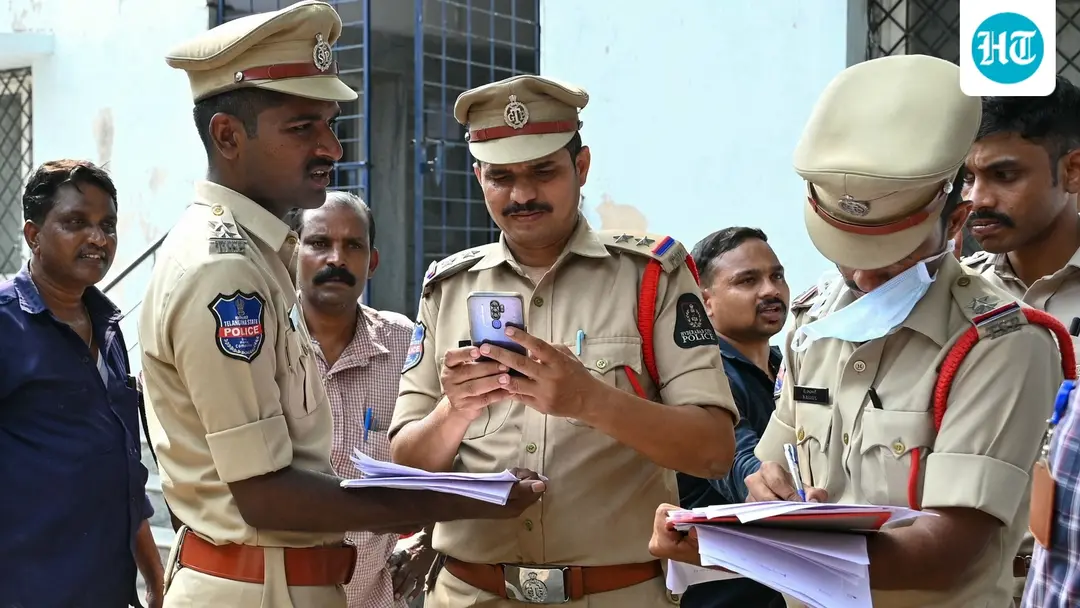
Hyderabad security guard arrested over alleged molestation of techie
Police said on Wednesday that a security guard has been arrested in Hyderabad for allegedly molesting a 26-year-old software engineer. The incident took place on Tuesday and came to light after the woman filed a complaint against the guard, who works at a nearby hostel. She alleged that as she was getting down from a cab, the guard standing beside the vehicle grabbed and kissed her. A case was registered under BNS sections for assault to outrage a woman's modesty and sexual harassment. The accused denied the allegation, saying he held her after she fell. Investigation is underway.
Source
Hindustan Times — India · read the original report ↗
Desk check · some claims need care
What the desk checked (5)
- A security guard was arrested in Hyderabad for allegedly molesting a 26-year-old software engineer. — Attributed to police, stated on Wednesday in the source.
- The incident occurred on Tuesday as the woman was getting out of a cab; the guard allegedly grabbed and kissed her. — Attributed to the woman's complaint as summarised in the source.
- A case was registered under BNS sections for assault or criminal force to outrage a woman's modesty and sexual harassment. — Attributed to police; specific section numbers not given in source.
- The accused denied the allegation, saying he held the woman after she fell. — Attributed to the accused's statement to police; unverified.
- The guard works at a nearby hostel and investigation is underway. — Attributed to police; no further detail in source.
Analysts’ view opinion
This is an early-stage criminal case, and the legal architecture around it is now fairly well settled. Police have invoked Bharatiya Nyaya Sanhita provisions covering assault or criminal force on a woman with intent to outrage her modesty, along with sexual harassment — offences where a prompt complaint by the woman is itself treated as the foundation for registering an FIR. The accused's competing account, that he steadied the complainant after she fell, does not stop the process; it becomes a question of fact for investigation and, if charges are framed, for trial.
- The story describes an arrest and registration of a case, not any finding of guilt — under Indian criminal procedure the accused retains the presumption of innocence throughout.
- Offences of this nature are cognisable, which is why police could register a case and arrest without prior court permission, though an arrested person must be produced before a magistrate within the constitutional 24-hour limit.
- The accused's explanation that he held the woman as she fell goes to intent, which is the legal heart of an 'outraging modesty' charge — courts typically test such claims against the complainant's account, medical or forensic material and any independent or CCTV evidence.
- Because the alleged incident occurred in a public place near a hostel and beside a cab, the investigation will likely turn on contemporaneous corroboration such as witnesses, the cab driver or camera footage, none of which the story establishes exists.
- The complainant has statutory rights that shape procedure — including recording of her statement and, in sexual offence matters, safeguards around how and by whom that statement is taken.
What to watch — Watch for whether the accused is remanded or released on bail, and whether police file a chargesheet within the statutory period with corroborative material beyond the two competing accounts.
The story does not establish what happened — it reports an allegation, an arrest and a denial, with no charge framed, no evidence described and no court adjudication so far.
Deep dive
Research brief · 8 facts · 4 dates · exam-readyThe brief
Context
A 26-year-old software engineer in Hyderabad complained that a security guard working at a nearby hostel grabbed and kissed her as she was getting out of a cab. Police registered a case under the Bharatiya Nyaya Sanhita (BNS) — the criminal code that replaced the Indian Penal Code — for assault or criminal force with intent to outrage a woman's modesty and for sexual harassment, and arrested the guard. The accused denies the allegation, claiming he only held the woman after she fell. The report places the case alongside recent molestation incidents in Bihar's Darbhanga and Jamui districts, where POCSO and BNS cases were filed and minors were among those held.
Key facts
- A security guard was arrested in Hyderabad for allegedly molesting a 26-year-old software engineer; police confirmed the arrest on Wednesday.
- The incident took place on Tuesday and surfaced after the woman lodged a police complaint against the guard, who works at a nearby hostel.
- The case was registered under BNS sections covering assault or criminal force against a woman with intent to outrage her modesty, and sexual harassment.
- The complaint states the woman was getting down from a cab when the guard, standing beside the vehicle, grabbed and kissed her.
- The accused told police he had only held the woman after she fell down; further investigation is underway.
- In Bihar's Darbhanga district, a girl was allegedly molested in public on Monday in Keeratpur village by two motorcycle-borne persons who tried to snatch her dupatta.
- In the Darbhanga case, filed at Jamalpur police station under the POCSO Act and BNS sections, both accused were tracked down within five hours; the 19-year-old was jailed and the minor sent to the juvenile justice board.
- In the September 19 Jamui incident, two main accused were arrested after being injured in an encounter on Tuesday, taking total arrests to five, including three minors.
Timeline
- September 19Jamui incident: a teenage girl and a boy from the same coaching centre were allegedly harassed by a group on a road; videos circulated on social media.
- MondayA girl was allegedly molested in public in Keeratpur village, Darbhanga, Bihar; two accused tracked down within five hours.
- TuesdayHyderabad molestation incident occurs; separately, two main accused in the Jamui case are arrested after an encounter in which both were injured.
- WednesdayPolice announce the arrest of the security guard in the Hyderabad case; investigation continues.
Who has a stake
- The 26-year-old software engineer (complainant) — Her safety in a public setting and the credibility of her complaint, now to be tested through police investigation.
- The accused security guard — Faces arrest and BNS charges of outraging modesty and sexual harassment; denies the allegation, claiming he held her after she fell.
- Hyderabad police — Responsible for registering the case, gathering evidence and completing an impartial investigation.
- Hostel employing the guard — Its security staffing and vetting practices come under scrutiny as the accused works at a nearby hostel.
- Bihar Police (Darbhanga, Jamui cases) — Under pressure to act swiftly on public molestation cases; made arrests within five hours in Darbhanga and via an encounter in Jamui.
- Juvenile justice board — Handles the minor accused in the Darbhanga case, as required for offenders below 18.
Why it matters
The case underlines how vulnerable women remain in everyday public situations such as stepping out of a cab, and how quickly complaints now translate into arrests under the new Bharatiya Nyaya Sanhita. Read with the Darbhanga and Jamui incidents, it points to a pattern of public harassment of women and girls where police responsiveness — and the handling of minor accused — becomes the test of the criminal justice system.
UPSC angle
Prelims pointers
- Bharatiya Nyaya Sanhita (BNS) is the criminal law under which the Hyderabad case was registered — for outraging a woman's modesty and sexual harassment.
- The Darbhanga case was registered under the POCSO Act along with BNS sections, as the victim was a girl going to school.
- Minor accused are produced before the juvenile justice board, not a regular criminal court — as seen in the Darbhanga case.
- Hyderabad incident: 26-year-old software engineer; accused is a security guard at a nearby hostel; incident on Tuesday, arrest announced Wednesday.
- Jamui incident of September 19: five arrests in total, including three minors; two main accused arrested after an encounter on Tuesday.
Mains framing
The Hyderabad case, in which a security guard was arrested for allegedly grabbing and kissing a 26-year-old software engineer as she stepped out of a cab, illustrates that violence against women is most often committed in ordinary public spaces by people present in the immediate neighbourhood — here, a guard employed at a nearby hostel. The legal response now flows through the Bharatiya Nyaya Sanhita, with distinct provisions for assault or criminal force to outrage a woman's modesty and for sexual harassment, and, where the victim is a child, the POCSO Act, as in Darbhanga. The clustered incidents reported from Darbhanga and Jamui show both the scale of street harassment and the state's reactive posture: arrests within five hours in one case, an encounter-linked arrest in another, and the involvement of multiple minors, which raises questions about deterrence, bystander intervention and juvenile handling. The accused's denial in Hyderabad also highlights why evidence collection and fair investigation matter as much as swift arrest. A credible way forward, on the evidence in this report, lies in prompt and complete investigation, accountability for employers over the conduct and vetting of security personnel, safe reporting mechanisms for women, and careful adherence to juvenile justice procedures where minors are accused.
Key terms
- Bharatiya Nyaya Sanhita (BNS)
- India's criminal code under which the Hyderabad and Bihar cases were registered, including offences of outraging a woman's modesty and sexual harassment.
- Outraging a woman's modesty
- Offence of assault or use of criminal force against a woman with intent to outrage her modesty — one of the sections invoked in the Hyderabad case.
- POCSO Act
- Protection of Children from Sexual Offences law, invoked in the Darbhanga case where the victim was a schoolgirl.
- Juvenile justice board
- Body before which accused below 18 are produced; the minor accused in the Darbhanga case was taken before it.
- Encounter
- Police confrontation in which suspects are injured or killed; two main Jamui accused were arrested after being injured in one on Tuesday.
Practice questions
- Public harassment of women often occurs in routine, everyday settings. Examine, with reference to recent incidents, how far legal provisions under the Bharatiya Nyaya Sanhita and POCSO Act address such offences.
- Swift arrests are often projected as proof of effective policing. Critically discuss the difference between rapid arrest and sound investigation in cases of sexual offences against women.
- Discuss the challenges in handling cases where minors are among the accused in crimes against women and girls, with reference to the juvenile justice framework.
Grounded only in the source report — figures and dates are the source's, not inferred.