
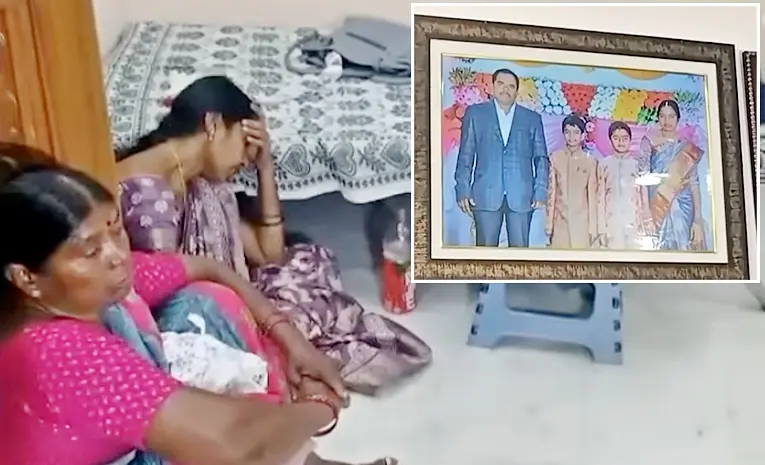
Father, son found dead in suspicious circumstances in Nalgonda
A father and son were found dead in suspicious circumstances in Kanakadurga Colony in Nalgonda district headquarters on Monday. Pabbatireddy Lingareddy (45), a junior lineman in the electricity department, and his son Praneeth Reddy (14) were found lying in a pool of blood by his wife Kavitha around 4 pm. Police said Praneeth Reddy had head injuries, a hammer was found in the house and a pesticide tin lay beside Lingareddy. Police suspect Lingareddy killed his son and then died by suicide. The bodies were sent to the government hospital for postmortem.
Source
Nalgonda — నేరాలు · read the original report ↗
Desk check · some claims need care
What the desk checked (5)
- Pabbatireddy Lingareddy (45), a junior lineman in the electricity department, and his son Praneeth Reddy (14) were found dead in Kanakadurga Colony, Nalgonda, on Monday. — Attributed to police and local residents in the source; figures and names appear in source.
- Praneeth Reddy had severe head injuries and a hammer was found on a TV stand in the house. — Described in source as observed at the scene by police; no forensic confirmation cited.
- Froth was seen coming from Lingareddy's mouth and a pesticide tin was found beside him. — Scene detail reported in source; not independently confirmed.
- Police suspect Lingareddy killed his son with a hammer and then died by consuming pesticide. — Explicitly framed in source as police suspicion, not an established conclusion.
- Dog squad and clues team collected fingerprints; bodies sent to Nalgonda government hospital for postmortem. — Procedural detail attributed to police action in the source.
Analysts’ view opinion
At this stage what exists is a working police hypothesis — a killing followed by suicide — not a legal finding. Because both the person suspected and the deceased child are dead, there is unlikely to be any prosecution or trial; the case would ordinarily close on an investigation report rather than a court verdict. That makes the forensic chain — post-mortem, fingerprints on the hammer, clues-team material — the decisive element here.
- The head injuries, the hammer and the pesticide tin are circumstantial indicators only; without direct witnesses they must be corroborated by forensic findings.
- Sending both bodies for post-mortem and calling a clues team and dog squad is standard procedure in unnatural-death cases, and the story indicates that was done.
- The gate being latched from the inside weakens the possibility of outside involvement, but on its own it is not legally conclusive.
- Since the person police suspect is himself deceased, criminal prosecution cannot proceed and the matter is likely to end with a closure or final investigation report.
- The surviving family — the mother and elder son — have an interest in a transparent inquiry, while the deceased are equally entitled not to be publicly convicted before the evidence is in.
What to watch — Watch for the post-mortem findings, viscera analysis and the fingerprint results from the hammer, which will either support or unsettle the police's initial reading.
The story does not establish the cause of death, any motive, or whether anyone else was involved — all of that rests, for now, on a preliminary police assessment.
Deep dive
Research brief · 8 facts · 5 dates · exam-readyThe brief
Context
A 45-year-old junior lineman in the electricity department, Pabbatireddy Lingareddy, and his 14-year-old son Praneeth Reddy were found dead in a pool of blood inside their home in Kanakadurga Colony on Devarakonda Road in Nalgonda town on Monday. The family originally belongs to Mirlonigudem village under Appajipet gram panchayat in Nalgonda mandal. The bodies were discovered around 4 pm by Lingareddy's wife Kavitha, who had gone to Hyderabad that morning to drop their elder son at a hostel. Police, based on a hammer found in the house and a pesticide tin beside Lingareddy, suspect the father killed the boy and then died by suicide.
Key facts
- Pabbatireddy Lingareddy (45), a junior lineman in the electricity department, and his son Praneeth Reddy (14) were found dead on Monday in Kanakadurga Colony, Nalgonda district headquarters.
- The family hails from Mirlonigudem village under Appajipet gram panchayat, Nalgonda mandal, and lived on Devarakonda Road in Nalgonda town.
- Elder son Prashanth Reddy recently completed Class 10 and joined Intermediate at a private college in Hyderabad.
- Wife Kavitha left for Hyderabad on Monday morning to drop Prashanth Reddy at his hostel; Lingareddy's father Sattireddy went to Mirlonigudem for farm work, leaving only the father and younger son at home.
- Family members said Kavitha phoned Praneeth Reddy in the afternoon and he replied that he had eaten.
- Kavitha returned around 4 pm to find the gate latched from inside; with a neighbour boy's help she opened it and found both lying in a pool of blood.
- Praneeth Reddy had severe head injuries and a hammer was found on the TV stand; Lingareddy had froth from his mouth and a pesticide tin lay beside him.
- One Town CI Emireddy Rajasekhar Reddy inspected the scene; a dog squad and clues team collected evidence, including fingerprints on the hammer and of the deceased.
Timeline
- Monday morningKavitha leaves for Hyderabad to drop elder son Prashanth Reddy at his hostel; grandfather Sattireddy goes to Mirlonigudem for farm work.
- Monday afternoonKavitha calls Praneeth Reddy from Hyderabad; he says he has eaten.
- Monday, about 4 pmKavitha reaches home, finds the gate latched from inside, opens it with a neighbour boy's help and discovers both bodies in a pool of blood.
- Monday, after the alertOne Town CI Emireddy Rajasekhar Reddy reaches the spot with staff; dog squad and clues team collect evidence.
- MondayBoth bodies shifted to Nalgonda government hospital for postmortem.
Who has a stake
- Kavitha (wife/mother) — Lost husband and younger son; discovered the bodies and is the key witness to the sequence of events.
- Prashanth Reddy (elder son) — Newly joined Intermediate in a Hyderabad college; has lost his father and brother.
- Nalgonda One Town police / CI Emireddy Rajasekhar Reddy — Investigating the suspicious deaths and establishing whether it was murder followed by suicide.
- Clues team and dog squad — Forensic collection of fingerprints from the hammer and from the deceased to confirm the sequence.
- Nalgonda government hospital — Conducting the postmortem that will determine cause of death.
- Electricity department — Lingareddy was its junior lineman; employee death has service and family welfare implications.
Why it matters
Family murder-suicides inside the home are among the hardest crimes to prevent or detect, and they hinge entirely on forensic reconstruction — here a hammer, fingerprints, a pesticide tin and a gate latched from inside. The case also points to the everyday availability of household pesticides as a means of suicide and to the absence of mental-health support for working-class families under stress. Police conclusions remain a suspicion until the postmortem and fingerprint evidence speak.
UPSC angle
Prelims pointers
- Nalgonda is a district in Telangana; the incident occurred in Kanakadurga Colony on Devarakonda Road at the district headquarters.
- Mirlonigudem village falls under Appajipet gram panchayat, Nalgonda mandal.
- A 'clues team' and dog squad are standard police forensic aids deployed at suspicious-death scenes.
- Postmortem in such cases is conducted at the government hospital to establish cause of death.
- Junior lineman is a field-level post in the state electricity department.
- CI (Circle Inspector) of One Town police station led the spot inspection.
Mains framing
The Nalgonda case — a 45-year-old electricity department lineman and his 14-year-old son found dead at home, with a hammer beside the boy's head injuries and a pesticide tin beside the father — illustrates how intra-family violence and suicide intersect in ways that policing alone cannot address. Investigatively, the case rests on circumstantial reconstruction: a gate latched from within, an afternoon phone call establishing the boy was alive, and forensic evidence in the form of fingerprints on the hammer, with the postmortem yet to confirm the cause of death; police therefore describe murder-followed-by-suicide only as a suspicion. Structurally, the episode reflects two recurring public-health concerns visible in the facts: easy household access to pesticides as a suicide means, and the lack of any early detection of distress in an ordinary salaried family. A way forward lies in strengthening forensic and clues-team capacity so that suspicious deaths are conclusively classified, restricting and safely storing agricultural pesticides in residential settings, and building accessible community mental-health and helpline support so that adults in crisis are reached before children become victims.
Key terms
- Junior lineman
- A field-level technical post in the state electricity department; the deceased Lingareddy held this job.
- Clues team
- A police forensic unit that visits crime scenes to collect physical evidence such as fingerprints and weapons.
- Dog squad
- Police sniffer-dog unit used at crime scenes to trace movement and detect evidence.
- Postmortem
- Medico-legal autopsy conducted to determine the cause of death; both bodies were sent to Nalgonda government hospital.
- Suspicious death
- A death whose cause is not immediately clear, requiring police investigation and forensic examination before classification.
- Gram panchayat
- The village-level unit of rural local self-government; Mirlonigudem lies under Appajipet gram panchayat.
Practice questions
- Suspicious deaths within families test the quality of forensic policing more than any other crime. Discuss with reference to the evidence-gathering steps taken in the Nalgonda case.
- Easy access to agricultural pesticides in rural and semi-urban households remains a major suicide risk factor in India. Examine the measures needed to reduce this risk.
- What institutional mechanisms exist at the district level to detect and support families in psychological distress, and how can they be strengthened?
Grounded only in the source report — figures and dates are the source's, not inferred.