
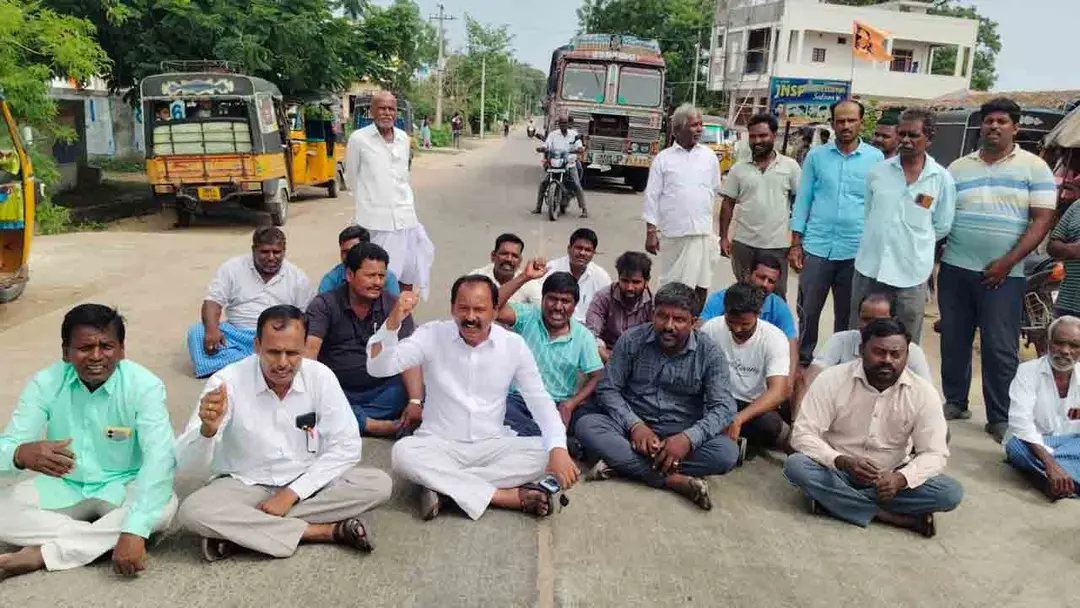
Farmers block road in Kamareddy, seek scrapping of urea app
Farmers staged a protest, sitting on the road at Uppal Vayi village in Ramareddy mandal of Kamareddy district. They alleged that urea bags are not available on time and that information on the app is disorganised. The farmers said agriculture department officials are not conveying the details posted on the urea app to villagers, leaving them without urea. They demanded that the app system be cancelled and urea be distributed directly to farmers. Police reached the spot and tried to pacify them.
Source
Kamareddy — వార్తలు · read the original report ↗
Desk check · compared with the source
What the desk checked (5)
- Farmers staged a protest on the road in Uppal Vayi village, Ramareddy mandal, Kamareddy district. — Stated as reported fact in the source; no official confirmation cited.
- Urea bags are not available on time and information on the app is disorganised. — Attributed to the protesting farmers as an allegation, not independently sourced.
- Agriculture department officials are not informing villagers of the information posted on the urea app. — Allegation attributed to farmers; no departmental comment given in the source.
- Farmers demanded cancellation of the app system and direct distribution of urea. — Demand attributed to the protesters in the source.
- Police reached the spot and tried to pacify the farmers. — Reported in the source without named official attribution.
Analysts’ view opinion
This is a small protest with a large economic signal: when urea reaches farmers late in the sowing window, the cost is paid in lost yield, not in rupees at the counter. The dispute here is not about the subsidised price of fertiliser but about the allocation mechanism — an app-based system that farmers in Uppal Vayi say is opaque and poorly communicated by agriculture officials. Digital rationing tools can cut diversion and queue-jumping, but they only work if the last mile — information reaching the village — actually functions; otherwise they add a transaction cost on the least connected farmers.
- Fertiliser timing is an input-cost and productivity issue: urea applied late in the crop cycle delivers less yield per bag, so delays effectively raise the cost of every unit of output.
- The farmers' complaint is about distribution and information flow, not about the sale price, which points to a governance/administrative bottleneck rather than a market pricing problem.
- App-based allocation is designed to curb hoarding and diversion and to ration a subsidised input, but its benefits accrue only if stock data is accurate and communicated locally.
- The burden of any information gap falls hardest on smaller and less digitally connected farmers, who may end up spending more time and travel cost — or turning to costlier informal channels.
- The story does not establish whether the underlying issue is a genuine supply shortfall or purely a distribution-information failure, and the policy fix differs sharply between the two.
What to watch — Watch whether the administration responds with better local disclosure of app stock data and dealer-level allotments, or with a partial return to direct distribution — and whether similar protests spread to other mandals during the sowing period.
The story records farmers' allegations and their demand; it does not establish actual urea stock levels, the scale of any shortage, or any official response from the agriculture department.
Deep dive
Research brief · 7 facts · 2 dates · exam-readyThe brief
Context
Farmers in Uppal Vayi village of Ramareddy mandal in Telangana's Kamareddy district staged a road protest over the non-availability of urea bags. Urea distribution in the area is routed through an app-based system that posts information on stock and allotment. The protesting farmers said the app's information is disorganised and that agriculture department officials do not pass on what is posted on the app to villagers, leaving them without fertiliser. They demanded that the app system be scrapped and urea be handed directly to farmers.
Key facts
- Farmers sat on the road in protest at Uppal Vayi village, Ramareddy mandal, Kamareddy district (report dated June 21, 2026, 11:07 AM IST).
- The farmers alleged urea bags are not available to them on time.
- They alleged that information on the urea app is disorganised (asthavyastam).
- They said agriculture department officials are not conveying the information posted on the urea app to villagers.
- Their demand: cancel the app-based system and distribute urea directly to farmers.
- Police reached the spot after receiving information and tried to pacify the protesting farmers.
- The outcome of the protest or any official response is not stated in the source.
Timeline
- June 21, 2026 (report time 11:07 AM IST)Farmers of Uppal Vayi village block the road demanding scrapping of the urea app and direct urea distribution.
- Same day, after the protest beganPolice reach the spot and attempt to pacify the farmers.
Who has a stake
- Farmers of Uppal Vayi village, Ramareddy mandal — Timely access to urea bags for their crop; they say the app system is denying them fertiliser.
- Agriculture department officials — Accused of not communicating urea app information to villagers; responsible for distribution.
- Police — Maintaining law and order on the blocked road; pacifying the agitating farmers.
- Kamareddy district administration — Managing fertiliser supply and grievances arising from the app-based allotment system.
Why it matters
Urea is the most widely used nitrogenous fertiliser and delays during the cropping season can directly hit yields, making its distribution politically sensitive. The protest shows how a digital, app-based allotment system can fail if last-mile communication to villagers is weak, turning a transparency tool into a barrier. It raises the question of whether technology-led rationing must be backed by offline information channels at the village level.
UPSC angle
Prelims pointers
- Kamareddy district, Telangana; Ramareddy mandal; Uppal Vayi village — site of the farmers' road protest.
- Protest date as per source: June 21, 2026.
- Grievance: urea bags not available on time; urea app information described as disorganised.
- Farmers' demand: scrap the app-based system, distribute urea directly to farmers.
- Agriculture department officials accused of not relaying app information to villagers.
- Police intervened to pacify farmers; no resolution stated in the source.
Mains framing
The Kamareddy road blockade over urea illustrates a recurring tension in Indian agriculture: scarce input supply managed through a digital interface that farmers neither understand nor can access. As reported, the immediate causes are two — urea bags not reaching farmers on time, and app-based information that farmers call disorganised and that agriculture department officials allegedly do not communicate to villagers. The implication is a trust deficit: a system designed to ration and track a subsidised input becomes, in farmers' perception, the reason for denial, pushing them from the counter to the road. Any answer should note that the farmers' demand is not for more subsidy but for direct distribution, i.e. a governance and last-mile communication failure rather than a purely supply failure. The way forward suggested by the facts themselves is straightforward: village-level dissemination of app data through officials, notice boards or panchayat channels, grievance redress at the mandal level, and matching app allotments with actual, timely stock arrival. The source does not state any official response or policy change, so conclusions must stay within that limit.
Key terms
- Urea app
- The app-based system on which urea stock/allotment information is posted; farmers here say its information is disorganised.
- Mandal
- Administrative sub-district unit in Telangana; Ramareddy is the mandal in this story.
- Agriculture department
- State department responsible for fertiliser distribution and informing farmers, accused here of not relaying app details.
- Direct distribution
- Farmers' demand that urea be handed to them directly instead of through the app-based allotment system.
Practice questions
- Digital rationing of farm inputs can improve transparency but also create new exclusion. Discuss with reference to app-based urea distribution and farmers' grievances.
- Why do fertiliser shortages trigger immediate agitation in rural India? Examine the role of last-mile communication and grievance redress in input delivery.
- Evaluate the argument that technology-led agricultural schemes must be paired with offline, village-level information channels to be effective.
Grounded only in the source report — figures and dates are the source's, not inferred.