
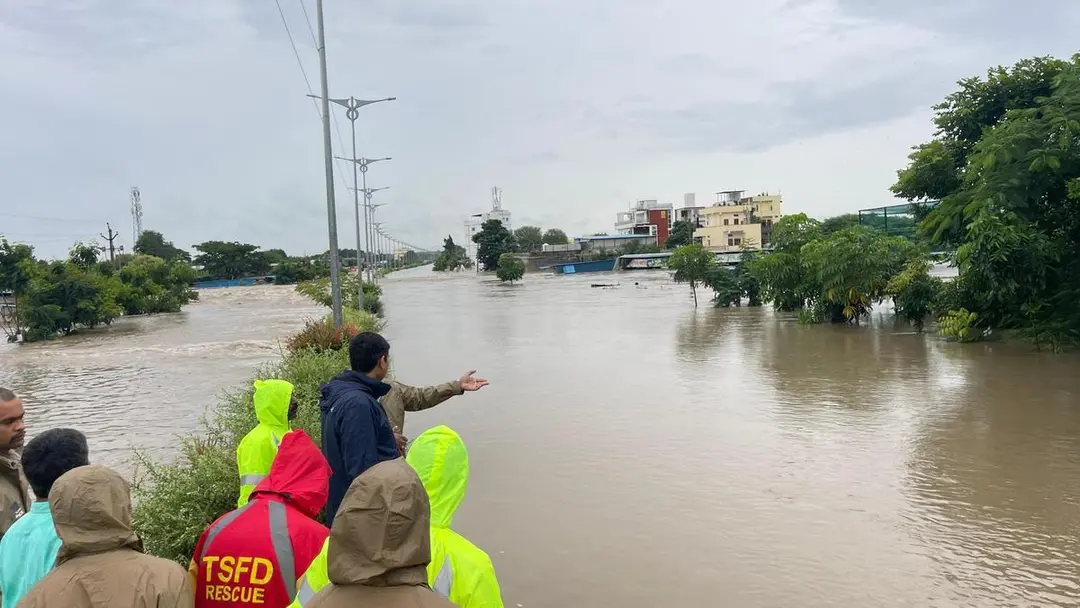
Kamareddy town still submerged after heavy rain; colonies flooded
Heavy rain on August 27 left the Kamareddy district headquarters in Telangana still under water, with residents vacating homes. GR Colony, Teachers Colony, Housing Board Colony and Sarampally ST Residential School were worst hit, with a teacher saying water rose two floors in under two hours. NDRF and SDRF teams carried out rescues, including 50 people at Ugrawai village. NH-44 caved in near Jangampally, halting traffic.
Source
Kamareddy — politics · read the original report ↗
Desk check · compared with the source
What the desk checked (5)
- Water rose to the level of two floors within two hours in three Kamareddy colonies on August 27, 2025 — Attributed to a government school teacher quoted in the source and repeated in the report's own description.
- Nalas blocked by encroachments worsened flooding in GB Colony and Housing Board Colony — Attributed to Kamareddy Municipality councillor Avadhuta; not independently verified in the source.
- NDRF and SDRF teams, with Kamareddy police, rescued 50 people from a shed near an old age home in Ugrawai village — Figure appears in source; no official statement cited for the number.
- NH-44 from Hyderabad to Nagpur caved in near Jangampally, halting traffic for hours — Stated in source; officials named as camping at the site, but damage details are unattributed.
- Ramadugu project in Dharpally mandal received an inflow of 11,609 cusecs, which was released downstream — Figure appears in source without named attribution.
Analysts’ view opinion
The Kamareddy inundation is no longer just a weather event — it is a political test of urban governance and municipal accountability. The fact that a local councillor himself points to encroachments blocking the nalas gives real political force to the argument that nature alone did not cause this. With Teachers Colony and Housing Board Colony — the kind of organised middle-class voters who make noise — hit in the district headquarters itself, the political echo is likely to be loud, and the NH-44 cave-in pushes the issue from local to State-and-Centre level.
- The reference to encroached nalas raises questions about municipal planning and permissions, feeding a narrative that this is a years-long governance failure rather than one day's rain.
- NDRF, SDRF and police rescue work, including the 50 people saved at Ugrawai village, gives the ruling side a credible "rapid response" talking point.
- At the same time, the account of water reaching two floors within two hours opens space for opposition criticism that early warning and preparedness fell short.
- Because colonies in the district headquarters and an ST residential school were affected, demands for compensation and rehabilitation will move quickly onto the local political agenda.
- Damage to NH-44 could turn road quality and Centre-State coordination into a fresh line of political blame.
What to watch — Watch for ministerial and MLA-level field visits, any relief or compensation announcements, and whether an inquiry or demolition drive against nala encroachments is ordered.
The story does not fix responsibility on any party or official, and establishes nothing about the scale of losses, compensation decisions, or who is behind the encroachments.
Deep dive
Research brief · 8 facts · 4 dates · exam-readyThe brief
Context
Unprecedented rainfall on Wednesday, August 27, 2025 inundated Kamareddy district in Telangana, leaving the district headquarters town under a sheet of water a day later. Residential colonies and a residential school were submerged, forcing families to abandon homes, while overflowing irrigation tanks damaged roads and bridges in rural areas. NDRF and SDRF teams were deployed for rescues, and the Hyderabad-Nagpur stretch of National Highway 44 caved in near Jangampally, stalling traffic for hours.
Key facts
- Unprecedented rains lashed Kamareddy district and its rural parts on Wednesday, August 27, 2025; the district headquarters remained under water the next day.
- Three colonies - GR Colony, Teachers Colony and Housing Board Colony - and Sarampally ST Residential School in Kamareddy Town were the worst affected.
- A government school teacher said water began rising from 10 a.m. and in two hours submerged two floors, forcing escape to a nearby third-floor building.
- Rescue teams and police reached a shed near an old age home in Ugrawai village and rescued 50 people sheltering there.
- The Kamareddy-Bibipet main road was washed away; water from the overflowing Bibipet irrigation tank damaged the bridge, halting vehicular traffic.
- NH-44 from Hyderabad to Nagpur caved in near Jangampally due to flood waters, holding up traffic for several hours on both sides.
- Ramadugu project in Dharpally mandal of Nizamabad district was overflowing, receiving an inflow of 11,609 cusecs, all of which was let out.
- Kamareddy Municipality councillor Avadhuta said nalas blocked by encroachments worsened flooding in GB Colony and Housing Board Colony.
Timeline
- August 27, 2025, from 10 a.m.Water levels began rising suddenly in Kamareddy Town colonies and entered houses.
- August 27, 2025, within two hoursFlood water rose to cover two floors; residents escaped to a third-floor building.
- August 27, 2025NDRF and SDRF teams carried out rescues; 50 people rescued at Ugrawai village; NH-44 caved in near Jangampally; Kamareddy-Bibipet road washed away.
- August 28, 2025Kamareddy district headquarters still submerged; report published at 12:45 pm IST.
Who has a stake
- Residents of GR Colony, Teachers Colony, Housing Board Colony and GB Colony — Homes submerged up to two floors; forced to vacate and lose belongings and documents.
- Sarampally ST Residential School, Kamareddy Town — Among the worst hit institutions; safety of resident students and school property at risk.
- NDRF and SDRF — Worked overtime rescuing people from marooned areas.
- Kamareddy district police and administration — SP M. Rajesh Chandra camped on NH-44 monitoring the situation; police waded through waters to rescue people.
- Nizamabad police (CP P. Sai Chaitanya, Additional DCP Baswa Reddy) — Monitored the damaged NH-44 stretch and traffic disruption.
- Kamareddy Municipality — Councillor Avadhuta flagged encroachment-blocked nalas as a cause of flooding; urban drainage governance under scrutiny.
- Villagers of Rajampet, Bhikanoor, Ugrawai and Gadkol — Houses inundated as irrigation tanks and a local stream overflowed; main roads flooded.
Why it matters
A district headquarters town going under two floors of water within two hours shows how fast short-duration extreme rainfall can overwhelm small urban centres, especially where storm-water nalas are encroached upon. The caving in of NH-44, the Hyderabad-Nagpur artery, and the washing away of the Kamareddy-Bibipet road show that flood damage cascades into national connectivity and emergency access. The episode underlines the reliance on NDRF and SDRF for last-mile rescue in inland, non-coastal flood events.
UPSC angle
Prelims pointers
- Kamareddy is a district in Telangana; its headquarters town was flooded on August 27, 2025.
- NH-44 is the Hyderabad-Nagpur arterial highway; it caved in near Jangampally due to flood waters.
- NDRF (National Disaster Response Force) and SDRF (State Disaster Response Force) carried out the rescues.
- Ramadugu project in Dharpally mandal, Nizamabad district, recorded an inflow of 11,609 cusecs, fully let out.
- Cusec is the unit used for reservoir inflow/outflow measurement - cubic feet per second.
- Encroachment on nalas (storm-water drains) was cited by a municipal councillor as worsening the urban flooding.
Mains framing
The Kamareddy flooding of August 27, 2025 is a textbook case of urban and peri-urban flood risk in a small Indian district town: an unprecedented, short-duration downpour raised water levels by two floors in under two hours, while nalas blocked by encroachments, as a municipal councillor noted, prevented drainage and turned colonies such as GR Colony, Teachers Colony and Housing Board Colony into basins. Rural distress compounded the crisis as irrigation tanks at Bibipet and Bhikanoor and two tanks near Rajampet overflowed, washing away the Kamareddy-Bibipet road and its bridge, and the Ramadugu project in neighbouring Nizamabad passed on an inflow of 11,609 cusecs downstream. Connectivity failure at NH-44 near Jangampally, monitored on site by senior police officers, shows that transport lifelines are a critical vulnerability during floods. The response leaned on NDRF, SDRF and local police, who rescued 50 people at Ugrawai village, indicating that rescue capacity functioned but preparedness and early warning did not reach residents, who were "caught unawares". The way forward, as indicated by the source, lies in restoring encroached storm-water nalas, safer siting and protection of residential schools and colonies, coordinated tank-to-town flood forecasting, and flood-resilient highway and bridge design.
Key terms
- NDRF
- National Disaster Response Force, the central specialised force deployed for rescue in disasters, active in Kamareddy's marooned areas.
- SDRF
- State Disaster Response Force, the State-level rescue force that worked alongside NDRF in the Kamareddy floods.
- Nala
- A storm-water drain or channel; encroachments on nalas were blamed for worsening flooding in Kamareddy colonies.
- Cusec
- Cubic feet per second, the unit for water inflow/outflow; Ramadugu project received and released 11,609 cusecs.
- NH-44
- National Highway 44, the Hyderabad-Nagpur and beyond arterial route, which caved in near Jangampally.
- Sarampally ST Residential School
- A Scheduled Tribe residential school in Kamareddy Town listed among the worst affected by the flood waters.
Practice questions
- Extreme short-duration rainfall events increasingly overwhelm small Indian towns. Using the Kamareddy floods of August 2025, discuss how encroachment on storm-water drains converts heavy rain into urban disaster.
- Examine the role of the NDRF and SDRF in inland flood rescue operations, with reference to the rescue of 50 people at Ugrawai village in Kamareddy district.
- Damage to arterial highways such as NH-44 during floods disrupts more than local traffic. Discuss the need for flood-resilient road and bridge infrastructure in India.
Grounded only in the source report — figures and dates are the source's, not inferred.