
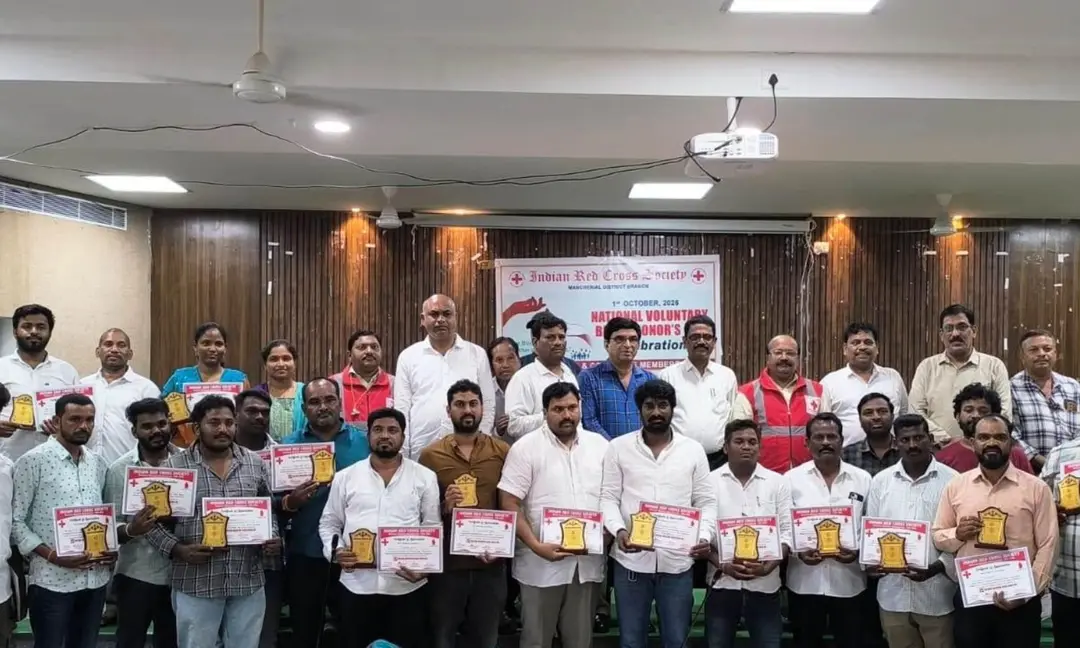
Additional Collector urges youth to donate blood voluntarily in Mancherial
Blood donation can save many lives during emergencies, Mancherial Additional Collector (Local Bodies) P. Chandraiah said. Marking National Voluntary Blood Donation Day, a donation camp was held Thursday at the Integrated District Offices Complex in Naspur by the Indian Red Cross Society–Mancherial district blood bank centre. He said donated blood is valuable for thalassemia, sickle cell and anaemia patients and accident victims, and urged youth to come forward. Frequent blood and platelet donors were honoured with certificates and mementoes.
Source
Mancherial — స్థానికం · read the original report ↗
Desk check · compared with the source
What the desk checked (5)
- Blood donation can save many lives in emergencies — Attributed to Additional Collector (Local Bodies) P. Chandraiah in the source.
- Camp held Thursday at the Integrated District Offices Complex, Naspur, for National Voluntary Blood Donation Day — Stated in source; weekday mentioned without a date.
- Organised by the Indian Red Cross Society–Mancherial district blood bank centre — Named in source as the organiser.
- DMHO Dr Narender Rathod and District Welfare Officer Rauf Khan attended — Names and designations listed in source; not independently verifiable.
- Frequent voluntary blood and platelet donors honoured with certificates and mementoes — Appears in source; no numbers provided.
Analysts’ view opinion
This looks like a routine awareness event, but the policy model behind it is clear — shifting blood collection away from paid or family-replacement sourcing towards a base of voluntary, repeat donors. The district machinery (Additional Collector, DMHO, welfare department) standing alongside the Indian Red Cross blood centre is a textbook example of a state–voluntary sector partnership. Still, appeals and felicitations are only a publicity instrument; the real test lies in year-round stocks, component-separation capacity and whether donors come back.
- The specific mention of thalassaemia, sickle cell and anaemia patients signals that the appeal targets chronic, repeat-transfusion needs, not just one-off trauma cases.
- Honouring platelet donors separately suggests a policy emphasis moving from raw unit counts towards component-based collection.
- References to educational institutions, Singareni and government and private bodies show reliance on a camp-driven model — fast to mobilise, but prone to stock swings around holidays and festival seasons.
- Focusing on youth is a strategy to build a long-term donor pool, but sustaining it needs recall systems and donor registries, not recognition ceremonies alone.
- Holding the drive inside the integrated district offices complex continues the older practice of putting government staff forward as first donors — useful as an example, but no substitute for broad public participation.
What to watch — Watch whether district blood centre stocks, repeat-donor rates and availability of rare blood groups hold up in the months after the observance-day camps.
The story establishes no numbers — units collected, current shortfall, targets or comparison with previous years — so it cannot tell us whether this approach is actually delivering results.
Deep dive
Research brief · 8 facts · 2 dates · exam-readyThe brief
Context
National Voluntary Blood Donation Day was marked in Telangana's Mancherial district with a blood donation camp organised by the Indian Red Cross Society–Mancherial district blood bank centre. The camp was held at the Integrated District Offices Complex in Naspur, with district administration and health officials present. Additional Collector (Local Bodies) P. Chandraiah used the occasion to appeal to youth to donate blood voluntarily, noting that timely supply saves lives in emergencies. The source does not state the number of donors or units collected.
Key facts
- The blood donation camp was held on Thursday at the Integrated District Offices Complex (Samekrutha Jilla Karyalayala Bhavana Samudayam) in Naspur, Mancherial district.
- The event marked National Voluntary Blood Donation Day and was organised by the Indian Red Cross Society–Mancherial district blood bank centre.
- Additional Collector (Local Bodies) P. Chandraiah said donating blood can save many lives during emergencies.
- Chandraiah said donated blood is especially valuable for patients of thalassemia, sickle cell disease and anaemia, and for those injured in accidents needing blood urgently.
- Officials present included District Medical and Health Officer Dr Narender Rathod, District Welfare Officer Rauf Khan and Indian Red Cross Society representatives.
- Chandraiah praised the cooperation extended to the blood bank centre by donors, voluntary organisations, educational institutions, Singareni, and government and private bodies.
- Donors who had given blood voluntarily the most number of times, and platelet donors, were honoured with certificates of appreciation and mementoes.
- District Medical and Health Department Mass Media Officer Bukka Venkateswarlu, Red Cross district representatives, staff and donors participated.
Timeline
- Thursday (date not stated in the source)Blood donation camp held at the Integrated District Offices Complex, Naspur, to mark National Voluntary Blood Donation Day.
- Same day, after the campFrequent voluntary blood donors and platelet donors honoured with certificates and mementoes.
Who has a stake
- P. Chandraiah, Additional Collector (Local Bodies), Mancherial — Led the appeal for voluntary blood donation and acknowledged institutional support to the district blood bank.
- Indian Red Cross Society–Mancherial district blood bank centre — Organiser of the camp; depends on voluntary donors to maintain blood and platelet stocks.
- Patients with thalassemia, sickle cell disease and anaemia — Need repeated, assured supply of safe blood for survival and treatment.
- Accident victims needing emergency blood — Survival depends on timely availability of blood at the district level.
- Youth, educational institutions, voluntary organisations, Singareni, government and private bodies — Identified as the main pool of voluntary donors and supporters of the blood bank.
- District Medical and Health Department (DMHO Dr Narender Rathod, Mass Media Officer Bukka Venkateswarlu) — Responsible for public health messaging and supporting blood donation drives.
Why it matters
Blood cannot be manufactured, so district blood banks depend entirely on voluntary, unpaid donors to meet emergency and chronic-patient demand. In districts like Mancherial, thalassemia, sickle cell and anaemia patients need repeat transfusions, while road accident victims need blood within minutes, making sustained youth participation a public health necessity rather than a one-day event.
UPSC angle
Prelims pointers
- National Voluntary Blood Donation Day was the occasion for the Mancherial camp; the camp was organised by the Indian Red Cross Society district blood bank centre.
- Venue: Integrated District Offices Complex, Naspur, Mancherial district (Telangana).
- Officials named: Additional Collector (Local Bodies) P. Chandraiah, DMHO Dr Narender Rathod, District Welfare Officer Rauf Khan.
- Diseases cited as needing regular transfusion: thalassemia, sickle cell disease and anaemia.
- Platelet donors were honoured separately from whole-blood donors, with certificates and mementoes.
- Singareni was named among the institutions supporting the district blood bank centre.
Mains framing
Voluntary, unpaid blood donation is the backbone of transfusion safety and availability, and the Mancherial camp illustrates both the strengths and the gaps of the district-level model. On the supply side, the Indian Red Cross Society's district blood bank depends on a narrow base of repeat donors, educational institutions, voluntary bodies and employers such as Singareni, which is why officials appeal specifically to youth; on the demand side, thalassemia, sickle cell disease and anaemia create predictable, recurring needs, while trauma and accidents create unpredictable emergency needs including platelets, which have a very short shelf life. Recognition of frequent donors through certificates and mementoes is a low-cost behavioural tool to convert one-time donors into repeat donors. The way forward, as suggested by the event's own emphasis, lies in institutionalising donation beyond commemorative days: sustained college and workplace camps, registries of platelet and rare-group donors, and awareness that removes fear and misinformation about donating. Equity in access, cold-chain and storage capacity, and screening quality remain the measures of whether such appeals translate into lives saved.
Key terms
- Voluntary blood donation
- Donating blood without payment or family-replacement pressure, considered the safest source of blood supply.
- Indian Red Cross Society (IRCS)
- Humanitarian organisation that runs blood banks, including the Mancherial district blood bank centre that organised this camp.
- Thalassemia
- Inherited blood disorder causing defective haemoglobin, requiring lifelong repeated blood transfusions.
- Sickle cell disease
- Genetic disorder in which red blood cells become sickle-shaped, causing pain crises and anaemia needing transfusion support.
- Platelet donation
- Donation of only platelets, the clotting component of blood, critical for patients with bleeding or low platelet counts.
- DMHO
- District Medical and Health Officer, the head of public health administration in a district.
Practice questions
- Why is voluntary, unpaid blood donation considered safer and more sustainable than replacement or paid donation? Discuss with reference to district-level blood bank functioning in India.
- Patients of thalassemia and sickle cell disease require lifelong transfusion support. Examine the institutional arrangements needed at the district level to assure them safe and timely blood.
- Commemorative days such as National Voluntary Blood Donation Day generate short bursts of donation. Suggest measures to build a year-round base of repeat voluntary donors, especially among youth.
Grounded only in the source report — figures and dates are the source's, not inferred.