
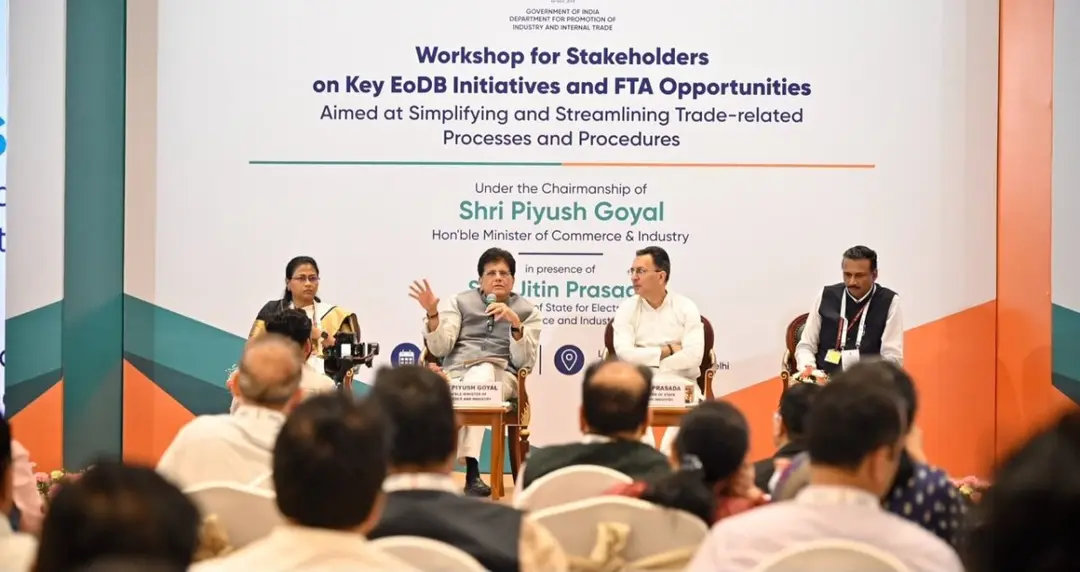
Goyal meets industry on ease of doing business, FTA gains
Union Commerce and Industry Minister Piyush Goyal and Minister of State Jitin Prasada interacted with industry representatives after a DPIIT workshop on ease of doing business, FTA opportunities and trade reforms at Bharat Mandapam, New Delhi, on Tuesday. Goyal outlined integrated Commerce and Industry offices in major cities, a proposed network of about 1,000 trained local personnel knowing regional languages to help exporters, and the Trade Connect platform offering tariff and FTA information. Roller chain makers reported 15-fold growth, ₹500 crore investment and 5,000 jobs.
Source
Commerce & Industry — Piyush Goyal · read the original report ↗
Desk check · compared with the source
What the desk checked (5)
- DPIIT held a stakeholder workshop on EoDB, FTA opportunities and trade reforms at Bharat Mandapam, New Delhi, on Tuesday, followed by an interaction with Piyush Goyal and Jitin Prasada. — Stated in source with named ministers and venue; no external verification possible.
- Roller chain and industrial components sector reported 15-fold expansion, about ₹500 crore fresh investment and around 5,000 new jobs due to QCOs, MIP and higher import duties. — Figures appear in source, attributed to industry representatives rather than official data.
- A network of about 1,000 trained local personnel with regional-language knowledge is proposed to support exporters at district and State levels. — Attributed to the Minister as a proposal in the source.
- A Trade Connect platform is being developed to give exporters product-wise and HSN-code-wise information, including destination tariffs and FTA procedures. — Attributed to Goyal; described as under development, no timeline given in source.
- Integrated Commerce and Industry offices are envisaged in major cities as a single access point to multiple departments. — Attributed to Goyal as a government plan; no dates or locations specified.
Analysts’ view opinion
This is not a headline policy shift so much as a "plumbing" reform aimed at cutting transaction costs for exporters — integrated commerce offices, roughly 1,000 regional-language handholding staff, and a Trade Connect platform for tariff and FTA information. The real beneficiaries would be MSMEs and first-time exporters, since documentation, rules-of-origin and certification costs weigh far more heavily on them than on large firms. At the same time, the story presents only one side of the QCO and minimum-import-price debate: the investment and jobs figures for roller chains are the industry's own claim, not an independent assessment.
- Single-window style offices plus a digital platform mainly reduce compliance time and cost — a productivity gain rather than a subsidy, so the fiscal cost is comparatively light.
- The proposed 1,000 local-language facilitators could pull district-level and smaller-city firms into the export economy, though the story gives no budget, funding source or timeline.
- The reported 15-fold expansion, roughly ₹500 crore of investment and about 5,000 jobs are concentrated in one sector that clearly gained from protective measures.
- The cost side of protection is usually diffuse: downstream users of those components can face higher input prices, a trade-off this story does not examine.
- Sea-freight costs, documentation backlogs and electronic transmission of Certificates of Origin are the binding constraints on export competitiveness, and arguably matter more than tariff tinkering.
What to watch — Watch whether the Trade Connect platform and the 1,000-person network get firm funding and deadlines, and whether electronic Certificates of Origin are extended to more FTA partners.
This is the readout of a consultation, not an implemented programme — the story does not establish approvals, budgets or timelines, and the QCO/MIP impact numbers are industry-reported and unverified here.
Deep dive
Research brief · 8 facts · 3 dates · exam-readyThe brief
Context
The Department for Promotion of Industry and Internal Trade (DPIIT) held a stakeholder workshop on Ease of Doing Business (EoDB), Free Trade Agreement (FTA) opportunities and trade-related reforms at Bharat Mandapam, New Delhi, on Tuesday. It was followed by an interactive session with Union Commerce and Industry Minister Piyush Goyal and Minister of State Jitin Prasada, described as the first such interaction with a regional industry association. Industry bodies from pharmaceuticals, textiles, copper, automotive, air-conditioners, logistics, MSMEs and women entrepreneurs raised issues on export competitiveness, documentation, FTA utilisation and standards. The Government outlined new export facilitation mechanisms, both physical offices and digital platforms.
Key facts
- DPIIT organised the workshop on EoDB, FTA opportunities and trade reforms at Bharat Mandapam, New Delhi, on Tuesday.
- Goyal said integrated Commerce and Industry offices are envisaged in major cities as a common point of access to multiple departments, instead of separate offices of every department everywhere.
- A proposed network of about 1,000 trained local personnel with knowledge of regional languages is to support exporters at district and State levels.
- The Trade Connect platform being developed will give exporters product-wise and HSN-code-wise data on destination-country tariffs, FTA opportunities and procedures for availing FTA benefits, using digital and AI-enabled tools.
- The roller chain and industrial components sector reported 15-fold expansion, fresh investments of about Rs 500 crore and around 5,000 new jobs.
- Industry credited Quality Control Orders (QCOs), Minimum Import Price (MIP) provisions and higher import duties for the sector's growth.
- DPIIT presentations covered Startup India, IPR, investment facilitation, the National Single Window System, industrial infrastructure and PESO-related reforms.
- Industry sought digital transmission and verification of Certificates of Origin under FTAs and further integration of the export cycle across DGFT, Customs and banks.
Timeline
- Tuesday (day of the event)DPIIT stakeholder workshop on EoDB, FTA opportunities and trade reforms held at Bharat Mandapam, New Delhi.
- Same day, after the workshopInteractive session of industry representatives with Piyush Goyal and Jitin Prasada; first such interaction with a regional industry association.
- Same sessionGoyal announced integrated Commerce and Industry offices, the proposed 1,000-strong local personnel network and the Trade Connect platform; directed officials to examine industry suggestions.
Who has a stake
- DPIIT and Department of Commerce — Senior officials led the workshop and presentations; responsible for EoDB reforms, trade facilitation and examining industry suggestions.
- Piyush Goyal, Union Minister of Commerce and Industry — Outlined export facilitation architecture and directed officials to examine industry proposals.
- Jitin Prasada, Minister of State for Commerce and Industry — Participated in the interactive session with industry.
- Roller chain and industrial components manufacturers — Reported 15-fold growth, about Rs 500 crore investment and 5,000 jobs from QCOs, MIP and higher import duties.
- Exporters, MSMEs and women entrepreneurs — Stand to gain handholding support, integrated offices and Trade Connect data; raised regulatory certainty and competitiveness concerns.
- Industry associations and Export Promotion Councils — Encouraged to build awareness of destination-market standards and flag fraudulent or substandard manufacturing.
- DGFT, Customs and banks — Asked to integrate further so the export cycle and Certificates of Origin move digitally end to end.
Why it matters
India's expanding FTA network creates market access that firms can use only if documentation, rules of origin, testing and certification processes work smoothly. The measures announced — integrated offices, a district-level handholding cadre and the Trade Connect platform — target the practical, procedural barriers that keep smaller exporters from utilising trade agreements. The roller chain sector's reported gains also feed the wider debate on whether QCOs, MIP and higher duties help domestic manufacturing or raise input costs.
UPSC angle
Prelims pointers
- DPIIT = Department for Promotion of Industry and Internal Trade, under the Ministry of Commerce and Industry.
- Trade Connect platform: to give exporters product-wise and HSN-code-wise destination tariffs and FTA procedures, with AI-enabled tools.
- Proposed network: about 1,000 trained local personnel with regional-language knowledge for district and State level export handholding.
- Roller chain sector data cited: 15-fold expansion, about Rs 500 crore investment, around 5,000 new jobs.
- PESO = Petroleum and Explosives Safety Organisation; reforms covered in DPIIT presentations along with National Single Window System, Startup India and IPR.
- Certificates of Origin under FTAs: industry sought digital transmission and verification, extendable to other FTA partners.
Mains framing
India's ease-of-doing-business and trade-facilitation agenda is shifting from headline reform to last-mile delivery: the DPIIT workshop showed that firms' binding constraints are procedural — trade documentation backlogs, sea-freight costs, rules of origin, weak testing and certification infrastructure, fragmented systems across DGFT, Customs and banks, and low FTA utilisation by MSMEs. The Government's response combines physical consolidation (integrated Commerce and Industry offices as a single point of access in major cities), human capacity (about 1,000 trained, regional-language local personnel for district and State level handholding, including through industry chambers) and digital tools (the Trade Connect platform offering HSN-code-wise tariff and FTA information with AI-enabled opportunity mapping), alongside systemic work on the National Single Window System, IPR, investment facilitation and PESO reforms. On the protection side, industry testimony that QCOs, Minimum Import Price and higher import duties delivered 15-fold growth, about Rs 500 crore in investment and 5,000 jobs in roller chains illustrates the case for calibrated standards-based interventions, while the parallel emphasis on international standards and on flagging substandard manufacturing shows the credibility risk if quality regulation is used only as a trade barrier. The way forward lies in interoperable systems (electronic Certificates of Origin extended to more FTA partners), an integrated export cycle, predictable regulation for MSMEs and sustained Government–industry consultation of the kind demonstrated here.
Key terms
- Ease of Doing Business (EoDB)
- Framework of reforms to simplify regulation, cut compliance burden and improve approvals and service delivery for business.
- Free Trade Agreement (FTA)
- Trade pact under which partner countries reduce tariffs and barriers; creates both opportunities and obligations for industry.
- Quality Control Order (QCO)
- Government order making compliance with specified standards mandatory for a product, affecting both domestic output and imports.
- Minimum Import Price (MIP)
- Floor price below which a product cannot be imported, used to shield domestic producers from cheap imports.
- Certificate of Origin
- Document certifying where goods were made, required to claim preferential tariffs under an FTA; industry wants it transmitted and verified digitally.
- National Single Window System
- Digital platform to give investors a single point for clearances and approvals across departments.
Practice questions
- Despite an expanding FTA network, Indian exporters underutilise preferential benefits. Examine the procedural and institutional bottlenecks highlighted at the DPIIT workshop and suggest measures to address them.
- Quality Control Orders, Minimum Import Price and higher import duties are credited with reviving sectors such as roller chains. Critically discuss the benefits and risks of such standards- and price-based interventions.
- How can digital platforms such as Trade Connect and integrated Commerce and Industry offices improve ease of doing business for MSME exporters? Discuss with reference to last-mile delivery of trade facilitation.
Grounded only in the source report — figures and dates are the source's, not inferred.