
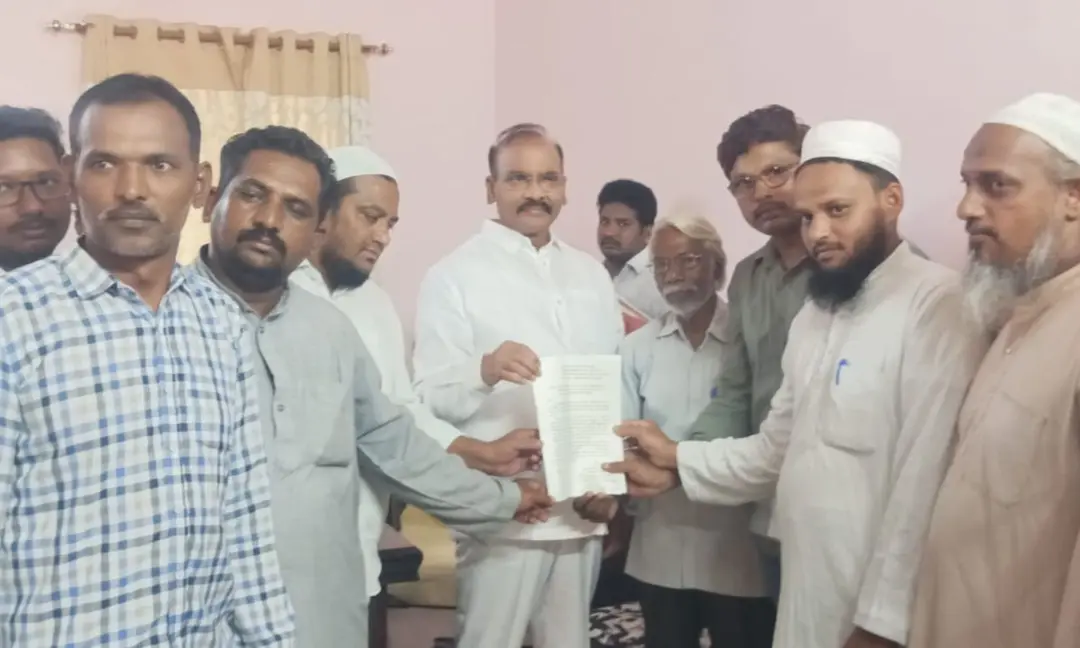
Petition seeks restart of stalled minority gurukul school works
Awaaz Committee leaders on Wednesday submitted a petition to MLA Prattipati Pullarao seeking the immediate resumption of stalled construction of a minority girls' gurukul school at Tatapudi village in Chilakaluripet. They said the Rs 18 crore project, for which the foundation stone was laid between 2014 and 2019, had come to a halt, leaving Muslim girls deprived of education. The MLA said the matter had already been brought to Chief Minister Chandrababu's notice and assured that works would begin and be completed soon. Awaaz district president Sheikh Fairoz and CPM leader Venkateswarlu took part.
Source
Chilakaluripet — స్థానికం · read the original report ↗
Desk check · compared with the source
What the desk checked (5)
- Construction of a minority girls' residential (gurukul) school at Tatapudi village has been stalled. — Attributed to Awaaz Committee leaders in their petition; no official document cited in source.
- The project is worth Rs 18 crore and its foundation stone was laid between 2014-19. — Figure and period appear in the source as stated by the petitioners; no departmental record cited.
- Muslim girls are being deprived of education due to the stalled work. — Stated as the petitioners' grievance, not backed by data in the source.
- MLA Prattipati Pullarao said the matter was already brought to CM Chandrababu's notice and works would begin soon. — Directly attributed to the MLA; a promise, not a verified outcome.
- Awaaz district president Sheikh Fairoz and CPM leader Venkateswarlu attended. — Names appear in the source; roles as given, unverified externally.
Analysts’ view opinion
This is not simply a stalled building; it is a textbook case of infrastructure launched with a foundation stone and then left mid-course as governments and priorities change. A Rs 18 crore minority girls' residential school whose foundation was laid between 2014-19 and which remains incomplete points to weak design around funding continuity and unclear ownership of project completion. Because the intended beneficiaries — rural Muslim girls — have little political leverage, the cost of delay falls hardest on them.
- The gurukul residential model exists precisely to bring first-generation, low-income girls closer to schooling; without the building, the policy objective itself stalls.
- Laying foundations is easy, finishing is hard — schemes that are not ring-fenced with multi-year funding are structurally vulnerable to exactly this outcome.
- The story does not state why work stopped — funds, land or administrative clearances — and that silence is itself a sign of thin public accountability.
- Resolution being sought through a petition to an MLA suggests reliance on individual political initiative rather than a systematic review mechanism for stalled welfare projects.
- The presence of both the Awaaz committee and a CPM leader suggests minority education infrastructure is becoming a cross-party demand rather than a single constituency's ask.
What to watch — Watch whether the MLA's assurance converts into a specific budget allocation, fresh tendering and a time-bound administrative sanction, rather than another round of assurances.
The story does not establish why the work halted, how much has already been spent, the current revised cost, or whether any interim schooling arrangement exists for the affected girls.
Deep dive
Research brief · 8 facts · 4 dates · exam-readyThe brief
Context
A minority girls' residential gurukul school sanctioned at Tatapudi village in Chilakaluripet, Andhra Pradesh, has remained unbuilt despite its foundation stone being laid during the 2014-19 period. The Rs 18 crore project was intended to provide residential schooling to minority, largely Muslim, girls. On Wednesday, leaders of the Awaaz Committee submitted a petition to local MLA Prattipati Pullarao demanding that the stalled construction resume immediately. The MLA said the issue had already been placed before Chief Minister Chandrababu Naidu and promised early completion.
Key facts
- Awaaz Committee leaders submitted a petition on Wednesday to MLA Prattipati Pullarao seeking immediate resumption of the stalled school works.
- The project is a minority girls' gurukul (residential) school at Tatapudi village, Chilakaluripet.
- The project cost is Rs 18 crore.
- The foundation stone for the project was laid between 2014 and 2019.
- Petitioners said the stalling of the project is keeping Muslim girls away from education.
- The MLA said the matter has already been brought to the notice of Chief Minister Chandrababu.
- The MLA assured that works would be started and completed soon.
- Awaaz district president Sheikh Fairoz and CPM leader Venkateswarlu took part in the programme.
Timeline
- 2014-2019Foundation stone laid for the Rs 18 crore minority girls' gurukul school at Tatapudi village.
- Date not stated in the sourceConstruction work on the project comes to a halt.
- Before the petition (date not stated)MLA says the issue was brought to Chief Minister Chandrababu's notice.
- Wednesday (report published 26 August 2026)Awaaz Committee leaders submit petition to MLA Prattipati Pullarao; MLA assures early start and completion.
Who has a stake
- Muslim girls of Tatapudi and Chilakaluripet area — Access to residential schooling; petitioners say they are being deprived of education because the school is unbuilt.
- Awaaz Committee (district president Sheikh Fairoz) — Leading the demand for immediate resumption of the stalled construction.
- MLA Prattipati Pullarao — Recipient of the petition; has assured that works will start and be completed soon.
- Chief Minister Chandrababu — The issue has reportedly been placed before him for a decision on restarting the project.
- CPM (leader Venkateswarlu) — Joined the petition programme, lending political support to the demand.
- State minority welfare/education administration — Responsible for executing the Rs 18 crore gurukul project; further details not stated in the source.
Why it matters
Residential gurukul schools are a key instrument for bringing first-generation learners, especially girls from minority and poor households, into formal education. A sanctioned Rs 18 crore school whose foundation stone was laid years ago but which remains incomplete shows how project delays translate directly into lost schooling years for the intended beneficiaries. The case also illustrates how local civil society petitions and legislator intervention remain the main route for reviving stalled welfare works.
UPSC angle
Prelims pointers
- Tatapudi village, Chilakaluripet (Andhra Pradesh) — site of the proposed minority girls' gurukul school.
- Project cost: Rs 18 crore; foundation stone laid between 2014 and 2019.
- Petition submitted by the Awaaz Committee; district president Sheikh Fairoz.
- MLA concerned: Prattipati Pullarao; matter said to be raised with Chief Minister Chandrababu.
- Gurukul schools = state-run residential schools, here targeted at minority girls.
- CPM leader Venkateswarlu also participated in the petition programme.
Mains framing
The stalled Rs 18 crore minority girls' gurukul school at Tatapudi is a small but telling example of the gap between sanction and delivery in educational infrastructure for disadvantaged groups. The foundation stone was laid in the 2014-19 period, yet construction has halted, and petitioners argue the consequence is concrete: Muslim girls in the area remain without access to the residential schooling the project promised. Causes of such stalling are typically fiscal and administrative — changes in government priorities, fund release delays and weak monitoring — though the source does not specify the reason here. The implications go beyond one building: incomplete residential schools depress girls' enrolment and retention among minorities, and repeated delays erode community trust in welfare commitments. The way forward suggested by the episode is procedural rather than new policy: time-bound resumption and completion as assured by the MLA, escalation to the Chief Minister's level for fund clearance, and transparent public reporting of project status so that civil society bodies like the Awaaz Committee need not petition repeatedly to revive sanctioned works.
Key terms
- Gurukul school
- A state-run residential school providing free schooling and boarding, here proposed specifically for minority girls.
- Awaaz Committee
- The community organisation that submitted the petition; its district president is Sheikh Fairoz.
- Chilakaluripet
- The Andhra Pradesh town/constituency in whose Tatapudi village the school is proposed.
- Vinatipatram (petition/representation)
- A formal written representation submitted to an elected representative or official seeking redress of a grievance.
- MLA
- Member of the Legislative Assembly; here Prattipati Pullarao, who received the petition and gave the assurance.
Practice questions
- Stalled welfare infrastructure projects affect the most disadvantaged learners the hardest. Examine this with reference to residential schools for minority girls.
- Discuss the role of residential gurukul schools in improving girls' enrolment and retention among minority communities in India.
- What institutional mechanisms can ensure that sanctioned education projects are completed in a time-bound manner? Suggest reforms.
Grounded only in the source report — figures and dates are the source's, not inferred.