
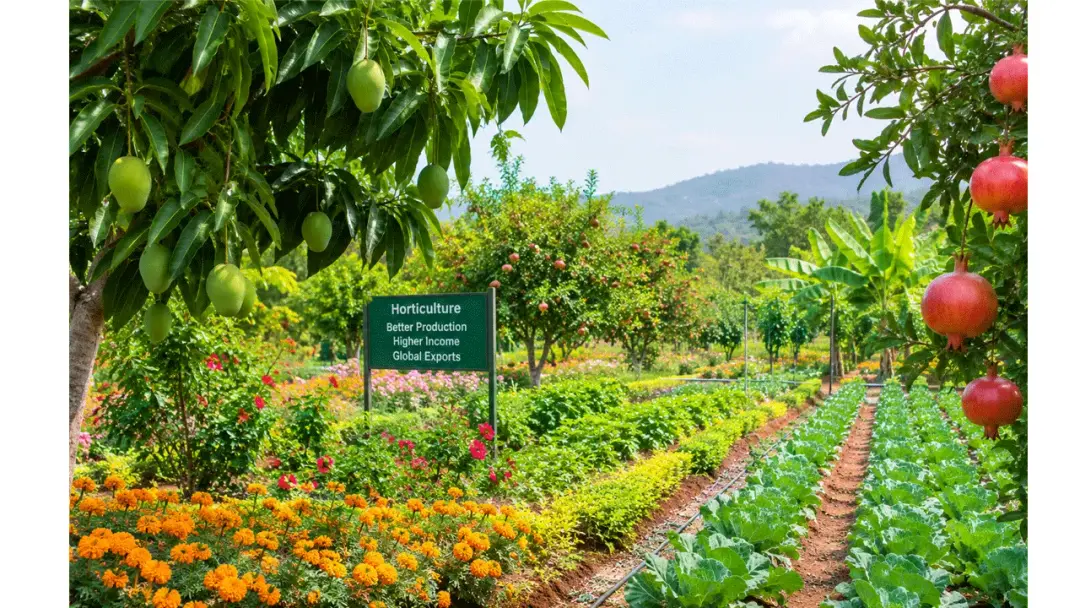
Chittoor district gets Rs 1,529.69 crore horticulture plan
Chittoor district has been allocated Rs 1,529.69 crore under the Rayalaseema Integrated Horticulture Development Plan. Twenty horticulture clusters will be developed across 27 mandals over three years — five in 2026-27, eight in 2027-28 and seven in 2028-29. The largest share, Rs 620.40 crore, is earmarked for micro irrigation. Cold storages, processing units and marketing facilities are also planned. Chief Minister Chandrababu and Union Finance Minister Nirmala Sitharaman will launch the project at Madanapalle on Friday, Gandhi Jayanti.
Source
Annamayya — వార్తలు · read the original report ↗
Desk check · compared with the source
What the desk checked (4)
- Chittoor district has been allocated Rs 1,529.69 crore under the Rayalaseema Integrated Horticulture Development Plan. — Figure appears twice in the source; no official document or named official cited.
- 20 horticulture clusters will be developed across 27 mandals in three years (2026-27 to 2028-29), in phases of 5, 8 and 7 clusters. — Internally consistent totals; cluster and phase details listed in source, mandal counts per phase are 7, 7 and 13.
- Rs 620.40 crore, the largest share, is earmarked for micro irrigation. — Figure appears in source and is consistent with the total outlay; no source attribution given.
- CM Chandrababu and Union Finance Minister Nirmala Sitharaman will launch the project on Friday at Madanapalle in Annamayya district on Gandhi Jayanti. — Stated as a scheduled future event in the source; no official announcement quoted, so treat as planned.
Analysts’ view opinion
The economically telling detail in this Rs 1,529.69 crore plan is its composition: roughly 40% (Rs 620.40 crore) goes to micro-irrigation, which in water-scarce Rayalaseema is arguably the highest-return line item available. The second pillar is post-harvest infrastructure — pre-cooling, cold storage, ripening chambers, processing units. In horticulture, the farmer's biggest loss usually comes not from the headline price but from being forced to sell immediately at harvest; closing that bargaining-power gap is the core economic logic here. But a three-phase rollout over three years means benefits arrive slowly, and last for the mandals in the final tranche.
- Allocating the single largest share to micro-irrigation (Rs 620.40 crore) targets the binding constraint — water — and is typically the highest-yield rupee in a dry region.
- Cold storage, processing and village-level grading/packing give growers the option of when to sell, which generally smooths price volatility and lifts net realisation.
- Grading, sorting, packing, logistics and certification work could generate non-farm local employment alongside farm income.
- With 20 clusters confined to 27 mandals, farmers outside those areas gain little directly, raising the risk of widening intra-district disparities.
- The export ambition is the high-value upside but depends on meeting international quality standards and on overseas demand and buyer linkages — variables outside state control.
What to watch — Watch the actual year-on-year fund release, the farmer contribution required for micro-irrigation, and who ends up owning and operating the cold chains and processing units — government, farmer producer bodies or private players.
The story does not establish the Centre-versus-state funding split, any farmer cost share, expected income or employment gains, or beneficiary numbers — it is an allocation announcement, not evidence of outcomes.
Deep dive
Research brief · 8 facts · 5 dates · exam-readyThe brief
Context
Chittoor district in Andhra Pradesh's Rayalaseema region has been allocated Rs 1,529.69 crore under the "Rayalaseema Integrated Horticulture Development Plan" to turn the district into what the state calls a Global Horticulture Hub. The plan bundles production, quality certification, post-harvest storage, processing, marketing and exports under one umbrella across 20 horticulture clusters in 27 mandals over three years. The biggest single allocation, Rs 620.40 crore, goes to micro irrigation, reflecting Rayalaseema's limited water availability. Chief Minister Chandrababu Naidu and Union Finance Minister Nirmala Sitharaman are to launch the project at Madanapalle in Annamayya district on Friday, Gandhi Jayanti.
Key facts
- Chittoor district allocated Rs 1,529.69 crore under the Rayalaseema Integrated Horticulture Development Plan.
- 20 horticulture clusters to be developed across 27 mandals of the district over three years.
- Rs 620.40 crore — the largest share of the outlay — earmarked for micro irrigation (drip and sprinkler).
- Phase 1 (2026-27): 5 clusters in 7 mandals — Palamaner, Baireddipalle, V. Kota, Ramakuppam, Kuppam, Santhipuram, Gudupalle.
- Phase 2 (2027-28): 8 clusters in 7 mandals — Peddapanjani, Gangavaram, Pulicherla, Rompicherla, Bangarupalyam, Thavanampalle, Irala.
- Phase 3 (2028-29): 7 clusters in 13 mandals including Chittoor, Gudipala, Puthalapattu, Yadamari, Vedurukuppam, Penumuru, Nagari, Nindra, Vijayapuram.
- Post-harvest infrastructure planned: pre-cooling centres, cold storages, ripening chambers, refrigerated transport vehicles and processing units.
- Village-level collection and consolidation centres, grading, sorting, packing units and digital price display boards are planned.
Timeline
- September 30 (report datelined Chittoor)Details of the Rs 1,529.69 crore Chittoor horticulture plan and its 20 clusters made public.
- Friday, Gandhi Jayanti (Oct 2)CM Chandrababu and Union Finance Minister Nirmala Sitharaman to launch the project at Madanapalle, Annamayya district.
- 2026-27First phase: 5 clusters in 7 mandals including Palamaner, Kuppam and V. Kota.
- 2027-28Second phase: 8 clusters in 7 mandals including Bangarupalyam and Irala.
- 2028-29Third phase: 7 clusters in 13 mandals including Chittoor, Nagari and Vijayapuram.
Who has a stake
- Horticulture farmers of Chittoor district — Higher productivity, better prices, water-use efficiency through drip/sprinkler, and reduced distress sales via storage and processing.
- Government of Andhra Pradesh / CM Chandrababu — Delivering the Rayalaseema Integrated Horticulture Development Plan and positioning Chittoor as a global horticulture hub.
- Union Finance Ministry / Nirmala Sitharaman — Associated with the launch of the project at Madanapalle; central-level backing for the initiative (funding split not stated in the source).
- 27 mandals covered in three phases — Sequenced access to cluster infrastructure; later-phase mandals wait till 2028-29.
- Exporters, processors and logistics operators — New pre-cooling, cold chain, ripening chambers, processing units and marketing-logistics facilities to build export-linked supply chains.
Why it matters
Horticulture is high-value but highly perishable, and Rayalaseema farmers face both water scarcity and forced low-price sales at harvest. By tying micro irrigation to cold chains, grading, certification and export linkage in cluster form, the plan tests whether a whole value chain can be built in one district rather than isolated subsidies. Its phased design over 2026-29 also means outcomes will depend on execution and on farmers in later-phase mandals not being left behind.
UPSC angle
Prelims pointers
- Rayalaseema Integrated Horticulture Development Plan: Chittoor district share Rs 1,529.69 crore.
- 20 horticulture clusters across 27 mandals; phases 2026-27 (5), 2027-28 (8), 2028-29 (7).
- Micro irrigation gets the largest allocation: Rs 620.40 crore.
- Launch venue: Madanapalle, Annamayya district, on Gandhi Jayanti (October 2).
- Crops promoted: exotic fruits, commercial vegetables, flowers and oil palm.
- Post-harvest components: pre-cooling centres, cold storages, ripening chambers, reefer vehicles, processing units.
Mains framing
Andhra Pradesh's Rs 1,529.69 crore Chittoor component of the Rayalaseema Integrated Horticulture Development Plan illustrates a shift from input subsidies to a cluster-based, value-chain approach in horticulture. The causes it addresses are visible in the design: water scarcity in Rayalaseema (hence Rs 620.40 crore, the largest share, for drip and sprinkler micro irrigation), high post-harvest losses and distress selling (hence pre-cooling centres, cold storages, ripening chambers, refrigerated transport and processing units), weak price discovery (hence village-level collection and consolidation centres, grading, sorting, packing units and digital price boards), and poor export readiness (hence rejuvenation of old orchards, pruning, plastic mulching, integrated pest management and international quality certification). The implications are significant — 20 clusters in 27 mandals phased over 2026-29 could link small growers of exotic fruits, commercial vegetables, flowers and oil palm to international markets and raise farm incomes. The way forward, on the source's own logic, lies in execution: timely completion of each phase, keeping cold-chain assets functional and farmer-accessible, ensuring certification support reaches smallholders, and making sure the 13 mandals in the final 2028-29 phase are not disadvantaged by the sequencing.
Key terms
- Rayalaseema Integrated Horticulture Development Plan
- State plan for horticulture development in Rayalaseema, under which Chittoor district gets Rs 1,529.69 crore.
- Horticulture cluster
- A contiguous group of mandals developed as a unit for cultivation, quality upgrading, storage, marketing and exports; 20 planned in Chittoor.
- Micro irrigation
- Drip and sprinkler systems that raise water-use efficiency; allotted Rs 620.40 crore, the plan's biggest head.
- Pre-cooling centre / ripening chamber
- Post-harvest facilities that cool produce quickly and control ripening to cut losses in perishable horticulture crops.
- Global Horticulture Hub
- The stated goal of making Chittoor an integrated horticulture centre linked from cultivation to export.
- Collection and consolidation centres
- Village-level points where produce is aggregated, graded, sorted and packed so farmers get better prices.
Practice questions
- Cluster-based horticulture development is being promoted as an answer to post-harvest losses and distress selling. Examine with reference to the Rayalaseema Integrated Horticulture Development Plan in Chittoor district.
- How does prioritising micro irrigation address the twin challenges of water scarcity and farm productivity in semi-arid regions like Rayalaseema? Discuss.
- Building cold chains and certification systems is necessary but not sufficient for linking small farmers to international markets. Critically analyse in the Indian context.
Grounded only in the source report — figures and dates are the source's, not inferred.