
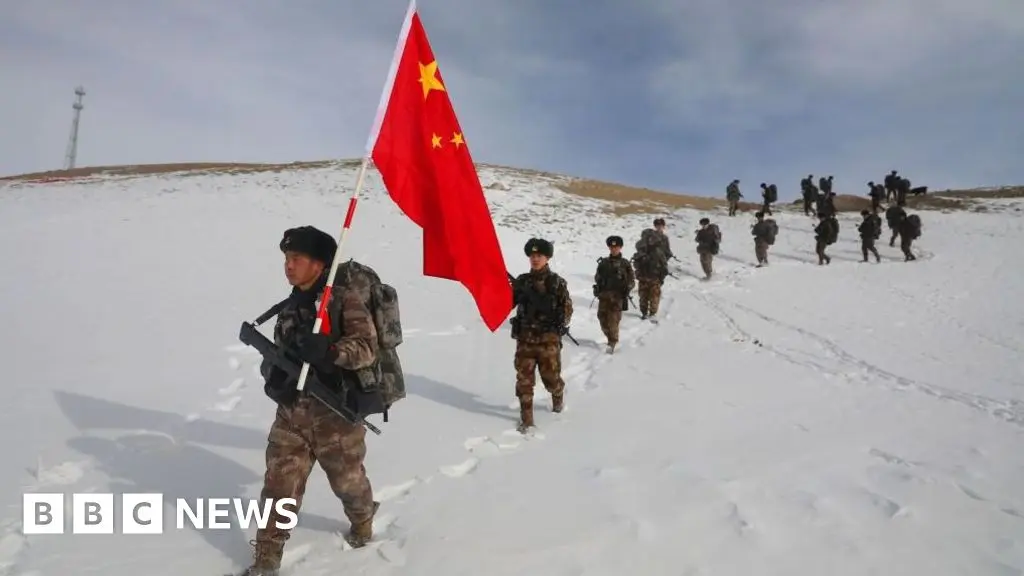
India rejects new Pakistan-China boundary joint commission
Pakistan and China last week operationalised the Pakistan-China Boundary Joint Commission, which Islamabad called a significant milestone that would deepen cooperation on border management, joint surveys and trade. India rejected it as having no legal basis, with foreign ministry spokesman Randhir Jaiswal saying no Pakistan-China boundary exists. The commission covers the Shaksgam Valley, about 5,180 sq km ceded by Pakistan to China in 1963 and claimed by India as part of Ladakh. Analyst Jabin T Jacob said there are no immediate implications for the LAC.
Source
The News International (Pakistan) · read the original report ↗
Desk check · compared with the source
What the desk checked (5)
- Pakistan and China operationalised the Pakistan-China Boundary Joint Commission last week. — Reported in source, with Pakistan describing it as a 'significant milestone'; attributed to official announcements.
- India rejected the commission as having no legal basis. — Directly quoted and attributed to Indian foreign ministry spokesman Randhir Jaiswal and an MEA statement.
- The Shaksgam Valley is roughly 5,180 sq km, ceded by Pakistan to China in 1963 and claimed by India as part of Ladakh. — Figure and dates appear in the source; presented as background without separate sourcing.
- A joint boundary commission was already provided for in the 1963 Sino-Pak Agreement; only the timing of operationalisation is new. — Attributed to Jabin T Jacob of Shiv Nadar University in a BBC interview.
- There are no immediate implications for the Line of Actual Control. — Attributed as analyst opinion to Jacob; not an official assessment.
Analysts’ view opinion
This is less a change on the ground than the institutionalisation of a status quo India has never accepted. By operationalising a mechanism already provided for in the 1963 agreement, Beijing and Islamabad are hardening their shared framing of Kashmir, while Delhi's rejection of its legal basis is consistent with decades of policy. The story notes no immediate implications for the LAC, but the strategic signal is unmistakable: bilateral stabilisation efforts do not alter China's broader vision for South Asia.
- The roughly 5,180 sq km Shaksgam Valley was ceded by Pakistan to China in 1963; India claims it as part of Ladakh and treats that agreement as illegal and invalid.
- Deeper China-Pakistan boundary cooperation on an adjacent stretch of frontier, just as India and China try to stabilise the LAC, revives Delhi's long-standing two-front anxiety.
- Experts cite practical drivers too — border management, preventing illegal crossings and protecting CPEC-linked infrastructure such as the Karakoram Highway corridor.
- The legal argument is circular: Pakistan says J&K's final status is undecided so India has no standing, while India says Pakistan has no locus standi over territory under illegal occupation.
- One analyst argues the move appears to sidestep Article 6 of the 1963 treaty, which envisaged renegotiation once the Kashmir dispute was settled.
What to watch — Watch whether joint surveys, demarcation work or new border infrastructure actually materialise under the commission — and whether this friction slows the India-China normalisation track on the LAC.
The story does not establish what concrete surveys, deployments or construction will follow, nor does it carry Beijing's own detailed explanation; the assessment of no LAC impact is a current reading, not a settled conclusion.
Deep dive
Research brief · 8 facts · 5 dates · exam-readyThe brief
Context
India has long refused to recognise any boundary between Pakistan and China, because the frontier in question runs through territory India claims as its own — notably the Shaksgam Valley, a tract Pakistan ceded to China under a 1963 agreement. Last week Pakistan and China operationalised a Pakistan-China Boundary Joint Commission to manage that frontier, calling it a "significant milestone" for border management, joint surveys, trade and people-to-people links. India rejected the commission as having "no legal basis", saying Pakistan has no locus standi over Indian territory under illegal occupation. The move comes as India and China try to stabilise ties after years of military tension along the Line of Actual Control (LAC).
Key facts
- Pakistan and China operationalised the Pakistan-China Boundary Joint Commission, announced on Wednesday last week, covering border management, joint surveys, trade and people-to-people connectivity.
- The commission concerns the Shaksgam Valley, a tract of roughly 5,180 sq km that Pakistan ceded to China in 1963 and which India claims as part of Ladakh.
- Indian foreign ministry spokesman Randhir Jaiswal: "There is no boundary between Pakistan and China. We reject the so-called Joint Commission, which is without any legal basis."
- India's MEA said Pakistan "has no locus standi to enter into arrangements concerning Indian territory under its illegal and forcible occupation".
- Jabin T Jacob (Shiv Nadar University) said a joint boundary commission is already provided for in the 1963 Sino-Pak Agreement; only the timing of operationalisation is new.
- Jacob said Article 6 of the 1963 agreement provided for renegotiation once the Kashmir dispute is settled, with whichever country ultimately controls the territory.
- Husain Haqqani, former Pakistani ambassador to the US, said the mechanism is meant to enhance border cooperation, prevent illegal crossings and protect CPEC-linked strategic infrastructure.
- Jacob said there are "no immediate or apparent implications for the LAC as of now".
Timeline
- 1963Sino-Pak boundary agreement signed; Pakistan cedes the roughly 5,180 sq km Shaksgam Valley to China. India calls the deal illegal and invalid.
- Not dated in the source (Article 370)India abrogates Article 370 in Indian-administered Kashmir; Haqqani says Pakistan's approach evolved in response.
- Recently, before the announcementPresident Xi Jinping's Brics summit trip; Haqqani says the release of the commission news was timed for after it.
- Last week (Wednesday)Pakistan and China operationalise the Pakistan-China Boundary Joint Commission; Pakistan calls it a "significant milestone".
- Same weekIndia rejects the commission as without legal basis; Randhir Jaiswal says no Pakistan-China boundary exists.
Who has a stake
- India / Ministry of External Affairs — Sovereignty claim over Shaksgam Valley and Gilgit-Baltistan; resisting institutionalisation of arrangements it rejects while stabilising ties with China.
- Pakistan — Treats the 1963 agreement as valid and Jammu and Kashmir as disputed; institutionalises de facto arrangements with China along a frontier where its other borders face instability.
- China — Demarcating its boundaries, protecting CPEC infrastructure, and signalling to India that it views Kashmir through the Pakistani prism.
- CPEC and Karakoram Highway projects — Existing connectivity and strategic infrastructure in the region whose security the commission is meant to support.
- Ladakh and Gilgit-Baltistan populations — Regions at the heart of competing claims; Gilgit-Baltistan borders China and is claimed by India.
- Indian Army along the LAC — Operates on a disputed Himalayan frontier; analysts see no immediate LAC implications but warn of a two-front threat perception.
Why it matters
The commission converts a decades-old, India-rejected cession into a functioning bilateral mechanism, chipping away at India's legal and cartographic position without any shot being fired. It also reinforces Delhi's two-front anxiety, with Haqqani describing Pakistan as "China's secondary deterrent against India", even as India and China attempt to normalise relations after LAC tensions.
UPSC angle
Prelims pointers
- Shaksgam Valley: about 5,180 sq km, ceded by Pakistan to China in 1963; India claims it as part of Ladakh.
- Pakistan-China Boundary Joint Commission was provided for in the 1963 Sino-Pak Agreement; operationalised last week.
- Article 6 of the 1963 Sino-Pak Agreement envisaged renegotiation after the Kashmir dispute is settled.
- LAC (Line of Actual Control) separates Indian and Chinese forces along much of the Himalayan frontier.
- CPEC and the Karakoram Highway are the main China-Pakistan connectivity links in the region; Gwadar port is a key CPEC node.
- Randhir Jaiswal is the Indian foreign ministry spokesman who rejected the commission.
Mains framing
The operationalisation of the Pakistan-China Boundary Joint Commission illustrates how territorial disputes are contested through institutions and narratives, not only troops. Its roots lie in the 1963 Sino-Pak agreement under which Pakistan ceded roughly 5,180 sq km of the Shaksgam Valley to China — an accord India has never recognised, arguing that the land belonged to the princely state of Jammu and Kashmir and was under Pakistan's illegal occupation, leaving Islamabad with no locus standi. Pakistan counters that J&K is disputed and that India's own internal changes, such as the abrogation of Article 370, justify institutionalising what has been de facto since 1963. Analysts read the timing as deliberate: reassurance to Pakistan after Xi Jinping's Brics trip, protection of CPEC infrastructure, and a reminder to Delhi of a two-front threat, with Haqqani calling the core disagreement "geo-strategic, not cartographic". Jacob notes no immediate LAC implications, but flags Article 6's renegotiation clause and China's advantage in the global information space through outlets like CGTN and CRI. The way forward for India lies in sustained legal objection, stronger public diplomacy and cartographic messaging, and continued engagement on the LAC without conceding legitimacy to third-party arrangements over claimed territory.
Key terms
- Pakistan-China Boundary Joint Commission
- Mechanism operationalised last week for border management, joint surveys, trade and connectivity along the Pakistan-China frontier; rejected by India.
- Shaksgam Valley
- Roughly 5,180 sq km tract ceded by Pakistan to China in 1963; claimed by India as part of Ladakh.
- 1963 Sino-Pak Agreement
- Boundary accord under which Pakistan ceded Shaksgam to China; provides for a joint boundary commission and, in Article 6, renegotiation after Kashmir's settlement.
- Line of Actual Control (LAC)
- Disputed line separating Indian and Chinese forces along much of the Himalayan frontier.
- CPEC
- China-Pakistan Economic Corridor, the connectivity and infrastructure network including Gwadar port that the commission is said to help protect.
- Locus standi
- Legal standing to act; India says Pakistan has none over territory it holds in illegal and forcible occupation.
Practice questions
- Critically examine India's legal and diplomatic objections to the Pakistan-China Boundary Joint Commission and the 1963 Sino-Pak boundary agreement.
- "The India-China border dispute is geo-strategic, not cartographic." Discuss in the light of China's engagement with Pakistan along the Shaksgam-Gilgit-Baltistan frontier.
- How does the deepening China-Pakistan boundary and CPEC cooperation shape India's two-front security calculus, and what non-military instruments can India use in response?
Grounded only in the source report — figures and dates are the source's, not inferred.