
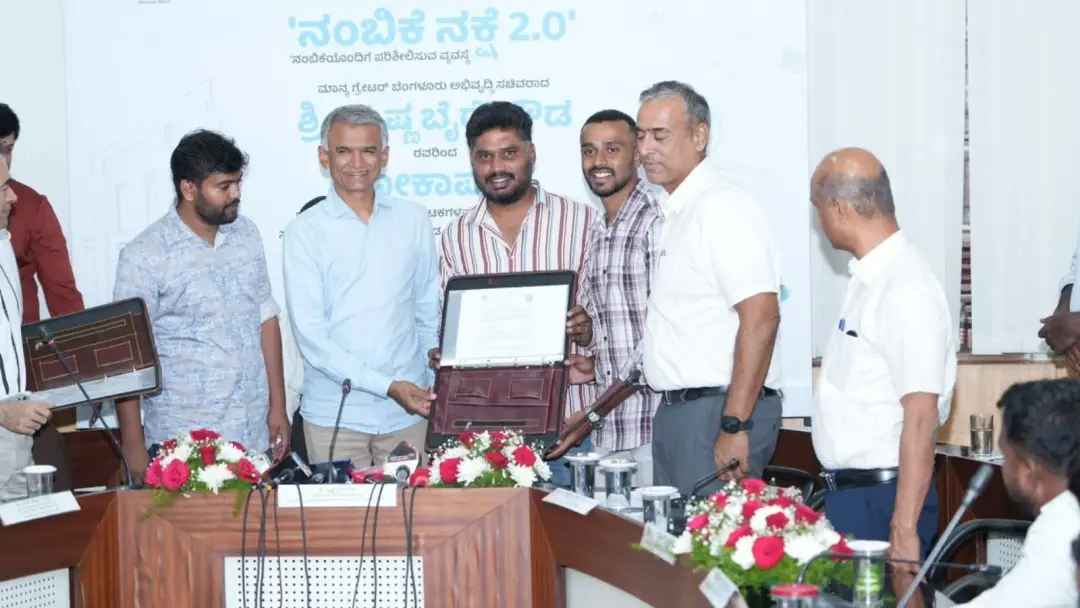
Bengaluru launches 30-minute automated building plan approval system
The Greater Bengaluru Authority on Saturday launched 'Nambike Nakshe 2.0', a fully automated building plan approval system for residential sites up to 50x80 feet (4,000 sq ft), allowing up to four dwelling units. Plans filed online through a qualified architect and conforming to town planning rules will be approved in about 30 minutes, against two to three months earlier. Entering the e-Khata number retrieves ownership details automatically. It will run as a pilot in selected areas first.
Source
Indian Express — Cities · read the original report ↗
Desk check · compared with the source
What the desk checked (5)
- GBA launched 'Nambike Nakshe 2.0' on Saturday, an automated building plan approval system for residential sites up to 50x80 feet (4,000 sq ft) with up to four dwelling units. — Attributed to the Greater Bengaluru Authority in the source; figures appear in source text.
- Conforming plans submitted online through a qualified architect will be approved automatically in about 30 minutes. — Stated in source as a feature of the system; timeline is the authority's claim, not independently tested.
- The earlier approval process could take two to three months. — Figure appears in source without a specific data source or official citation.
- Applicants need only enter the e-Khata number, after which ownership details are retrieved automatically. — Attributed to GBA in the source.
- The system will run on a pilot basis in selected areas before expansion across GBA jurisdiction. — Stated in source; specific pilot areas not named.
Analysts’ view opinion
'Nambike Nakshe 2.0' is an administrative reform, but it is also a showcase of 'governance that delivers' at a moment when the newly structured Greater Bengaluru Authority needs to prove itself. Promising to compress a two-to-three-month process into about 30 minutes speaks directly to Bengaluru's middle-class homebuilders and architects — a specific and politically vocal constituency. Equally, because it is still only a pilot, the same announcement could become an opposition talking point if the promise is not met on the ground.
- Reducing 'human intervention' at the local level effectively trims the discretion of lower-level officials — useful as an anti-corruption message, but it can also generate resistance inside the system.
- Capping eligibility at 4,000 sq ft and four dwelling units means the beneficiaries are mostly small and middle-class owners rather than large builders, which looks like a deliberate political framing.
- The Bengaluru Development Minister launching it personally suggests this is meant as a government performance story rather than a routine departmental notice.
- Linking approvals to e-Khata increases dependence on digitised property records, so complaints from areas with incomplete records could become a political issue.
- The choice of pilot areas raises the question of which constituencies benefit first, a detail the story does not specify.
What to watch — Watch which areas the pilot covers, how many plans actually clear in about 30 minutes, and how quickly it is extended across the GBA's jurisdiction.
The story does not establish how well the system performs in practice, nor does it record any opposition or bureaucratic reaction — at this stage it is an announced promise, not a demonstrated outcome.
Deep dive
Research brief · 8 facts · 4 dates · exam-readyThe brief
Context
Building plan approval in Bengaluru has traditionally been a paperwork-heavy process requiring repeated visits to government offices, often taking two to three months even for small residential plots. On Saturday, the Greater Bengaluru Authority (GBA) launched 'Nambike Nakshe 2.0', a fully automated online system that issues approvals for small residential sites in about 30 minutes if the plan complies with town planning regulations. The system is linked to Karnataka's e-Khata property record database, so ownership details are fetched automatically instead of being uploaded by the applicant. It will run first as a pilot in selected areas before being extended across GBA's jurisdiction.
Key facts
- The Greater Bengaluru Authority launched 'Nambike Nakshe 2.0' on Saturday, a fully automated building plan approval system.
- It covers residential sites measuring up to 50x80 feet (4,000 sq ft) and permits construction of up to four dwelling units.
- Compliant plans submitted online will be automatically processed and approved in around 30 minutes.
- Earlier, the building plan approval process could take two to three months.
- Applications must be filed entirely online through a qualified architect.
- Applicants need not separately upload Khata and several other property documents; entering the e-Khata number auto-retrieves basic ownership information.
- The system will first be implemented on a pilot basis in selected areas of Bengaluru, then reviewed and improved before wider rollout.
- The launch was made by Bengaluru Development Minister Krishna Byre Gowda.
Timeline
- Before the launchBuilding plan approvals in Bengaluru could take two to three months, with paperwork and repeated visits to government offices.
- Saturday (launch day, as reported)Greater Bengaluru Authority launches 'Nambike Nakshe 2.0' for residential sites up to 50x80 feet, with approval in about 30 minutes.
- Initial phaseImplementation on a pilot basis in selected areas of Bengaluru.
- Next stageClose review and incorporation of improvements before expansion to other areas within GBA's jurisdiction.
Who has a stake
- Greater Bengaluru Authority (GBA) — Owns and operates the new system; must run the pilot, review it and expand it across its jurisdiction.
- Homeowners building on small residential plots — Gain approvals in about 30 minutes instead of two to three months, with less documentation.
- Krishna Byre Gowda, Bengaluru Development Minister — Launched the system; has framed it as rethinking the process from the citizen's point of view, not merely digitising it.
- Qualified architects — Plans can be submitted only through them, making them the gatekeepers of compliance with town planning rules.
- Planning/approval officials — Routine human intervention in approvals is deliberately reduced, changing their role in the process.
Why it matters
Delays and discretion in building plan approvals are a major source of harassment and unauthorised construction in fast-growing Indian cities. By automating approvals for small residential plots and linking them to digitised property records, Bengaluru is testing whether rule-compliant citizens can be served without case-by-case official scrutiny. If the pilot works, it offers a replicable template for urban local bodies elsewhere.
UPSC angle
Prelims pointers
- 'Nambike Nakshe 2.0' is the automated building plan approval system launched by the Greater Bengaluru Authority (GBA).
- Eligibility: residential sites up to 50x80 feet (4,000 sq ft), with up to four dwelling units.
- Approval time: about 30 minutes, against two to three months earlier.
- e-Khata is the digitised version of the traditional property account record in Karnataka; its number auto-fetches ownership details.
- Applications must be routed through a qualified architect and comply with town planning regulations.
- Bengaluru Development Minister Krishna Byre Gowda launched the system; it starts as a pilot in selected areas.
Mains framing
Urban building permissions in India have long combined multiple documentary requirements with wide official discretion, producing months-long delays, repeated office visits and incentives for both rent-seeking and unauthorised construction. Bengaluru's 'Nambike Nakshe 2.0' responds by shifting from digitised paperwork to process redesign: for small residential plots up to 4,000 sq ft with a maximum of four dwelling units, a plan filed online by a qualified architect and conforming to town planning regulations is approved automatically in about 30 minutes, while integration with the e-Khata property record removes the need to upload Khata and other ownership documents. The implications are significant for ease of living and for the credibility of municipal governance, but also shift the burden of compliance verification onto architects and onto the accuracy of underlying digitised land and property records, with enforcement moving to the post-approval stage. The stated way forward is cautious: run it as a pilot in selected areas, review it closely, incorporate improvements, and only then expand across the Greater Bengaluru Authority's jurisdiction. Broader lessons include the need for robust digitised records, clear accountability for false declarations, and effective post-construction inspection so that speed does not come at the cost of planning compliance.
Key terms
- Nambike Nakshe 2.0
- GBA's fully automated online building plan approval system for small residential sites, issuing approvals in about 30 minutes.
- Greater Bengaluru Authority (GBA)
- The authority that launched the system and within whose jurisdiction it will be expanded after the pilot.
- e-Khata
- Digitised version of the traditional property account record in Karnataka; entering its number auto-retrieves basic ownership details.
- Building plan approval
- Statutory permission that a proposed building conforms to town planning regulations before construction.
- Dwelling unit
- An independent residential unit; the new system permits up to four such units on an eligible site.
Practice questions
- Automating building plan approvals can improve ease of living but may weaken planning compliance. Critically examine with reference to Bengaluru's 'Nambike Nakshe 2.0'.
- How do digitised land and property records such as Karnataka's e-Khata enable faster municipal service delivery? Discuss the prerequisites for their success.
- Discuss the argument that e-governance must redesign processes rather than merely move paperwork online, using the example of building plan approvals in Bengaluru.
Grounded only in the source report — figures and dates are the source's, not inferred.